

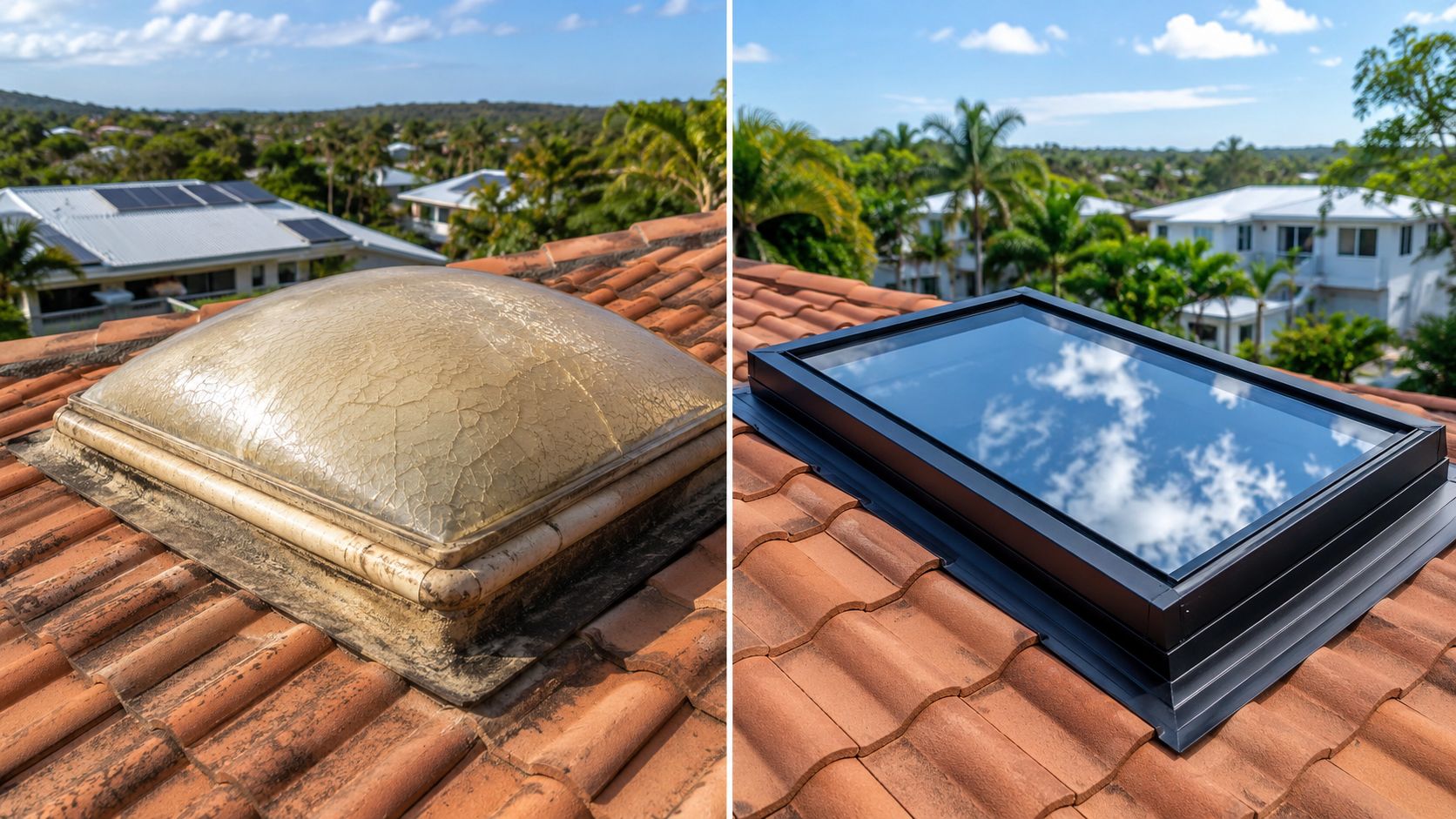
If you're in South East Queensland and you've got an old plastic dome skylight, you probably already know the pattern. It looked fine years ago. Now it's yellowed, brittle, noisy in heavy rain, and it can make the room underneath feel hotter than the rest of the house. From the street it dates the roof. From inside it turns daylight into a dull haze.
That's usually when homeowners start searching glass skylights vs plastic, or looking into an acrylic dome replacement. And in SEQ, that's a practical question, not a cosmetic one. Strong sun, humidity, and storm seasons are hard on older plastics. What worked in a past renovation often doesn't suit the way people want their homes to perform now.
Table of Contents
Why SEQ Homeowners Are Ditching Plastic Skylight Domes
You usually notice the problem on an ordinary hot afternoon. The old dome over the hallway or kitchen is still keeping water out most of the time, but it has gone yellow, the edges look tired, and the room underneath feels hotter than it should. Then summer rain hits and the sound on the roof is hard to ignore.

That is the point where many South East Queensland homeowners stop asking for another plastic dome and start asking for a better type of skylight. The job is no longer just to cover an opening. It is to bring in daylight without cooking the room, survive storm season, and stop making the roofline look dated.
That shift is easy to understand in older SEQ homes. Plastic domes were common because they were light, cheap, and quick to install. Years later, the same features can become the reason they get replaced. Under strong sun, plastic often loses clarity. Under constant exposure, it can craze, discolour, and look older than the rest of the roof. On a house you are trying to improve, that stands out fast.
A skylight sits high and in plain view, so wear is hard to hide. A yellowed dome is a bit like cloudy headlights on a car. It still works in a basic sense, but it makes the whole thing look older and performs worse than it should.
What SEQ climate exposes quickly
South East Queensland is hard on older dome skylights for a few practical reasons.
Intense sun: Long runs of UV and heat tend to show up quickly in plastic through yellowing, brittleness, and surface wear.
Humidity: Warm, sticky conditions make poor-performing roof glazing feel worse indoors, especially in bathrooms, hallways, and closed-up living areas.
Storm season: Heavy rain, wind, and flying debris put pressure on both the skylight material and the way the unit is flashed into the roof.
That is why many replacements are upgrade decisions, not emergency repairs. Homeowners are replacing something that technically still exists, but no longer suits the house or the climate. In practice, an ageing acrylic dome can start acting like a thin sheet over a roof hole. Light still gets through. So does a lot of the heat, noise, and visual clutter.
Practical rule: If the dome already looks bad from the street and makes the room below less comfortable, replacing it is usually money better spent than patching around it.
For homeowners weighing up options suitable for local conditions, it helps to compare energy-efficient skylights for the Queensland climate instead of treating old plastic domes and modern glass units as if they do the same job.
Glass vs Plastic Skylights At a Glance
The quickest way to compare glass skylights vs plastic is to look at how they behave in real homes, not in a catalogue. One is built around long-term clarity and thermal control. The other is often chosen for a lower upfront price and lighter weight.
| Feature | Vivid Double-Glazed Glass | Standard Plastic/Acrylic Dome |
|---|---|---|
| Appearance | Flat, clean, architectural look | Raised dome look, often dated on older roofs |
| Light quality | Clear, crisp daylight | More diffused light, often hazier with age |
| Long-term clarity | Holds its appearance far better over time | More likely to yellow or go cloudy |
| Heat control | Better suited to controlled glazing systems | Tends to let heat transfer more freely |
| UV resistance | Better suited to long-term interior protection | Material can age under strong sun |
| Noise in rain | Denser build helps reduce harsh drumming | Thin dome can sound louder |
| Surface durability | More resistant to scratching in normal cleaning | Softer surface is easier to mark |
| Lifespan outlook | Built for long service life | Shorter service life is common |
| Replacement cycle | Usually a longer-term solution | More likely to need earlier replacement |
| Upfront cost | Higher initial spend | Lower initial spend |
What the materials actually are
A double-glazed glass skylight uses two panes with a sealed insulating gap between them. In practice, that gives the unit more control over heat, noise, and condensation than a simple plastic dome. Some glass units also use coatings designed to improve solar performance.
A plastic skylight, usually acrylic in older homes, is often a formed dome. It's light and simple, which is why so many were installed years ago. But simple isn't always cheap in the long run if the material ages badly on a Queensland roof.
For homeowners weighing an acrylic skylight replacement option, the core question isn't just what costs less today. It's which material still looks and performs properly years after installation.
Where the real gap shows up
The difference becomes obvious in lived experience:
Morning sun: Glass tends to feel more controlled. Plastic often feels more direct and harsh.
Cleaning day: Glass usually comes back looking sharp. Old acrylic often stays dull even after a clean.
Summer storms: Better-built glass units generally feel quieter and more substantial.
That's why the debate usually ends up less about material labels and more about daily comfort.
Clarity and Longevity A View That Lasts
Most plastic dome replacements start with one word. Ugly. Not because homeowners are being fussy, but because ageing acrylic is hard to ignore. It yellows, hazes, and loses that clean daylight effect a skylight is supposed to give.

Glass ages differently. It keeps a clearer, sharper look and suits homes that have moved on from the old bubble-on-the-roof style. If you've renovated a kitchen, updated flooring, or opened up living spaces, an old acrylic dome can stick out like an old yellow light switch on a fresh white wall.
Why plastic loses the battle visually
Acrylic starts out doing one simple job. It lets light in. The problem is what happens after years of sun, heat, and weathering.
You'll often see these signs first:
Yellowing: The light loses its clean quality and the skylight starts to look old even when the roof is sound.
Clouding: Instead of crisp daylight, you get a dull wash.
Edge cracking: Fine fractures can begin around stress points and fasteners.
Surface marking: Plastic is softer, so everyday cleaning and debris can leave it looking tired.
That decline matters because skylights sit in one of the most visible planes of the home. You look up at them. You notice them in changing light. When they age badly, they don't disappear into the architecture. They announce themselves.
Lifespan is where glass pulls away
The long-term difference is clearer when you look at service life. Independent guidance commonly places plastic or acrylic skylights at about 10 to 15 years, while quality glass skylights are described as lasting well beyond 20 years, often for decades according to this skylight life expectancy guide.
That gap changes the whole decision.
A plastic dome can behave like cheap outdoor furniture left in the sun. It does the job for a while, then the weather starts collecting its debt. Glass is closer to a proper window system. It's built to stay stable and presentable for the long haul.
Replace a yellowed dome with clear glass and the room doesn't just get brighter. It usually looks newer, cleaner, and more settled.
For SEQ homeowners, that's often the moment the decision stops being about repair. It becomes about ending a repeat problem.
Beating the Heat Thermal and UV Performance
By 2 pm in a South East Queensland summer, an old plastic dome can turn a hallway or bathroom into the hottest pocket in the house. Homeowners feel it straight away after replacement. The light looks cleaner, but the bigger difference is that the room stops carrying that baked, trapped heat.

Roof glazing works harder than almost any other window in the home. It cops direct overhead sun, long summer days, humidity, and hot roof space temperatures. In SEQ, that combination exposes the weakness of older acrylic domes pretty quickly. They let in daylight, but they often let in too much heat at the same time.
How modern glass controls heat better
The main advantage of a modern glass skylight is the full glazing system. Sealed double glazing slows heat transfer. Low-E coatings help reflect a portion of radiant heat before it builds up inside the room. Together, those features make the skylight behave more like a well-built window and less like a clear lid sitting in the roof.
A simple way to picture it is a esky with the lid on versus one with a thin plastic cover. Both close the opening. Only one does a decent job of resisting heat.
This is important because roof glazing gets the harshest sun exposure on the house. Wall windows can get help from eaves, blinds, nearby fencing, and orientation. A skylight has far less protection, so the glass itself has to do the work.
For a plain-English explanation of coatings, this guide on what low-E glass is explains why the surface treatment makes such a noticeable difference overhead.
What that changes inside the home
Good thermal performance shows up in everyday comfort.
Less midday heat build-up: Rooms under the skylight feel more stable instead of sharp and stuffy.
Lower strain on cooling: Air conditioning is not constantly trying to pull back heat coming through the roof opening.
Better use of the room: Kitchens, stairwells, ensuites, and hallways stay more comfortable through the hottest part of the day.
That last point is usually what sells the upgrade. Homeowners are not chasing a lab result. They want the room to feel normal again.
With old plastic domes, the problem is easy to recognise. The light comes in, the heat comes with it, and the space below never quite settles. Modern double-glazed glass units from Vivid are designed to break that pattern, which is why they suit SEQ replacements so well.
A skylight should brighten the room without making the ceiling feel like a heater.
UV control protects more than comfort
Heat gets noticed first. UV damage usually shows up later, after flooring fades unevenly, a timber vanity dries out, or fabric near the light starts losing colour.
Better glazing helps reduce that exposure compared with older dome-style units. That gives homeowners two wins at once. The room is more comfortable to stand in, and the finishes underneath are not taking the same daily punishment.
If outside comfort is also tied to broader noise issues around the home, it can help to solve noise with soundproof windows so you improve more than one weak point in the building envelope.
Peace of Mind Noise Insulation and Storm Safety
Anyone who's lived through a Queensland storm under an ageing dome knows the sound. Rain doesn't patter. It drums. Hail doesn't just drift overhead. It announces itself on plastic like handfuls of gravel on a wheelie bin lid.
That noise wears on people more than they expect. Bedrooms, hallways, ensuites, and stairwells all feel different when roof glazing turns every storm cell into a percussion solo.
Rain noise changes how the room feels
Denser, better-sealed glazing generally softens outside noise far better than a thin plastic dome. That matters in homes where the skylight sits over a bed, a kitchen island, or the main passage through the house.
If outside noise is already a broader issue in your home, not just from the roof, it can also help to look at ways to solve noise with soundproof windows so you're treating the whole envelope, not one opening in isolation.
A good comparison is a solid front door versus a hollow one. Both close the opening. Only one feels settled when weather turns rough.
Storm safety is also a replacement trigger
A new skylight isn't judged only on sunny days. It's judged when wind lifts, rain hits sideways, and the roof is under pressure. That's where old domes can become a confidence problem. Even before they fail, they often look like they might.
Homeowners usually worry about three things:
Brittleness with age: Plastic that has spent years in strong sun doesn't inspire confidence in storm season.
Leaks around the unit: Even small movement or ageing can show up at the flashing and seals.
Debris impact: Branches, grit, and hail are a different proposition on an old dome than on a modern glazed unit.
For anyone replacing a tired dome, the goal isn't just a neater look. It's a skylight system that feels properly integrated with the roof. Details like flashing design and water management matter just as much as the glazing itself, which is why homeowners often start by looking at leak-proof skylights rather than shopping by shape alone.
The strongest sign a skylight is past its prime isn't always an active leak. Often it's that every storm makes you wonder if this will be the one.
That uncertainty is reason enough for many SEQ homeowners to move on from old plastic.
Making the Switch Your Upgrade Path to a Vivid Skylight
Replacing an old dome is usually simpler when you treat it as a measured upgrade, not a guess-and-hope job. Start with the opening, the room, and what you want the skylight to do apart from letting in light.

A lot of homeowners assume replacement means custom work from scratch. Sometimes it does. Often it doesn't. Standard sizing can make an acrylic dome replacement far more straightforward than expected, especially when the shaft and roof opening are already there.
Check the opening before anything else
Before choosing a unit, get clear on the existing setup.
Measure the roof opening carefully: Don't rely on the visible dome size alone.
Check roof type and pitch: Tiled and metal roofs need the right flashing approach.
Look at the shaft condition inside: If the old skylight has leaked before, plaster and trims may also need attention.
Many homeowners save time by working from the existing opening rather than redesigning the whole ceiling.
Choose fixed or operable based on the room
Not every room needs an opening skylight. Some do.
A fixed skylight suits spaces where the goal is clean daylight with minimal fuss. Hallways, living rooms, stairwells, and kitchens often fall into this category.
An operable skylight makes more sense where humidity and trapped warm air are part of the problem. Bathrooms, laundries, upper-storey landings, and rooms with high ceilings benefit from ventilation. To address these needs, Vivid Skylights offers practical choices, including double-glazed fixed units and operable skylights in electric and solar-powered versions. Options such as rain-sensing openers and fly screens can also make sense in SEQ conditions. The range can be delivered nationwide in Australia.
When a traditional skylight won't work
Some homes have awkward rooflines, lower floors, or spaces where a conventional roof opening isn't practical. That doesn't mean the room has to stay dark.
In those cases, the AuraGlow LED skylight range is a useful alternative. It's designed for locations where a traditional skylight can't be installed, while still giving the visual effect of a skylight. The light changes colour through the day to mimic the shifting tone of the sky, which makes it a design solution as much as a lighting one.
That can work well in:
Ground-floor internal rooms
Apartments or constrained roof spaces
Areas with complex structural limitations
The right path depends on the room, the roof, and whether you want daylight only or daylight plus airflow. Once those three are clear, the replacement decision usually becomes much easier.
The True Cost Why Glass is the Smarter Investment
A lot of South East Queensland homeowners start in the same place. They look up at an old yellow dome, ask for a replacement price, and wonder why the glass option costs more. Fair question. On the quote, plastic often looks easier to swallow.
Over the life of the roof, that first number can be misleading.
In SEQ, skylights work hard. They sit under harsh sun, cop humidity for months, and have to handle storm season without becoming brittle, noisy, or tired-looking. That matters because replacement cost is never just the price of the unit. It includes getting back on the roof, removing the old skylight, refitting and sealing the opening, and sometimes repairing paint or plaster inside if the old dome has already caused trouble.
That is why cheap twice is rarely cheap.
If a plastic dome ages poorly and needs replacing again, the second job usually costs more than homeowners expect. You are paying for labour all over again, plus the disruption of another install. It is similar to patching a worn-out roof sheet instead of replacing it properly. The first spend feels smaller, but it keeps coming back.
A well-made glass unit costs more upfront, but it usually makes better long-term sense for homeowners who plan to stay in the house, renovate properly, or stop dealing with dated acrylic domes every decade or so. The gain is not only durability. It is also a cleaner finish, steadier performance in summer, and a skylight that still looks right years later instead of turning cloudy and tired.
There is a comfort factor too. During heavy rain, most homeowners notice the difference straight away. In hot weather, they notice it again. And when they are improving a kitchen, hallway, or bathroom, they usually do not want the new room centred around a skylight that still looks like it belongs in 1998.
If you are comparing options, look at double-glazed glass skylights for replacement projects and weigh the full ownership cost, not just the install figure.
Plastic can be cheaper to buy. Glass is often the better investment.