

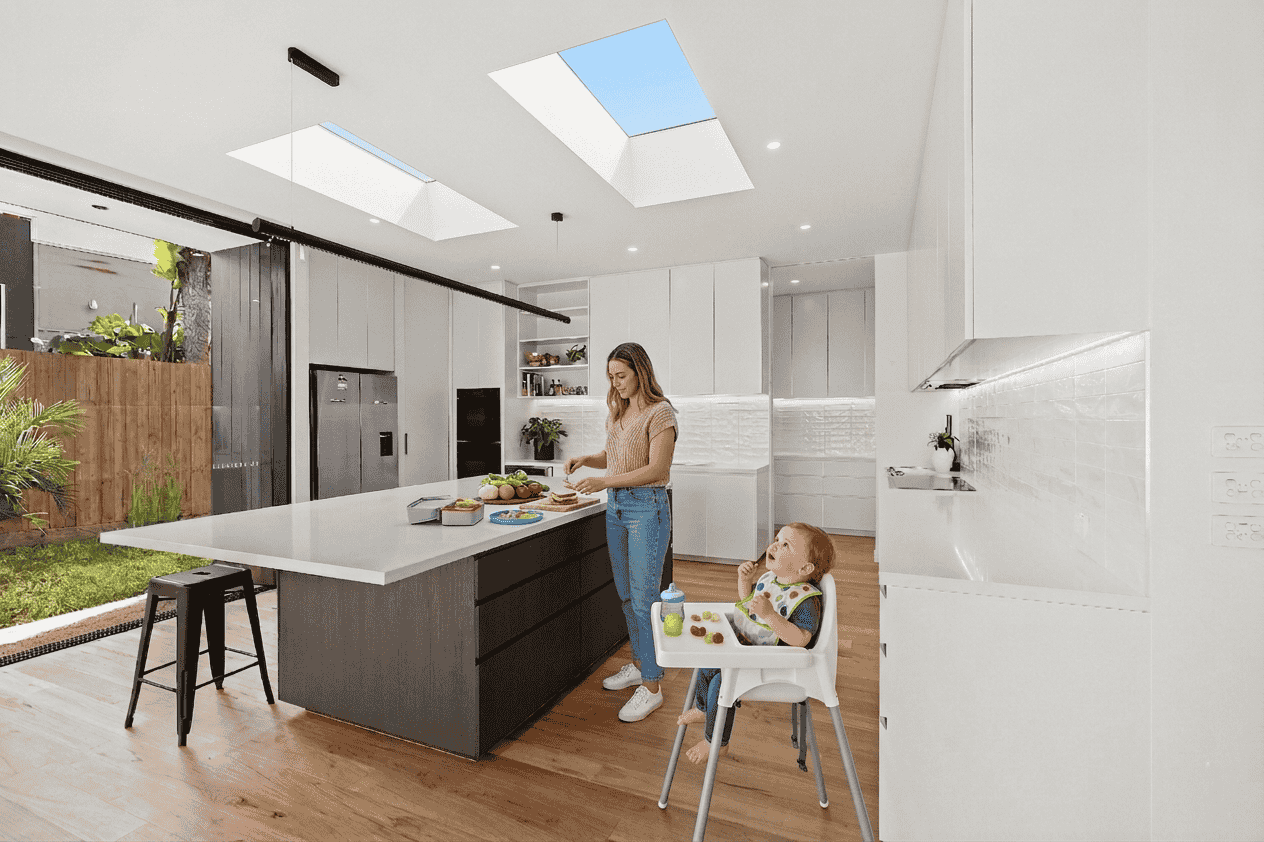
Your kitchen probably works fine. The cabinets do their job, the benchtop has enough room, and the appliances are where they need to be. But if the room feels flat at midday, gloomy on winter mornings, or dependent on downlights even when the sun is out, the problem usually isn’t the layout. It’s the light.
That’s why a skylight for kitchen renovations can change the whole room more than another splashback, tapware upgrade, or pendant ever will. Good overhead daylight makes colours read properly, gives the room more life, and shifts the kitchen from “service area” to the part of the house people want to stand in.
In Australian homes, that decision needs more thought than cutting a hole in the roof alone. A kitchen skylight has to bring in daylight without turning the room into a hot box in summer or a cold patch at night. That means choosing the right type, the right size, and the right glazing from the start.
Table of Contents
Transform Your Kitchen from Drab to Dynamic
A lot of kitchens suffer from the same problem. They’re technically bright enough at night, but during the day they feel dull, especially if the room sits in the middle of the house, faces the wrong way, or relies on a small window over the sink. You end up switching on lights at breakfast, and by afternoon the room still feels a bit shut in.
A skylight changes that because the light comes from where the room needs it. Overhead daylight lands across benchtops, islands, splashbacks, and floors in a way side windows can’t match. It doesn’t just brighten the space. It changes the mood of it.
I’ve seen homeowners focus first on pendants, paint colours, and joinery details, then realise the room still feels heavy because the ceiling is doing nothing. Add a properly planned skylight and the kitchen suddenly feels taller, cleaner, and more open. It’s the difference between lighting a room with a torch from the side and taking the lid off the top.
A kitchen skylight should feel like part of the architecture, not an afterthought punched into the roof.
The other reality is that not every kitchen needs the same solution. Some homes need a fixed skylight because the goal is simple, clean daylight with no moving parts. Others need an operable skylight because the room traps cooking heat and steam. In some homes, a traditional roof opening isn’t practical at all because of structure, services, or access. That’s where a ceiling-mounted daylight alternative makes more sense.
The right answer depends on how your kitchen behaves in real life. Does it run hot when you cook? Does glare hit the island at the wrong time of day? Is the ceiling location clear enough for a proper shaft? Those questions matter more than showroom inspiration photos.
The True Value of Natural Light in Your Kitchen
A lot of people justify a skylight by talking about energy savings. That’s not wrong, but it’s incomplete. In most Australian kitchens, the bigger win is the quality of the daylight and how the room feels to live in.

Daylight changes how the room feels
Natural light gives you proper colour, depth, and contrast. Stone looks like stone instead of a flat grey slab. Timber has warmth instead of a muddy tone. Food looks better on the bench, and the whole room reads as more inviting.
That matters even more in kitchens with darker finishes. If you’re working with charcoal joinery, walnut veneer, or a moody splashback, daylight becomes the balancing element that stops the room from feeling closed in. Designers also look at surface reflectance when planning light, and these LRV insights for designers are useful if you’re trying to understand why some dark kitchens feel rich and layered while others just feel dim.
A skylight can also make the room feel larger because the ceiling stops being a blank cap over the space. Your eye is pulled upward, which gives the kitchen more visual breathing room.
The real return isn’t just power savings
Here’s the contrarian truth. A skylight for kitchen upgrades isn’t always the smartest move if you’re viewing it only as an energy-saving product. In homes that already use efficient LED lighting, the stronger argument is usually daylight quality and reduced daytime lighting use, not dramatic electricity savings, as noted in this discussion of why homeowners love skylights in the kitchen.
That’s the right way to think about it. Ask yourself what you want fixed.
If the room feels lifeless, your target is better amenity.
If the kitchen gets stuffy while cooking, your target is heat and airflow.
If the room is dark for most of the day, your target is useful natural light where you prep and gather.
For a broader look at what daylight does across the home, this guide on the benefits of natural light in the home is worth a read.
A good skylight doesn’t just save you from switching on lights. It makes the kitchen feel worth being in.
Choosing Your Perfect Skylight Type
Pick the skylight type the same way you’d pick an appliance. Match it to how your kitchen behaves. A bright kitchen that already breathes well needs a different solution from one that turns into a hot box after lunch.

Fixed skylights for pure overhead light
A fixed skylight does one job well. It brings in strong overhead daylight without adding moving parts, extra controls, or more maintenance.
Choose fixed if your kitchen already gets decent airflow from windows, stacker doors, or a nearby laundry or dining opening. In that setup, spending more on better glazing makes more sense than paying for an opening unit you may barely use. You’ll get a cleaner look, a simpler install, and fewer things to go wrong.
This option suits homeowners who want the kitchen to feel brighter and more open, but don’t need help clearing steam or cooking smells.
Operable skylights for light plus airflow
An operable skylight is the better choice in kitchens that hold heat, moisture, and odours. Hot air rises. Give it a place to escape and the whole room feels less heavy, especially after cooking.
This matters in Australia. The wrong skylight can flood a kitchen with harsh sun and add summer discomfort at the exact time you want the room to feel usable. If your kitchen faces hard afternoon sun, runs warm for half the year, or sits in an open-plan area that struggles to cool down, prioritise an operable model with glazing designed to control heat and glare. Brightness on its own is not the win. Comfort is.
Electric and solar-powered units are usually the smart pick. A skylight that’s hard to reach often stays shut, which defeats the point. If you want a practical breakdown of the main options, this guide to different types of skylights for Australian homes is a good place to compare them.
AuraGlow LED skylights when a roof opening won’t work
Some kitchens won’t take a traditional skylight. The roof space may be crowded with services, the structure may fight you, or the shaft may chew up too much ceiling space.
In those cases, an AuraGlow LED skylight makes more sense. It sits at ceiling level and creates the visual effect of a skylight, with light that shifts through the day to echo the changing sky. It won’t ventilate the room, and it isn’t a substitute for real roof glazing if your main goal is actual daylight from above. But for apartments, internal kitchens, and awkward retrofits, it solves a real problem neatly.
Vivid Skylights Options at a Glance
| Skylight Type | Best For | Key Feature | Ventilation? |
|---|---|---|---|
| Fixed Double Glazed Skylights | Dark kitchens that need strong natural light | Clean overhead daylight with no moving parts | No |
| Operable Ventilating Skylights | Kitchens that build up heat, steam, or odours | Daylight plus opening function, available in electric and solar-powered formats | Yes |
| AuraGlow LED Skylight | Kitchens where a traditional skylight can’t be installed | Ceiling-mounted daylight effect with changing sky-like colour | No |
If you want one practical brand example, Vivid Skylights supplies double glazed fixed and operable skylights, including electric and solar powered opening models, and can deliver nationwide across Australia. They also offer the AuraGlow LED range for spaces where a traditional skylight can't be installed.
Strategic Placement and Sizing for Maximum Impact
A skylight for kitchen design can be perfectly made and still underperform if it's the wrong size or in the wrong spot. Placement decides whether you get useful light or annoying glare. Size decides whether the room feels balanced or overexposed.
Start with this visual guide, then look at the room as it gets used.

Start with the floor area, not guesswork
In Australia, a practical rule is to size the skylight area at about 5% to 15% of the kitchen floor area, with around 10% often working well. That means a 10 m² kitchen can be well served by roughly 1 m² of skylight area, according to this guide to skylights in kitchens.
That range matters because bigger isn't automatically better. Too small and the skylight looks timid and doesn't do much. Too large and the room can pick up glare and extra heat gain, especially on exposed roof planes.
A useful example from the same guidance is that a compact 60 cm × 90 cm unit can cover up to 50% of daily lighting needs in that kind of kitchen space, which shows how effective a modest, well-placed skylight can be when the sizing is sensible.
Place light where the kitchen actually works
Centre placement gives broad ambient light. That works well in compact kitchens or galley layouts where you want the whole room lifted evenly.
Over an island or main prep zone, the skylight behaves more like premium task lighting. It highlights the part of the kitchen where people chop, serve, gather, and stand around talking. Long, narrow skylights often suit benches better than square units because the light spreads along the workspace instead of dropping into one bright patch.
This walkthrough can help you visualise roof and ceiling relationships before you commit:
Roof orientation matters too. East-facing roof areas can produce sharper morning glare right when the kitchen is busiest for breakfast. West-facing sections can make late-afternoon cooking uncomfortable. The right answer isn't always “put it on the sunniest side”. It's “put it where the daylight helps without punishing the room”.
Practical rule: chase balanced daylight, not maximum sunlight.
If you're narrowing down product sizes before speaking to an installer, the skylight dimensions guide is the place to start.
Understanding Glazing and Thermal Performance
The biggest mistake homeowners make is assuming every skylight is basically the same piece of glass in a frame. It isn't. In Australian conditions, glazing specification decides whether your skylight feels refined or becomes the weak spot in the roof.
Why glazing quality matters more than most people realise
A roof opening sits in a harsher position than a wall window. It takes direct sun, weather exposure, and temperature swings from above. If the unit isn't built properly, that opening can undo a lot of the comfort your insulation and wall glazing are trying to preserve.
That's why I push homeowners toward insulated double glazing and proper flashing details, especially in kitchens where heat, steam, and temperature changes are part of daily use. As noted in this technical discussion of rooflight thermal design, a skylight can become a major source of energy loss if it isn't specified correctly, and high-performance units should use insulated double glazing and airtight flashing to control condensation and heat transfer.
The plain-English version is simple. Your roof opening shouldn't act like a thermal shortcut between your kitchen and the weather outside.
What stops condensation and night-time heat loss
Condensation usually shows up when warm, moist indoor air meets a cold surface. Kitchens create moisture every day, so poor skylight specification gets exposed quickly. Better units reduce that risk by using insulated glazing and installation details that limit unwanted air leakage.
The flashing matters just as much as the glass. If the flashing and fit-up aren't airtight and weather-tight, the unit can leak heat, invite moisture problems, and create draughts around the opening. That's why the cheap version of a skylight often ends up being the expensive one once repairs and rework start.
For homeowners comparing product standards, double glazed skylights are the benchmark worth focusing on.
If you wouldn't accept thin, poorly sealed glazing in a major window wall, don't accept it in the roof.
Installation A DIY or Professional Job
The success or failure of many kitchen skylight projects often hinges on critical factors. The issue isn't just cutting the hole. It's whether the skylight fits the roof structure properly and whether the flashing is installed without compromise.

When DIY makes sense
If you're experienced on roofs, comfortable with framing, and you understand waterproofing, a DIY installation can be realistic on the right job. But you need to be honest about your skill level.
Use this checklist:
Roof access and safety: You need safe access, confidence at height, and proper fall protection.
Carpentry ability: You must be able to cut and frame the opening cleanly without making a structural mess.
Flashing knowledge: This is the make-or-break part. Poor sealing is how leaks start.
Electrical competence: Operable units add complexity if wiring or controls are involved.
Building awareness: You need to know what your roof can and can't be altered to do.
When a professional installer is the smarter call
Most homeowners are better off using a pro, especially for flat-ceiling homes, tiled roofs, tricky pitches, or any kitchen where the opening needs to be framed neatly and finished well inside. A good installer protects the roof, gets the flashing right, and leaves you with a skylight that looks like it belonged there from day one.
There's also a structural reality you can't ignore. Skylight dimensions are often dictated by rafter spacing and the roof bay, so installers usually have to work backwards from the structure. This sizing guidance on roof opening dimensions notes that poor fit-up is a primary cause of leaks and that the first step is to confirm the roof bay dimension, then choose a module and flashing system that fits without compromise.
That last point matters. Don't choose the skylight first because it “looks about right” in a brochure. Check the roof bay first.
If you're weighing up whether your job is suitable for self-install, this guide to a do-it-yourself skylight is a sensible starting point.
Your Vivid Skylights Decision Checklist
If you want to make a good decision quickly, run through these questions in order.
Ask the questions that actually matter
Do you need ventilation, or just daylight? If the kitchen gets hot or steamy, look at an operable unit. If airflow is already fine, fixed is often cleaner and simpler.
Is the room dark because of layout, or because finishes absorb light? Sometimes the problem is both. Dark joinery and a central floorplan make overhead daylight work harder and matter more.
What does the roof give you to work with? Roof pitch, rafter spacing, and ceiling structure will narrow your options fast.
Where does glare show up during the day? Breakfast glare and late-afternoon heat can ruin an otherwise good idea.
Can a standard skylight be installed? If not, a ceiling-mounted alternative may solve the problem without forcing a bad roof alteration.
Are you choosing for comfort, appearance, or both? Be honest. That answer should drive the specification.
The right kitchen skylight isn't the biggest unit or the flashiest one. It's the one that suits the room, the roof, and the way you live in the house.
If you're comparing options for your own renovation, Vivid Skylights is a practical place to start. You can review fixed, electric opening, solar powered, and AuraGlow LED skylight options, then match the product to your kitchen layout, roof constraints, and comfort goals.