

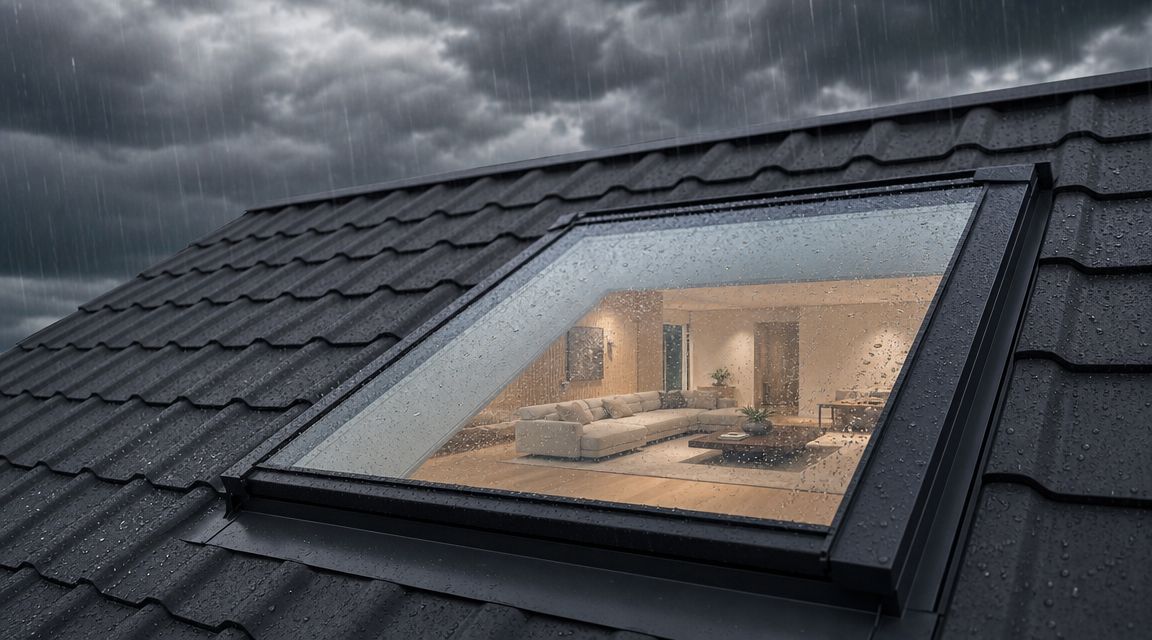
The first real test of a skylight in Queensland isn't the sunny day when it fills a room with light. It's the afternoon storm that rolls over Brisbane, dumps hard rain on a hot roof, and drives water sideways under every weak detail. That's when a homeowner finds out whether the skylight was designed as part of the roof, or just dropped into it.
A lot of people still treat skylights as a leak risk by default. That comes from bad installs, shallow flashing, rushed sealing, and retrofits that never properly accounted for storm water movement. In Australian conditions, especially during the QLD storm season, a skylight only stays dry when the whole assembly works together. The glazing matters. The frame matters. The flashing matters even more. Installation matters most of all.
For homeowners comparing options, the good news is simple. Leak-proof skylights are achievable. Not by hoping a bead of sealant will hold, but by using a purpose-built system with the right geometry, the right seals, and the right roof integration for local weather. If you're planning a new skylight or replacing one that's already caused trouble, it helps to start with the storm itself and work backwards.
Table of Contents
Bracing for the Brisbane Storm Season
Brisbane homeowners know the pattern. The air turns heavy, the sky darkens fast, and then the rain hits hard enough to make every roof detail matter. If there's a weak point around a skylight, storm season usually finds it before anything else does.

That's why the old idea that skylights “just leak eventually” doesn't hold up anymore. What fails is usually the roof connection around the unit. The Australian conditions discussed in this Queensland skylight guide are exactly why storm-ready specification matters. Heat, UV, sudden downpours, and wind-driven rain put every seal, overlap, and flashing return under stress.
The climate itself makes the point. The Australian Bureau of Meteorology notes that Australia's climate is highly variable and that intense short-duration rainfall can create rapid runoff and ponding risk, especially on roofs with low pitch, making effective waterproofing at roof penetrations essential in storm-prone regions, as referenced in this discussion of skylight flashing and Australian rainfall conditions.
A skylight shouldn't be judged on a clear day. It should be judged by what happens when water is moving fast across the roof and looking for a way in.
That's the practical shift homeowners need to make. Don't ask whether a skylight is marketed as watertight. Ask how it handles runoff, wind pressure, roof movement, and debris during storm season. A good skylight can be a secure part of the roof. A poor one becomes a collection point for trouble.
What storm season exposes
Heavy rain doesn't just fall straight down. It bounces, backs up, and gets pushed sideways by wind. On a roof, that means water can test:
Flashing laps where installers cut corners
Seal transitions where different materials expand and contract
Low-pitch areas where runoff slows down
Debris points where leaves hold water against the frame
When a skylight has been engineered properly and installed to suit the roof type, those pressures are manageable. When it hasn't, the first major storm usually starts the conversation nobody wants to have.
Why Skylights Fail Understanding Common Leak Points
Most skylight leaks don't begin in the glass. They begin at the edges, under the roofing, or around poorly detailed junctions where water was never properly directed away in the first place.
Homeowners often describe “the skylight leaking” when the actual problem sits one layer out from the unit. The failure can come from flashing that was improvised on site, a seal that has aged under UV, debris that traps water, or an installation that relied too heavily on sealant instead of overlap and drainage. If you want leak-proof skylights, you need to understand how water gets in.
Flashing failure is usually the starting point
Flashing is the roof's traffic control system. Its job is to collect water moving down the roof, divert it around the skylight opening, and send it back onto the roof covering without letting it enter the assembly.
When that metalwork is too shallow, badly lapped, or mismatched to the roof profile, water can track under tiles, under sheets, or into fastener lines. That's why leak investigations often end up looking beyond the skylight frame itself. If you're already dealing with active ingress elsewhere, this practical guide to stopping roof water damage helps explain why prompt action matters before moisture spreads into insulation, ceilings, or framing.
Seals don't replace proper detailing
Gaskets and seal systems matter, but they are not magic. A seal works best when it's part of an engineered assembly that sheds water naturally. It works poorly when it's expected to hold back pooling water or compensate for bad geometry.
Common examples include:
Overreliance on sealant: A bead of sealant can crack, shrink, or separate as the roof moves.
Poor frame junctions: If the unit sits awkwardly against the roof covering, water pressure builds at the wrong points.
Mixed-material movement: Metal roofing, tile, flashing, and the skylight frame all move differently through heat and weather cycles.
Practical rule: If an installer talks more about sealant than flashing path, ask more questions.
Debris and drainage turn minor issues into leaks
Leaves, dirt, and roof grit don't sound dramatic, but they change how water behaves. Debris can slow runoff, trap moisture around the uphill side of the skylight, and create local ponding where the design expected free drainage. Once that happens, even a small weakness gets tested for longer and under more pressure.
This is one reason leak prevention isn't just about the day of installation. It also depends on what surrounds the skylight over time.
Installation errors can make a good product fail
A quality unit can still leak if it's installed out of square, integrated with the wrong flashing kit, or forced into a roof type it wasn't designed for. That's why skylight repairs and leak prevention in Brisbane usually focus on the roof interface rather than assuming the glazing unit itself is defective.
The hard truth is simple. A skylight leak is often a systems problem wearing a product label. Once you see it that way, the solution becomes much clearer.
The Anatomy of a Modern Leak-Proof Skylight
A modern skylight that performs well in Australian weather isn't just a pane of glass in a frame. It's a layered roof component. That's an important shift, because it changes how you judge quality. You're no longer buying only daylight. You're buying water management, thermal control, material durability, and a roof connection designed to stay stable over time.

Leading manufacturers now treat skylights as multi-layer building systems, with a 10-year installation warranty, 20 years on glass, three layers of water protection, and pre-attached seals in their weathertight assemblies, as described in VELUX weathertight product information. That warranty structure matters because it reflects a different standard of engineering. Leak-proof is no longer just a marketing phrase. It's something manufacturers are willing to back when the system is installed correctly.
The frame and glazing do more than hold daylight
The best designs reduce the number of places where water can stop, collect, or work sideways under pressure. Frameless top glazing helps because it removes exposed edges where debris and standing water often gather. On Australian roofs, that's a practical advantage, not a cosmetic one.
Double glazing also earns its place for reasons beyond energy performance. It helps control the internal temperature difference that can create condensation. Homeowners often mistake condensation for a leak, especially in bathrooms, kitchens, and high-humidity rooms. Better glazing reduces that confusion and helps the skylight behave more like a stable part of the building envelope.
Material choice affects long-term weather behaviour
A skylight frame has to cope with sun, rain, roof movement, and coastal exposure without losing alignment or corroding at critical points. Powder-coated aluminium is commonly specified because it handles those conditions better than lightweight assemblies that distort or degrade too quickly.
Here's what a strong modern assembly should do in practice:
Shed water cleanly: The upper surface shouldn't encourage pooling.
Hold shape under movement: The frame needs to stay stable as roofing materials expand and contract.
Support the seal system: Gaskets and contact points need a firm, consistent interface.
Limit internal moisture issues: Better glazing and insulation reduce condensation events.
Leak-proof skylights work because each layer has one job, and none of those jobs is left to chance.
One practical example in the Australian market is Vivid Skylights, which supplies double-glazed fixed and operable skylights, including electric and solar powered opening models, with frameless top glazing, powder-coated aluminium frames, and nationwide delivery across Australia. Those features matter because they address the actual failure points that cause leaks, rather than dressing up a basic roof opening with nicer glass.
Why operable units need careful engineering
Opening skylights add moving parts, so homeowners should be realistic about what matters. The question isn't whether an operable skylight can be weather-tight. It's whether the seals, closing pressure, and rain-management details are strong enough for regular use.
Electric and solar powered units can perform well when the opening mechanism closes consistently and the surrounding assembly is built as part of the whole roof system. Poorly designed operable units tend to fail at the transitions. Well-designed ones account for that from the start.
The Critical Role of Flashing and Installation
The fastest way to make a good skylight leak is to install it with bad flashing.
That's not a small detail. It's the detail. Flashing is what turns a roof opening into a weather-managed assembly. Without it, the skylight is just interrupting the path of water and hoping nothing goes wrong.
The geometry matters. The National Roofing Contractors Association recommends that skylight curbs allow for a minimum of 4 inches (10cm) of vertical flashing on all sides, a benchmark cited in IKO's skylight guidance. That recommendation is useful because it translates “leak-proof” into something physical. Water needs height, overlap, and direction. If the curb and flashing don't provide that, sealant ends up doing work it was never meant to do.
Water needs a path
A proper flashing kit works like a set of channels. Water coming down the roof meets the uphill flashing, gets redirected around the skylight opening, and returns to the roof surface below. When installers improvise those channels, the result is often too flat, too tight, or too dependent on site judgement.
For tiled and low-pitch roofs especially, purpose-built components matter. A back tray flashing is a good example of the kind of detail that helps manage water on the uphill side of the skylight, where runoff pressure is highest and where many leak paths begin.
A few installation principles don't change:
Match the flashing to the roof type. Tile, metal, and low-pitch roofs move water differently.
Respect the roof pitch. Some assemblies cope well with steeper drainage and perform poorly when used too flat.
Build in drainage, not just closure. The goal is to let water escape safely, not trap it behind a neat-looking finish.
Why site-built fixes often fail
A lot of leaking skylights look fine from inside until the next storm exposes them. The common pattern is a decent skylight unit paired with makeshift flashing folded on site to “fit” the opening. That usually creates awkward laps, inconsistent compression, and weak transitions into the roof covering.
This installation video gives a useful visual reference for how roof integration details affect the result:
Use the manufacturer's system where possible. Improvised flashing can work in the short term, but storm season tends to expose every shortcut.
Homeowners don't need to memorise flashing terminology. They just need to ask the right question. Is the installer using an engineered kit designed for that skylight and that roof, or fabricating the weatherproofing on the day? That answer tells you a lot.
Your Buyer's Checklist for a Storm-Ready Skylight
Most buyers start with size, shape, and how much light they want. For a Queensland roof, that's not enough. The right buying decision comes from checking whether the skylight is ready for hard rain, heat, movement, and the practical realities of long-term roof maintenance.
A simple rule helps. If a feature doesn't help with water control, durability, or maintenance, it shouldn't sit at the top of your shortlist.
Questions worth asking before you buy
Ask the supplier or installer these questions in plain language:
What comes with the unit? You want to know whether a dedicated flashing kit is included, or whether flashing is being left to site fabrication.
Is there leak coverage tied to installation? A warranty on glass alone doesn't tell you much about weather-tight roof integration.
Is the skylight fixed or operable, and how does it close? Opening units need reliable seals and well-resolved closing points.
Does the frame suit Australian exposure? Material stability and corrosion resistance matter more in coastal and high-UV settings.
How will it work on my roof type? Tile, metal, and lower-pitch roofs need different detailing.
Leak-Proof Skylight Feature Checklist
| Feature | Why It Matters for Leak Prevention | Vivid Skylights Solution |
|---|---|---|
| Dedicated flashing kit | Reduces guesswork and improves roof integration | Includes a skylight flashing kit for tiled roofs |
| Double glazing | Helps manage condensation that can be mistaken for leakage | Double-glazed units are available across fixed and operable models |
| Frameless top glazing | Reduces places where water and debris can sit | Frameless top surface is designed to minimise pooling |
| Operable options with weather-aware control | Helps avoid leaving an opening exposed during rain | Electric and solar powered opening models are available, with rain-sensing options |
| Durable frame material | Supports long-term seal stability in heat and weather | Black powder-coated aluminium frames |
| Leak-free warranty | Signals confidence in roof-level performance when installed correctly | Offered with leak-free warranty coverage |
Don't buy a skylight as a piece of glass. Buy it as a roof system with daylight attached.
Some homes also need a different answer entirely. If a traditional roof skylight can't be installed because of structure, access, or room position, an LED daylight-style alternative may be the more practical choice. That matters in renovations where homeowners want the effect of overhead light without opening the roof in a difficult location.
Long-Term Care for a Lifetime of Light
A well-installed skylight shouldn't become a constant maintenance job. But “leak-proof” doesn't mean “ignore it forever.” Roofs change over time, debris builds up, and severe weather can stress details that looked perfect on installation day.
That's why the better mindset is system care, not product care. A leak-proof skylight should be considered system-proof, because the surrounding flashings and seals are often where aging or storm-related issues show up, and warranty performance depends on correct installation plus basic roof maintenance, as discussed in Fine Homebuilding's guidance on leak-free skylights.
What homeowners should check
You don't need to climb onto the roof after every shower. But after heavy weather, it's sensible to look for warning signs from the ground and from inside the home.
A practical checklist includes:
Clear visible debris: Leaves and twigs around the uphill side of the skylight can slow drainage.
Watch the ceiling line: Staining, bubbling paint, or damp plaster near the opening usually means water is travelling from somewhere nearby.
Check nearby gutters and valleys: Overflow in adjacent roof drainage can push water toward the skylight.
Test operable units occasionally: Make sure they close cleanly and nothing is obstructing the seal.
For broader roof upkeep, this guide to roof leak prevention is useful because it frames skylights as one part of the larger roof drainage system, not an isolated fitting.
What not to do
Homeowners often make things worse by applying random sealants at the first sign of moisture. That can trap water, hide the actual failure point, and complicate later repairs. If the problem is flashing geometry, blocked drainage, or movement in surrounding roof materials, surface sealant rarely fixes it for long.
The first thing to inspect isn't always the skylight. It's the path water took before it got there.
Routine awareness goes a long way. A skylight can perform for years without drama when the roof around it is allowed to drain properly and gets checked after major weather.
The Vivid Skylights Advantage A Complete Solution
The lesson with leak-proof skylights is straightforward. The unit matters, but the system matters more. Good glazing, stable frame materials, dedicated flashing, and correct installation have to work together. If one part is weak, Queensland storm season eventually tests it.
For homeowners who want natural overhead light without taking on unnecessary roof risk, that means choosing a complete package rather than mixing parts and hoping they behave like a system. It also means being honest about the room, the roof type, and whether a fixed unit, an operable unit, or a non-traditional daylight solution makes the most sense.
That's where the broader Vivid Skylights range is relevant. The company supplies double-glazed fixed skylights and operable skylights, including electric and solar powered opening options, and can deliver nationwide across Australia. For areas where a conventional skylight can't be installed, the AuraGlow LED skylight range offers a different approach, creating a skylight-style light effect that shifts colour through the day to mimic the feel of the changing sky.
For buyers, that combination is useful because it widens the design options without turning every project into a roof compromise. Some homes need a traditional skylight with the right flashing and roof integration. Others need the visual effect of one in a location where structure, services, or layout make a roof penetration impractical.
The important part is keeping the standard high. Don't settle for generic “watertight” language. Ask how the system handles storm runoff, roof movement, and long-term exposure in Australian conditions. That's how you end up with daylight overhead and no anxiety when the next Brisbane storm rolls through.
If you're weighing up fixed, electric, solar powered, or alternative skylight options for your home, Vivid Skylights is a practical place to start. You can review the product range, explore design inspiration, and use the online pricing estimator to compare solutions that suit different roof types, rooms, and installation constraints across Australia.