

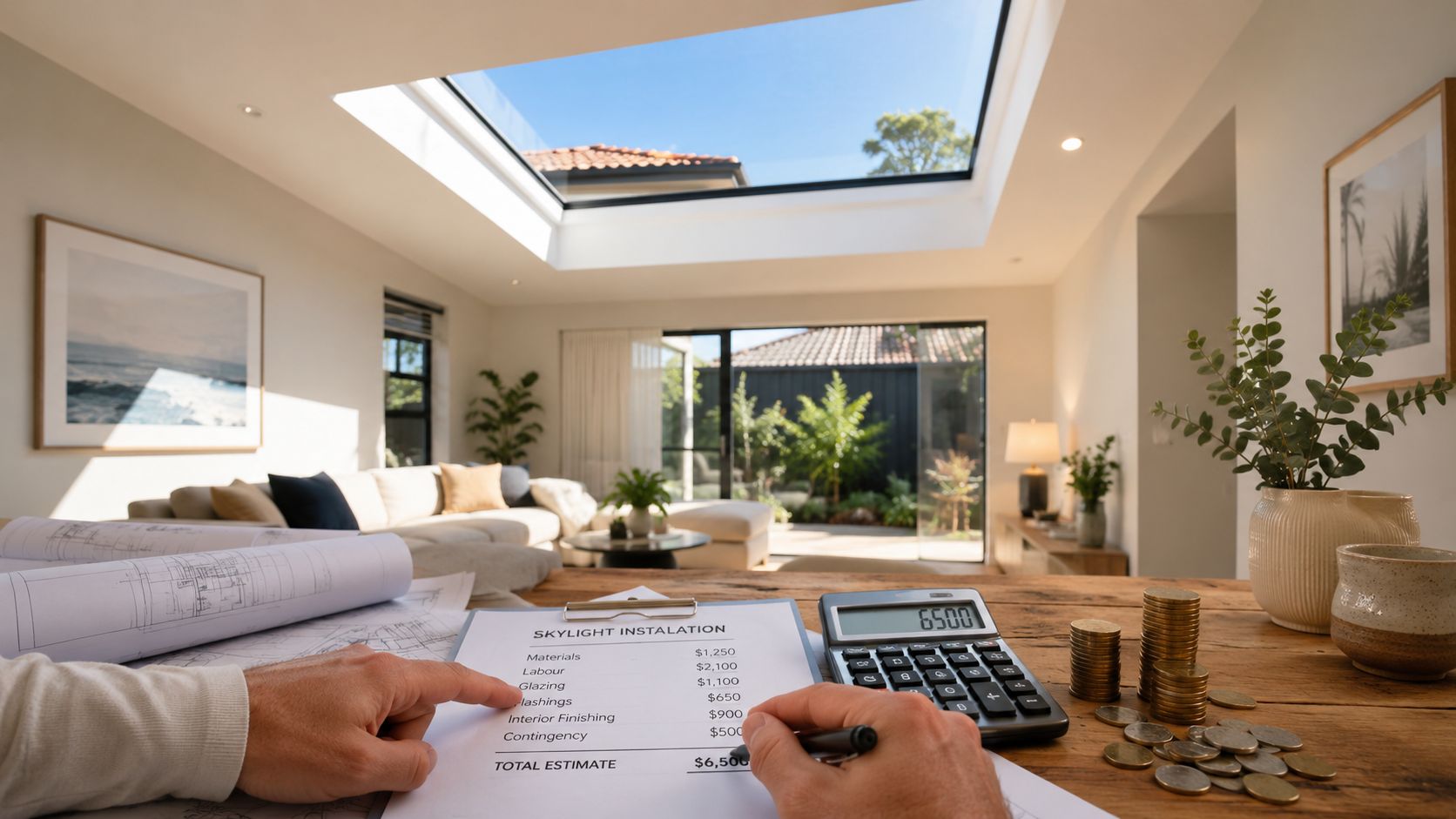
Most Australian homeowners should budget within the broad installed ranges seen in independent guides, about $1,000 to $3,800 or $2,600 to $4,200, with labour alone often accounting for $1,200 to $3,200 depending on roof type and complexity. In practice, your skylight installation price usually comes down to one thing: whether you're replacing an existing unit in a simple opening, or asking a roofer to cut, flash, waterproof, and finish a brand-new opening properly.
If you're reading this, there's a good chance you've got a dark kitchen, hallway, stairwell, or living area that never feels quite right during the day. You want more natural light, but you also want a straight answer on cost before you commit to anything.
That's fair. Skylights are one of those home upgrades where the advertised product price rarely tells the whole story. The main cost lies in the roof work, the flashing, the internal finishing, and the difficulty of making the installation watertight for the long term.
That's why it helps to think about skylight budgeting the same way you'd approach any other renovation. A planning tool like Trademaster's kitchen pricing tool is useful because it reminds homeowners to look past the headline item and price the full project, not just the visible product. Skylights are exactly the same. The unit matters, but the installation conditions matter just as much.
Table of Contents
Your Guide to Understanding Skylight Costs in Australia
The biggest mistake homeowners make is pricing a skylight as if they're buying a window off a shelf. You're not. You're paying for a roof penetration, weatherproof detailing, and often some degree of carpentry and ceiling repair. That's why skylight installation price varies far more than many people expect.
Independent guides consistently place installed skylight projects around the equivalent of about $1,500 to 3,800, with larger or more complex units reaching higher ranges, and they also note that a straightforward replacement in an existing opening should sit well below a full new-cut install on a difficult roof, as outlined by This Old House's skylight installation cost guide. That lines up with what homeowners see in practice. A simple job stays simple only if the roof, ceiling, and access all cooperate.
What usually works well
For most homes, the smoother projects have a few things in common:
Existing access is good: The installer can reach the roof safely without unusual setup.
The roof type is straightforward: Standard pitched roofs are usually easier to flash than awkward low-pitch or highly detailed rooflines.
The ceiling layout is simple: No major reframing, no hidden services, and no deep shaft to build.
The skylight choice suits the room: Fixed units for pure daylight. Opening units where heat and moisture need to escape.
Practical rule: If you want an accurate number, ask for the installed price, not the skylight price.
Where homeowners get caught out
The surprises usually come from parts of the job you can't see from the living room. Tile profile, roof pitch, flashing transitions, internal shaft work, plaster patching, paint touch-up, and wiring for powered models can all affect the final quote.
That's also why broad overseas numbers can be a starting point, not the final answer for your home. Australian labour, roofing methods, and finishing expectations shift the total project cost. The right way to budget is to break the work into product, roof work, internal finishing, and optional extras.
Skylight Installation Price Ranges for 2026
The best published baseline for budgeting is still the broader installed range from independent cost guides. One guide places typical skylight installation at about US$1,000 to US$2,800 or US$1,600 to US$4,200, with labour alone often making up US$300 to US$3,200 depending on roof type and complexity, as noted in HomeAdvisor's skylight installation cost overview. For Australian homeowners, that matters because the final number rarely reflects the skylight unit alone.

What the published ranges really mean
Those broad ranges are useful, but they flatten out important differences between products. A fixed skylight is a simpler package than an operable skylight. An electric opening unit introduces motor components and sometimes electrical coordination. A solar-powered unit changes the installation path again. And an LED daylight alternative is a different category entirely because it can solve lighting problems in areas where a traditional roof opening isn't practical.
If you want a local starting point, it helps to compare products by use case rather than chasing one “average” number. Homeowners often find the budgeting process easier after reviewing an Australian-specific breakdown such as this skylight installation cost page, then matching the product type to the room.
For wider context on how roofing conditions affect project pricing in general, a regional resource like the 2026 Dallas-Fort Worth roofing guide is a useful reminder that access, materials, and roof complexity change labour before the first cut is even made.
Estimated Cost of Vivid Skylights Unit and Installation
The table below groups common homeowner choices into practical product tiers. Because no verified product-specific price list was provided for these exact models, these are qualitative budgeting tiers, not fixed quoted amounts.
| Skylight Type | Estimated Price Range (Installed) | Best For |
|---|---|---|
| Double glazed fixed skylight | Usually sits toward the lower end of standard installed project ranges when roof conditions are simple | Living rooms, hallways, stairwells, spaces needing daylight only |
| Double glazed operable skylight | Usually sits above fixed units because opening hardware and installation complexity increase | Kitchens, bathrooms, upper rooms needing light and ventilation |
| Electric operable skylight | Generally priced above manual-style opening options where powered operation is required | High ceilings, hard-to-reach locations, convenience-focused upgrades |
| Solar powered operable skylight | Often priced in the higher part of the operable category due to added system complexity | Homes wanting opening functionality without the same wiring path |
| AuraGlow LED skylight | Best treated as a separate lighting solution rather than a standard roof opening | Internal rooms where a traditional skylight can’t be installed |
A low sticker price on the unit doesn't guarantee a low installed price. Roof work decides that.
For Australian homeowners comparing options, the useful split is this: fixed units usually offer the cleanest path to daylight at a lower installed cost, operable units cost more because they do more, and AuraGlow-style LED solutions become relevant when the roof or ceiling layout makes a conventional skylight unrealistic.
Key Factors That Influence Your Final Skylight Quote
The final quote doesn't move randomly. It moves because every skylight installer is really pricing a combination of roofing work, carpentry, waterproofing, and internal finishing.

Labour drives more of the price than most people expect
In Australia, one of the clearest benchmarks for understanding skylight installation price is labour. The Australian Bureau of Statistics data for May 2024 put mean weekly ordinary-time earnings for construction trades workers at A$1,771.50 and for all employees at A$1,396.80, which helps explain why roof and carpentry work is priced as specialist labour rather than a minor add-on, as referenced in this labour-market-based skylight cost discussion.
That matters because skylights aren't just “window installs”. A proper job can involve:
Roof access and setup: Getting onto the roof safely and working efficiently.
Opening preparation: Measuring, cutting, and protecting the surrounding structure.
Flashing integration: Matching the flashing method to the roof material and pitch.
Waterproof detailing: Making sure water sheds away from the unit over time, not just on install day.
If you want to understand why one flashing setup differs from another, this guide to roof flashing types is worth reviewing before you compare quotes.
Roof conditions that push a quote up
A skylight on a simple, accessible pitched roof is one thing. A skylight on a low-pitch roof, a hard-to-access upper storey, or a roof with trickier material transitions is another.
The common cost drivers are usually:
Roof material: Tile, metal, and more detailed roof finishes often require different cutting and flashing methods.
Roof pitch: Steeper roofs can slow the job down because movement, setup, and waterproofing become more demanding.
Access: Limited space around the home or difficult roof access adds labour before installation even starts.
New opening versus replacement: Replacing a skylight in an existing opening is usually far simpler than creating a new one.
The part that keeps a skylight dry isn't the glass you see from below. It's the detailing you don't see on the roof.
Interior work is where quotes often change
Homeowners often focus on the roof opening and forget the ceiling below it. But internal work can shift the price quickly. If the ceiling needs a shaft, trim, plaster repair, paint blending, or electrical coordination for an opening model, the quote starts to reflect multiple trades.
A short explainer on the installation process helps make that clearer:
What works well is deciding early whether your priority is pure daylight, ventilation, or a design effect. Once that's clear, the quote becomes easier to read because each line item has a purpose.
DIY vs Professional Installation A Cost Comparison
DIY skylight work can look attractive because you remove some labour from the equation. But the moment you move from “buying a skylight” to “cutting into a roof”, you're no longer comparing product cost. You're comparing risk, finish quality, and who carries responsibility if the waterproofing fails.

Where DIY can look cheaper on paper
The strongest argument for DIY is simple. You may save on direct labour if you already have the skills, tools, and confidence to work on the roof.
But that's only the visible part of the calculation. A major gap in many cost articles is the true installed cost once roof work, internal finishing, and framing are included. Australian builders often need to price framing separately, and framing alone is estimated at a national average of A$805 to A$1,355 per opening in 2026.
That means a DIY plan can still involve costs for:
Framing materials and structural adjustment
Plastering and paint repair
Specialised flashing components
Electrical work for powered models
The cost of fixing mistakes if the install goes wrong
What a professional installation changes
A professional installer prices the job as a complete roof opening and weatherproofing exercise. That usually gives you a cleaner scope, clearer accountability, and fewer handovers between trades.
For homeowners in Victoria or Queensland, professional installation support in Melbourne and Brisbane changes the equation again because site inspection, fitting, and finish coordination can be handled as one service path instead of a patchwork of suppliers and subcontractors.
If you're weighing that choice carefully, this article on DIY skylight installation is a practical place to compare the two paths before deciding.
A fair side-by-side view looks like this:
| Installation Path | Main Advantage | Main Risk |
|---|---|---|
| DIY | More control over upfront labour spend | Waterproofing, structural, and finishing mistakes can erase any savings |
| Professional | One accountable scope for roof work and finish quality | Higher upfront labour component |
If you're comfortable painting a repaired ceiling but not cutting and flashing a roof opening, that's usually the line. The roof work is the part you don't want to guess.
For many homeowners, professional installation ends up being the more economical decision over the life of the skylight because the result is cleaner, faster, and less likely to need remedial work.
How to Read Your Vivid Skylights Quote
A good quote should answer the question behind the question. Not just “what does it cost?” but “what exactly am I paying for, and what's included?”
The line items that matter
When you read a skylight quote, focus on whether it separates the project into real work categories. The useful line items are usually:
Skylight unit: Fixed, operable, electric, solar powered, or an alternative daylight product.
Flashing and roof interface: The roof-specific components that make the installation weatherproof.
Installation labour: The roofing and fitting work itself.
Internal finishing: Shaft work, trims, plastering, paint repair, or making-good.
Optional extras: Blinds, rain-sensing functions, fly screens, or powered accessories.
If any of those are missing, ask whether they're excluded or are rolled into a general amount.
What a detailed quote tells you
A detailed quote is usually a sign that the installer has thought through the roof conditions, not just the product. It also makes comparison easier. Two quotes can look far apart until you notice one includes finishing and the other doesn't.
When homeowners want to compare products and installation pathways in one place, a manufacturer and supplier page such as Vivid Skylights can help identify whether they're looking at fixed double glazed units, operable models, or non-traditional daylight options like AuraGlow LED units.
What works is asking these questions before accepting any quote:
Is this a replacement or a new opening price?
Does it include flashing suited to my roof type?
What interior repair or finishing is included?
If the job needs electrical or extra framing, how is that priced?
A short quote can still be accurate. But if it's too vague, you're the one carrying the uncertainty.
Beyond the Price Tag ROI Warranty and Financing
A skylight shouldn't be judged only on install-day cost. It should be judged on how the room feels afterwards, how often you use artificial lighting during the day, how much ventilation you gain from an opening unit, and how much confidence you have that the installation will stay watertight.

Value isn't only the install day cost
One of the biggest unanswered questions for Australian buyers is payback under local conditions. Upfront price matters, but so does the potential to reduce daytime electricity use and improve comfort depending on room type, roof orientation, glazing choice, and maintenance profile, as discussed in this skylight replacement cost article that highlights the local payback gap.
That's why the cheapest option on paper isn't always the strongest value. Double glazing, better thermal performance, and the right room placement can matter more over time than shaving the initial quote.
Why warranty and payment options matter
Warranty is part of the value calculation. If a skylight comes with a substantial leak-free warranty, that reduces the long-tail risk homeowners worry about most.
Finance also matters because a skylight project often lands alongside broader home upgrades. If you're looking at staged renovation budgeting, a practical primer like how to finance a roof replacement can help frame the decision, even if your project is smaller in scope.
For homeowners who want to spread costs rather than delay the upgrade, home improvement financing is often worth reviewing alongside the quote itself.
The best investment decisions usually come from balancing four things:
Light quality in the room
Ventilation needs
Long-term weatherproof confidence
A payment structure that fits the broader renovation budget
Your Skylight Installation Questions Answered
How long does a skylight installation usually take
That depends on whether you're replacing an existing skylight or cutting a new opening. Replacements are usually simpler. New installations take longer because the installer may need to cut the roof, frame the opening, fit flashing, and complete internal making-good.
Do I need approval to install a skylight
Approval requirements vary by location and by the scope of the work. A simple replacement may be treated differently from a new structural opening. The safest approach is to ask your installer what applies to your home and local council area before work starts.
What maintenance should I expect
A quality skylight should be relatively low maintenance, but it still needs periodic visual checks. Keep an eye on the internal lining for staining, check seals and operation on opening units, and make sure debris isn't building up around the roof area that drains water away from the skylight.
Are electric and solar opening skylights worth the extra cost
They can be, especially in high ceilings, bathrooms, kitchens, or spaces where convenience matters. The extra cost usually makes more sense when you'll use the ventilation function. If you only want daylight and never expect to open the unit, a fixed skylight is often the cleaner value choice.
What if a traditional skylight can't be installed
That's where an LED daylight-style product can make sense. In rooms with roof limitations, awkward structure, or no practical path for a conventional opening, an alternative lighting solution can deliver the visual effect of overhead light without a standard skylight installation.
If you're ready to price your project properly, start with Vivid Skylights. They supply double glazed fixed skylights, electric and solar powered operable skylights, and AuraGlow LED skylights for spaces where a traditional unit isn't practical. They also offer installation services in Melbourne and Brisbane, with nationwide delivery across Australia so you can compare options against your roof type, room layout, and budget before making a decision.