

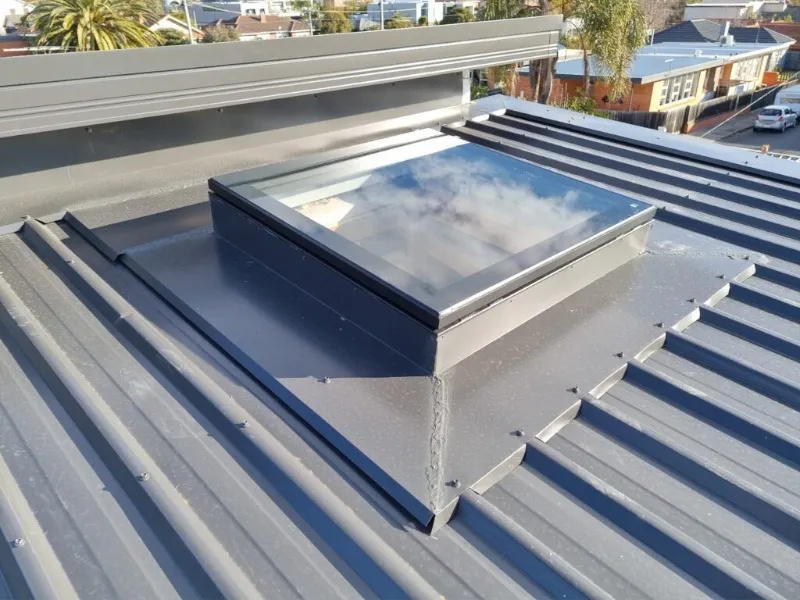
A lot of modern Australian homes look sharp from the street and feel dim inside. You get the clean roofline, the square-set ceilings, the minimalist exterior, then walk into a hallway, kitchen or rear living area that needs lights on by mid-afternoon. That's usually when homeowners start thinking about a skylight for a flat roof and then hit the same hesitation straight away. Will it leak?
That concern is fair. Flat and low-pitch roofs have a long history of being treated like they behave the same as pitched roofs. They don't. Water moves differently, flashing details matter more, and old-style skylight assemblies often gave flat roof installations a bad name. Modern units are a different category altogether, especially when the design accounts for drainage first and daylight second.
If you've been comparing options, looking at renovation photos, or trying to work out whether a skylight will suit a contemporary flat-roof home, the practical answer is yes. The right product, correct sizing, and proper installation detail make all the difference. For a useful outside perspective on how installers think through roof openings and weatherproofing, this guide to Arizona skylight installation is worth a look, even though local roofing methods differ from Australia.
Natural overhead light can change a room more than almost any finish upgrade. It lifts dark corners, sharpens materials, and makes a space feel calmer during the day. If you're weighing up whether that change is worth it, the benefits of skylights are a good place to start.
Table of Contents
Brightening Your Modern Home with a Flat Roof Skylight
You see it in a lot of modern homes. The finishes are sharp, the plan is open, the roofline is clean, and the middle of the house still feels flat and underlit. It might be the kitchen island that needs the lights on at noon, or a hallway that never feels connected to the rest of the home.
A flat roof skylight solves a problem vertical glazing often can't. Perimeter windows light the edges. Overhead glazing reaches the centre.

Why homeowners still worry
The hesitation is usually practical. People have seen older dome units, site-built flashings, and ceiling damage that started with a small failure around the opening. On a flat roof, that history sticks.
Modern skylights are a different category of product. The better systems are designed around drainage paths, insulated glazing, controlled curb detailing, and flashing components that are made for low-pitch conditions rather than adapted to them later. That shift is a big reason flat-roof skylights are now a realistic choice for contemporary Australian homes.
Frameless designs have changed the conversation as well. Older skylights often gave water more places to pause around exposed frame edges and junctions. A modern frameless glass rooflight reduces those interruption points and helps water clear the unit more cleanly. At Vivid Skylights, that is the design logic behind many flat-roof applications. Solve the old weak spots at the product level, not with silicone and hope on site.
A flat roof skylight should be treated as part of the roof system, with daylight as the benefit and water management built into the design.
What a modern unit changes
A good skylight for flat roof use needs to do two jobs well. It has to bring in balanced natural light, and it has to keep performing through heavy rain, leaf debris, and regular roof movement over time.
For Australian homes, this is significant because daylighting is tied closely to comfort, energy use, and how usable a room feels across the day. Done properly, overhead glazing can make an internal space feel larger, calmer, and less dependent on artificial lighting. You can see more of those practical skylight benefits for Australian homes in real living spaces, not just on paper.
Good design principles travel across climates, even though local roofing methods differ. For a broader view of roof window approaches and detailing, this overview of Arizona skylight installation is a useful comparison point.
Why Flat Roofs Demand a Smarter Skylight Solution
A pitched roof naturally helps water move away from an opening. A flat or low-pitch roof doesn't give you that margin. Water slows down, lingers, and tests every joint longer. That's why a skylight for flat roof use has to be designed differently from the start.
Consider placing a tray on a bench versus tilting it over a sink. On the bench, water sits there until something moves it. On the tilt, water sheds. Roofs work the same way. Even a small fall changes how much stress the perimeter of a skylight sees over time.

The drainage issue isn't minor
On a flat roof, the problem isn't only rainfall. It's ponding. If water collects near the curb, lower frame edge, or flashing line, the skylight stays under more persistent moisture exposure than it would on a steeper roof.
Independent product data for flat-roof skylights shows how sensitive these installations are to pitch. One guide specifies suitability for 0° to 15° roof pitch, while another deck-mounted unit is rated for 2° to 15° through this flat roof skylight specification. That small difference tells you something important. Low-slope work is not a rough estimate job. It needs exact geometry.
Why old designs struggled
Older framed skylights often created a shelf or lip where water could hesitate. On a pitched roof that might not show up quickly. On a flat roof, it gets exposed fast.
Modern frameless top-sheet designs address that by reducing edges that interrupt runoff. The cleaner the top surface and the better the transition into the flashing zone, the less chance water has to linger at the lower edge. That's one reason current low-pitch skylights perform so differently from the units that gave flat-roof skylights a poor reputation years ago.
If you're looking at the flashing side of the detail, a purpose-made back tray flashing is the sort of component that helps direct water away from the opening instead of letting it build pressure behind the unit.
Practical rule: Flat roofs don't forgive vague detailing. Small drainage mistakes that might stay hidden on a steeper roof tend to show up early on a low-pitch one.
Why the category keeps growing
The category itself has matured because demand is no longer driven by looks alone. Market reporting notes the flat-roof skylight sector was valued at about USD 148.2 million in 2025 and is projected to reach USD 212.7 million by 2033, growing at a 3.6% CAGR, according to this flat-roof skylight market report. The practical takeaway isn't the market figure by itself. It's what sits behind it. Homeowners, designers and builders are asking for daylight, tighter thermal performance, and more reliable water management in contemporary roof forms.
Choosing Your Perfect Skylight Type and Features
Once the roof detail is sorted, the next question is function. Do you want light only, or light plus ventilation? That decision shapes how the room feels day to day.
In most homes, the choice comes down to fixed versus operable units. Fixed skylights are simpler. Operable skylights add airflow, which can be valuable in the right room and unnecessary in the wrong one.
Fixed or operable
Bathrooms, kitchens and humid rooms benefit most from an opening skylight. General living areas, stair voids and hallways often don't need ventilation at all, so a fixed unit can be the cleaner solution.
That trade-off matters because opening units add motors, controls and weather integration. At the same time, vented designs can improve air quality where moisture tends to hang around. Product guidance on low-slope systems also points to suitability for roof pitches as low as 2 to 15 degrees, with the category increasingly engineered for tighter building envelopes, as outlined in this overview of the best skylights for different roof types.
| Feature | Fixed Skylight | Operable Skylight (Electric/Solar) |
|---|---|---|
| Main purpose | Daylight | Daylight plus ventilation |
| Best rooms | Hallways, living areas, stairwells | Kitchens, bathrooms, humid spaces |
| Complexity | Lower | Higher due to opening mechanisms |
| Maintenance | Fewer moving parts | More components to service over time |
| Weather response | Relies on installation and glazing spec | May include automated closing features depending on model |
| Cost position | Usually simpler to budget for | Usually higher due to controls and hardware |
For homeowners comparing options, types of skylights is a useful starting point because it helps match product type to room function rather than choosing by appearance alone.
Glazing matters more than many people expect
The frame gets attention, but the glazing does a lot of the work. Thermal comfort, glare control, and seasonal performance all depend heavily on what glass specification you choose.
One architects' guide for a flat-roof skylight lists a triple-glazed unit with SHGC 0.17, U-factor 0.29 BTU/h·ft²·°F, visible transmittance 0.33, and condensation resistance 67 in this flat-roof skylights architects guide. You don't need to memorise those numbers to understand the point. Lower solar heat gain helps limit unwanted summer heat. Lower heat transfer helps reduce winter losses through the roof opening.
A practical way to choose
If you're deciding between configurations, use the room rather than the product brochure as your guide:
Choose fixed when the room needs steady daylight and nothing else.
Choose operable when stale air, cooking moisture or bathroom humidity are part of daily use.
Choose high-performance glazing when the room gets strong sun or you're trying to avoid a hot spot under the opening.
Choose simpler hardware when the skylight will be hard to access and the room doesn't justify extra moving parts.
One example in the Australian market is Vivid Skylights, which supplies double-glazed fixed and operable skylights, including electric and solar-powered opening models, for low-pitch residential applications with nationwide delivery.
Getting Skylight Size and Placement Right
A flat-roof skylight can make a room feel calm and open, or harsh and overlit. Size and placement decide which way it goes. I see more problems from poor planning here than from the skylight unit itself.
The goal is even, useful daylight that suits how the room is lived in. In modern Australian homes with pale floors, clean ceilings and large open-plan spaces, roof light reads strongly. A skylight that looks modest on a plan can feel much larger once the sun hits the room.

Use the room size as the starting point
A good sizing rule is to keep the skylight proportionate to the floor area and the amount of existing window light already in the room, as noted earlier. This distinction is important because a dark internal hallway needs a different approach from a living room that already has full-height glazing on two sides.
In practice, I size from the room back to the roof opening. Existing windows, ceiling height, shaft depth, surface colours and orientation all affect how bright the finished space will feel. A white kitchen with stone tops and little wall shading will amplify overhead light far more than a darker, textured room.
If you want to translate that into actual product options, the available skylight dimensions for flat and low-pitch roofs help narrow the range before framing starts. That saves a lot of on-site guessing.
Placement changes how the room feels
Placement does as much work as size. A centred skylight usually gives the most balanced ambient light, while an offset skylight can direct attention to a benchtop, dining area or circulation path.
That is useful in flat-roof architecture, where the ceiling often acts like a clean sheet of paper. One opening in the right place can pull daylight deep into the plan. Two smaller openings often work better than one oversized unit because the light is spread instead of dumped into a single hot spot.
Use placement with purpose:
Over task areas such as kitchen islands, studies and work benches where top light improves function.
Along circulation zones such as hallways and stair landings where wall windows are limited or impossible.
At the centre of deeper rooms where perimeter glazing does not reach far enough.
To pick up architectural features such as a fireplace wall, textured finish or junction between living zones.
A skylight should suit the way the room is used, not just the easiest place to cut between rafters.
This short video gives a useful visual sense of how overhead daylight changes interior experience and planning decisions:
Don't ignore the ceiling shaft
On a flat roof, the shaft is part of the skylight. It shapes the light before it reaches the room. A deep, narrow shaft creates a tighter pool of light, while a wider shaft with well-finished sides spreads daylight further across the ceiling and walls.
This is one reason modern frameless skylight designs work so well in contemporary homes. They deliver a cleaner view of the sky and avoid the heavy visual border older domed or bulky framed units often created, but the indoor result still depends on the shaft geometry. The roof opening is only one part of the equation.
Get the shaft wrong and even a well-made skylight can feel underwhelming. Get it right and a modest opening can light the room naturally without the glare, heat concentration and visual clutter that gave older flat-roof skylights a bad name.
Ensuring a Leak-Free Installation on a Flat Roof
A quality skylight unit helps. The installation decides whether it stays trouble-free. On a flat roof, waterproofing isn't a finishing step. It's the job.
The key concept is the curb or upstand. Instead of dropping the skylight flush into a flat roof surface, the unit is raised so water has a chance to move away from the opening. That small change is what separates a proper low-pitch skylight installation from the old cut-and-seal approach that failed so often.

Why the 5-degree detail matters
A common question is whether a flat-roof skylight can sit perfectly level. In practice, it shouldn't. Guidance on flat skylight drainage notes they typically rely on about a 5-degree slope on the upstand or curb so water runs off instead of pooling, as explained in this article on why flat skylights need a pitch.
That small angle matters more than people expect. It reduces standing water at the perimeter, lowers stress on seals, and helps the roof opening behave more like a draining assembly than a basin.
What leak-free really means
A leak-free result comes from several parts working together:
Accurate opening preparation
The rough opening must match the unit and preserve structural support around it.Correct curb construction
The curb height, squareness and slope all affect drainage and how the skylight beds onto the roof.Compatible flashing
The flashing has to integrate with the roofing membrane or surrounding roof finish, not just sit over it.Sealed transitions
Corners, laps and junctions are where weak work usually shows up first.
A proper skylight flashing kit is part of that system. It's not decorative trim. It's one of the core waterproofing components in the assembly.
Most flat-roof skylight failures don't start in the middle of the glass. They start where one trade assumed another trade had handled the waterproofing detail.
DIY or professional install
Some homeowners are comfortable with framing and interior finishing. Fewer are comfortable integrating a roof penetration into a low-slope waterproofing system. That distinction matters.
DIY might be realistic when:
The roof build-up is straightforward and you've handled similar weatherproofing work before.
The interior work is the main task, such as shaft lining and finishing.
The skylight system comes with clear installation guidance and the roof detail is simple.
Bring in a pro when:
The roof is membrane-based or complex around falls, drainage points or parapets.
The opening sits in a weather-exposed zone where mistakes won't stay hidden.
You're unsure about curb geometry or flashing integration because that uncertainty is usually the warning sign.
When a Traditional Skylight Isn't an Option
Sometimes the room needs the effect of a skylight, but the roof build-up won't allow one. Ground-floor rooms below an upper storey, apartments, internal corridors, and some renovation layouts don't have direct roof access. That doesn't mean you have to settle for flat artificial lighting.
An LED skylight alternative makes sense. Instead of trying to force a conventional roof opening into a space that can't take one, you use a ceiling-mounted light feature designed to mimic the look of a real skylight and the changing character of daylight.
The role of AuraGlow LED skylights
The AuraGlow LED skylight range is built for exactly that kind of space. It creates a skylight-like ceiling effect where a traditional unit can't be installed, and its light changes colour through the day to resemble the shifting tone of the sky rather than a static panel light.
That makes it useful in spaces where the goal is not only brightness, but atmosphere. Hallways, internal bathrooms, dressing rooms and lower-level rooms often need that. They don't just need more lux. They need a less artificial feel.
A better fallback than doing nothing
For many homeowners, the failed skylight plan usually ends with extra downlights. That fixes visibility, but not mood. A skylight-style LED solution sits in a different category because it changes the ceiling experience itself.
The same kind of planning logic shows up in adjacent renovation decisions too. If you're thinking more broadly about how enclosed additions can still feel open and light-filled, this guide to planning your Sacramento sunroom addition is a useful example of how daylight and enclosure choices shape livability, even though the project type is different.
For homeowners comparing Melbourne skylights or planning a project elsewhere in Australia, the main point is simple. If a real roof skylight fits the structure, detail it properly and install it properly. If it doesn't, use a purpose-built alternative that still improves how the room feels.
If you're weighing up a skylight for a flat roof, comparing fixed versus operable models, or need an option for a room where roof access isn't possible, Vivid Skylights has product information, sizing guidance, gallery inspiration, and Australia-wide delivery to help you plan the right solution.