

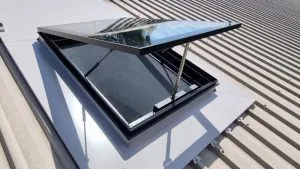
By mid-afternoon in Brisbane, a lot of homes start to feel the same. The light is harsh outside, the air inside is heavy, and the rooms under the roof hold onto heat long after the sun has shifted. You turn on lights in darker parts of the house, then turn up the air con because the ceiling space feels like it's radiating warmth back down.
That's where solar-powered opening skylights make real sense in this city. They don't just brighten a room. They give hot air somewhere to go. In Brisbane's warm, humid conditions, that matters because cooling is a significant part of household energy use, and daylighting solutions are often chosen to reduce artificial lighting while helping manage heat and ventilation, as noted in Brisbane skylight guidance.
If you're researching options for skylights in Brisbane, the useful question isn't just which model looks good on a brochure. It's which type of skylight truly works with a subtropical roof, a humid summer, and a house that needs to feel cooler, not just brighter.
Table of Contents
Beat the Brisbane Heat with Smarter Sunlight
A typical Brisbane home often has two separate problems that show up at the same time. The first is dark internal spaces that need lights on during the day. The second is trapped heat, especially in upstairs rooms, hallways, bathrooms, and living areas under a broad roofline.
A fixed skylight solves the first problem. An opening skylight can help tackle both.
When a solar-powered skylight opens high in the ceiling, it can release the warmest air sitting in the top of the room. That changes how the whole space feels. The room doesn't just look brighter. It starts to feel less stale, less stuffy, and easier to live in through a humid afternoon.
The comfort shift homeowners notice first
Brisbane homes don't always need more sun. They need better-managed daylight. In this climate, the useful upgrade is one that brings in natural light without locking in more heat than the room can handle.
That's why venting skylights are such a practical fit for subtropical homes. They work on two fronts:
Daylight where windows can't help: Central hallways, ensuites, walk-in robes, and open-plan zones often have poor wall access for natural light.
Ventilation at the highest point: Warm air rises. If it has no outlet, it lingers under the ceiling and pushes the whole room closer to air con dependence.
No added mains wiring for operation: A solar-powered opener suits retrofit jobs where owners want less disruption.
A skylight that only adds brightness can still leave a room feeling hot. A skylight that opens can change how the room breathes.
Why Brisbane is a strong fit
The appeal of Solar skylights Brisbane buyers are looking for isn't just style. It's function that matches the local climate. Homes here often need to reduce daytime lighting while dealing with heat and humidity at the same time.
That's why solar-powered opening skylights keep coming up in practical renovations. They suit the way Brisbane houses are used. Morning sun, sticky afternoons, summer storms, and rooms that hold heat all put pressure on a standard “light only” skylight choice.
Understanding Solar-Powered Skylights
A modern solar-powered skylight is easier to understand than one might expect. It's basically a roof window designed to bring in daylight, fitted with its own small solar power source so the opening function doesn't rely on household wiring.
That's the key distinction. Older skylights were usually fixed. They let in light, but they didn't help much with active ventilation. A solar-powered opening unit adds airflow control without turning the installation into an electrical project.
What makes them different
The simplest way to think about a solar venting skylight is this. It's a daylight opening in the roof that powers its own movement.
That makes it useful in renovations where running mains power to the roof cavity would add time, cost, and patch-up work. For many homeowners, the attraction is convenience as much as energy awareness.
If you want a close look at how a solar-powered skylight is configured, the important point is that the opening system is integrated into the unit rather than added as a clunky afterthought.
The three parts that do the work
Most buyers can ignore the jargon and focus on three working parts.
The skylight unit itself
This is the glazed roof opening. In practical Brisbane terms, the glazing and frame matter more than the headline idea of “more light”. If the unit isn't built to manage heat transfer well, comfort can go backwards.The solar collection component
A compact solar panel gathers energy for the opening mechanism. That means no ongoing household power draw for day-to-day operation of the venting function.The motor and controls
This is what opens and closes the sash. For the homeowner, this is the part that turns a passive roof light into an active comfort tool.
Practical rule: If you want ventilation benefits, buy the skylight for its glazing and weather detailing first, then its opening method second.
A good unit behaves like a complete system. The glass, seals, frame, and opening hardware need to work together. If one part is weak, especially around sealing or thermal performance, the whole skylight becomes harder to justify.
The Stack Effect Your Natural Air Conditioner
The most valuable thing a solar-powered opening skylight does in Brisbane isn't the light. It's the airflow.
Hot air rises. Every homeowner knows that instinctively, even if they've never heard the term stack effect. Stand in an upstairs hallway on a summer afternoon and you can feel it. The hottest, stalest air collects high, near the ceiling, where it has nowhere to escape.

Why hot air collects at the top
A house behaves a bit like a chimney. Warm air naturally moves upward. If the highest part of the home is sealed, that heat builds up in the ceiling zone and pushes discomfort down into the room below.
Open a skylight at the high point and you create an exit path. Once hot air escapes, cooler air can start entering through lower windows or doors. The movement is quiet, simple, and continuous when conditions are right.
That's why the stack effect is such a strong argument for venting skylights QLD homeowners are considering. It gives you a real mechanism for comfort, not just a vague promise of “better efficiency”.
How a venting skylight changes the airflow
Here, the difference between fixed and operable units becomes obvious.
With a fixed skylight:
You gain daylight
You improve the feel of a dark room
You don't create a high-level ventilation outlet
With an opening skylight:
You gain daylight
You create a release point for rising heat
You can encourage fresh air movement from lower openings
You may reduce the need to run cooling for as long in shoulder periods
Brisbane-specific guidance notes that while many pages claim energy savings, the meaningful mechanism in this climate is the stack effect reducing air-conditioning runtime, which matters because cooling is a major driver of household electricity use in Queensland's subtropical conditions, as outlined in this Brisbane solar skylight overview.
For homeowners interested in the wider roof-ventilation picture, this explanation of the benefits of solar attic ventilation is useful because it shows how removing trapped hot air from the upper parts of a building can improve comfort overall.
A passive airflow strategy works best when the skylight sits where heat naturally gathers. That could be over a stair void, in an upper living area, or near the top of a raked ceiling. Thoughtful passive ventilation design matters more than choosing the biggest unit.
A short visual makes the airflow principle easier to grasp:
Open the lowest windows a little and the highest skylight above. That height difference is what helps the house purge built-up warm air.
Find Your Perfect Match in the Vivid Skylights Range
Not every room needs the same kind of skylight. Some spaces are dark and need daylight. Others are bright enough but trap heat and moisture. Some have no realistic path for a traditional roof opening at all.
That's why it helps to separate the options by job rather than by product label.
Which type suits which room
A fixed double-glazed skylight is the straightforward choice when your main issue is lack of daylight. Think hallway, stair landing, kitchen zone, or living room where you want overhead light but don't need extra ventilation from the roof.
A solar-powered operable skylight suits rooms that get hot, humid, or stale. Bathrooms, upper-storey bedrooms, raked-ceiling living areas, and spaces under dark roofing often benefit most because you're addressing comfort and light together.
An electric operable skylight fits homes where owners want powered opening with integration into a broader electrical setup. It can suit new builds or major renovations where wiring access is already part of the job.
Then there's the category many homeowners don't realise exists. An AuraGlow LED skylight is useful where a traditional skylight can't be installed. That includes some ground-floor rooms, awkward roof layouts, and places where structural or access limits make a conventional opening unrealistic. The effect is different from a true roof aperture, but it gives a styled overhead light appearance that shifts in colour through the day to mimic the changing sky.
One supplier working across these categories is Vivid Skylights, which offers double-glazed fixed, electric opening, and solar-powered opening skylights, plus the AuraGlow LED range and Australia-wide delivery.
Vivid Skylights Model Comparison
| Skylight Type | Primary Function | Power Source | Ideal For |
|---|---|---|---|
| Fixed double-glazed skylight | Daylighting | None | Hallways, kitchens, living rooms, stairwells |
| Solar-powered operable skylight | Daylighting and natural ventilation | Integrated solar power | Upper rooms, bathrooms, hot living areas, humid spaces |
| Electric operable skylight | Daylighting and powered ventilation | Mains electrical connection | New builds, larger renovations, smart-home aligned projects |
| AuraGlow LED skylight | Simulated skylight-style ceiling light effect | Electrical | Rooms where a traditional skylight can’t be installed |
How to choose without overbuying
The common mistake is paying for opening capability in a room that only needs light. The other mistake is installing a fixed unit in a room that really needs heat relief.
A simple buying filter helps:
Choose fixed if the room is gloomy but not stuffy.
Choose solar opening if the room gets hot at ceiling level and you want a retrofit-friendly option.
Choose electric opening if wiring access is already planned and centralised controls matter.
Choose AuraGlow LED if the roof layout rules out a real skylight but you still want an overhead daylight-style effect.
Buy for the room's problem, not the product category. Light-only rooms and heat-trap rooms usually need different answers.
Designing for the Brisbane Climate and Roofs
Brisbane isn't forgiving when skylights are specified casually. A unit that looks fine on paper can become disappointing if the glazing, orientation, shaft, and weather detailing aren't suited to the roof and climate.
The big issue is simple. More daylight is only helpful if you control the heat that can come with it.
Heat control matters as much as daylight
In Queensland, skylight performance depends heavily on managing solar heat gain. Practical guidance for local conditions emphasises high-performance glazing, airtight sealing, and insulated details so the skylight delivers visible light without increasing cooling load, as explained in this Queensland skylight performance guide.
That's why panel size alone isn't a smart buying shortcut. A larger unit in the wrong position, or one with poor thermal detailing, can create a room that's brighter but harder to cool.
For Brisbane homes, the best outcomes usually come from balancing several factors together:
Roof orientation: Direct exposure changes light quality and heat gain.
Room use: A bathroom, bedroom, and kitchen all behave differently.
Shaft design: The ceiling cavity and shaft finish affect how light spreads.
Insulated perimeter detailing: This helps limit unwanted heat transfer.
If you're thinking more broadly about whole-home performance, this custom home builder's guide to passive design gives a useful overview of how glazing, orientation, shading, and ventilation should work together.
Storms, flashing, and roof compatibility
The other Brisbane issue is weather. Strong summer storms, intense rainfall, and roof exposure make weatherproofing more than a box-ticking exercise.
A lot of consumer content talks about brightness and convenience, but one of the most practical unanswered questions is durability under local storm conditions. Guidance on this point highlights the importance of understanding how flashing, drainage, and seals perform in heavy rain and high-exposure conditions, especially for roof penetrations in Queensland, as discussed in this storm resilience review for solar skylights.
For common Brisbane roofs, that means checking:
Corrugated metal roof compatibility: Flashing details need to suit the roof profile and pitch.
Tiled roof integration: The flashing and apron have to direct water cleanly without relying on sealant alone.
Drainage path: Water should be guided away from the opening, not trapped around it.
Installation quality: A good skylight can still leak if the curb, flashing, or surrounding roof work is poor.
The weak point is rarely “the idea of a skylight”. It's usually the detailing around the skylight.
Installation, Cost, and Long-Term Value
A skylight project usually becomes easier once you split it into two decisions. First, choose the right product type. Second, decide who's installing it.
Some homeowners are comfortable with a DIY approach, especially when they've handled roofing or carpentry work before. Others are better served by a professional installer because roof penetrations, flashing, and internal finishing all need to line up properly.
What the process usually looks like
A typical project moves through these stages:
Product selection
You match the room's problem to the skylight type. Daylight only, daylight plus ventilation, or an alternative like a ceiling-mounted LED solution.Roof and ceiling assessment
The installer or homeowner checks roof pitch, structure, access, and shaft path.Installation planning
During installation planning, electrical needs, if any, get clarified. For larger projects, contractors often use tools similar to Exayard electrical estimating software to scope and price electrical components accurately.Roof work and interior finish
The opening, flashing, shaft, and plaster finish need to work as one system.
For a closer breakdown of practical budget factors, this guide to skylight installation cost in Brisbane is a useful starting point.
Where the long-term value comes from
The long-term value doesn't come from one dramatic number. It comes from several smaller gains working together.
Lower daytime reliance on artificial lighting: The room is usable without flicking switches on.
Better comfort in heat-prone spaces: An operable unit can help purge trapped warm air.
Improved room appeal: Overhead daylight often changes how buyers and occupants perceive a space.
Less compromise in hard-to-light areas: Hallways, bathrooms, and internal rooms become more functional.
Warranty matters too. It tells you whether the manufacturer is prepared to stand behind the roof weatherproofing side of the product, not just the aesthetics.
Your Brisbane Skylight Questions Answered
Do solar opening skylights cope with Brisbane storms
They can, but only when the unit and the installation are treated as a weatherproofing system. For Brisbane buyers, storm resilience is a genuine concern because intense summer storms and heavy rainfall put pressure on flashing, drainage paths, and seals. That's one reason this issue deserves more attention than generic brightness claims.
Are they worth it if I already have LED lights
Sometimes yes, sometimes no. If your only problem is efficient illumination, LEDs may already cover that well. If the room is dark and traps heat or stale air near the ceiling, an opening skylight does a different job that lights alone can't do.
Do I need the right roof type
Yes. Roof pitch, roof material, and cavity conditions all affect what can be installed and how well it performs. Corrugated metal and tiled roofs can both work, but the flashing and detailing need to match the roof rather than being forced into a generic setup.
Ask about the flashing kit, drainage path, glazing type, and shaft insulation before you ask about colour options.
What maintenance should I expect
Mostly routine checks. Keep an eye on debris around the roof area, make sure any operable components are functioning smoothly, and have the unit inspected if you notice staining, condensation concerns, or changes after severe weather.
Is a fixed skylight enough for a Brisbane home
Sometimes. If you only need more daylight, fixed can be the right answer. If the room regularly feels hot and still, a venting model usually makes more sense because it gives warm air an escape route.
If you're weighing up solar skylights for a Brisbane home, Vivid Skylights is one place to compare double-glazed fixed, electric opening, solar-powered operable, and AuraGlow LED options, with Australia-wide delivery for homeowners, renovators, and trade projects.