

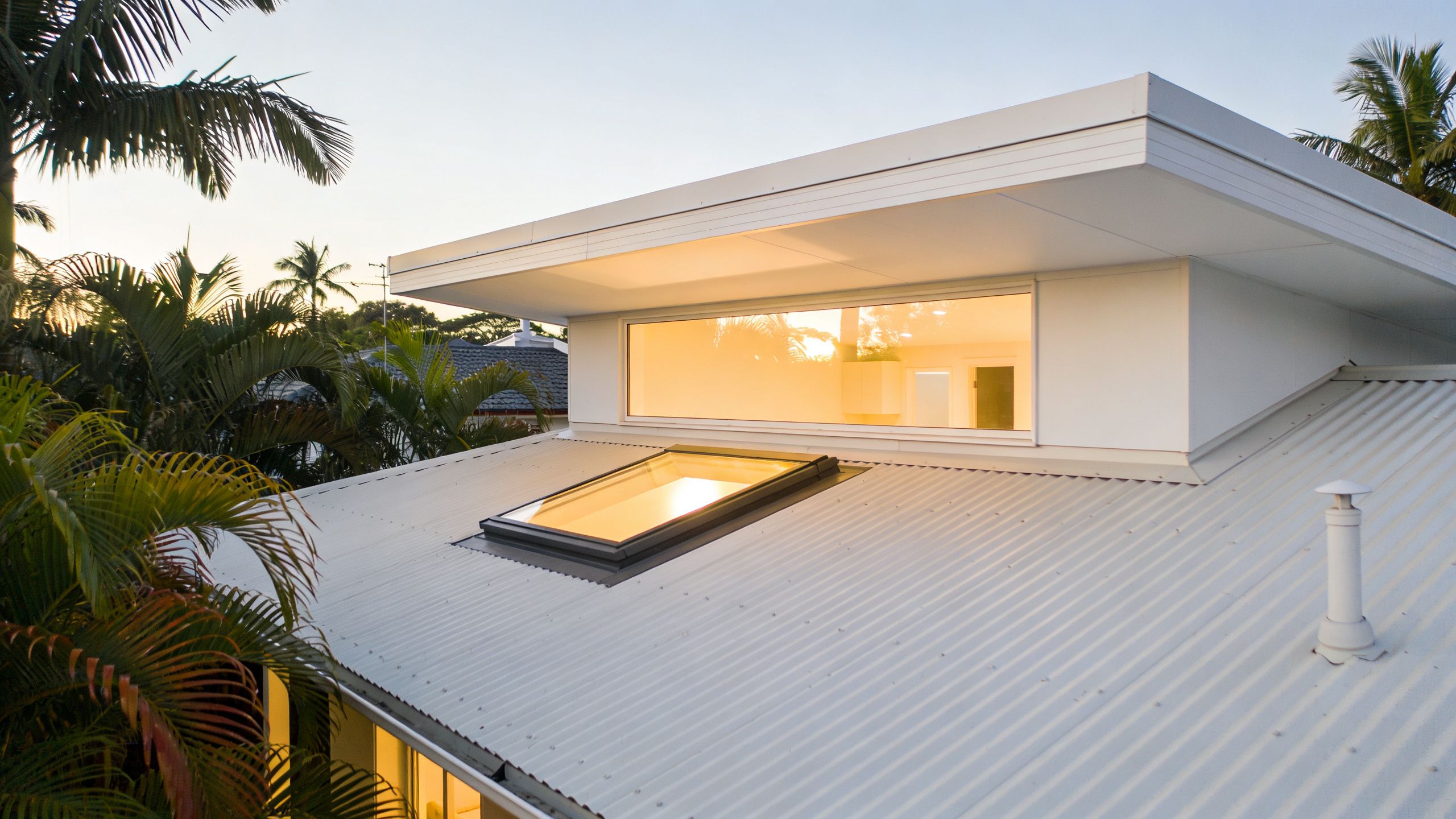
A lot of Brisbane renovations end the same way. The rear extension looks sharp, the ceiling line is clean, the roof is low-pitch or flat, and then the room still feels dim by mid-afternoon. You want daylight, but someone has already told you skylights and flat roofs don’t mix.
That advice is outdated. Modern flat roof skylights Brisbane homeowners are choosing now are built for low-pitch conditions, not adapted as an afterthought. The difference comes down to design, drainage, glazing, and installation detail. Get those right and a skylight becomes part of the architecture, not a future maintenance problem.
Table of Contents
Bringing Light to Brisbane’s Modern Homes
Brisbane’s newer extensions often trade wall space for privacy, boundary setbacks, and a more refined layout. That works well for street appeal and open-plan living, but it can leave kitchens, hallways, and living zones relying on artificial light in the middle of the day.
That’s where flat roof skylights have moved from niche feature to practical solution. In dense Australian cities such as Brisbane, flat roof skylights are increasingly used to bring daylight into homes with limited wall space. One Australian source says they can add about 2 extra daylight hours per day, deliver around 15% average energy savings, and offer a typical return on investment in about 5 years through reduced daytime electricity use (flat roof skylight guide).

Why flat-roof homes benefit more than most
A well-placed roof light can do something side windows often can’t. It reaches the centre of the floorplan. In a Brisbane extension with a deep living area or a kitchen pushed against a boundary, that matters more than people expect.
The visual change is immediate:
Dark zones lift: benchtops, dining areas, and circulation spaces stop feeling boxed in.
Ceilings feel higher: overhead daylight gives a room a more spacious feel.
The finish looks intentional: a sleek profile overhead often suits contemporary flat-roof design better than trying to force extra wall glazing into the plan.
A flat roof doesn’t rule out a skylight. It just means the skylight has to be designed for that roof, not borrowed from a pitched-roof system.
What homeowners usually get wrong
Most hesitation comes from old product assumptions. People remember domes, bulky frames, and leak stories from installations that were never right for low-pitch roofs in the first place.
Current low-pitch solutions are a different category. They are specified around drainage, glazing performance, roof build-up, and architectural finish from the start. That matters in Brisbane, where strong sun, sudden storms, and humid conditions punish weak detailing very quickly.
If you’re looking at a new extension, a renovation, or a dark room with very little perimeter glazing, the question isn’t whether a skylight can work. It’s which type gives you the light, ventilation, and roof integration that suit the house.
The Myth of the Leaky Flat Roof Skylight
The leak myth survives because it started with a real problem. A lot of older skylights were designed around steeper roofs. Put them on a near-flat surface and water sits where it shouldn’t.
Why older assumptions still hang around
On a standard pitched roof, gravity does a lot of the work. Water sheds quickly. Flashings direct runoff downslope. The frame isn’t sitting in prolonged contact with pooled water.
Flat and low-pitch roofs are different. In Southeast Queensland, waterproofing is the issue builders worry about most. Performance depends on curb height, membrane integration, and flashing compatibility, because those details stop water ponding and reduce failure risk during heavy rain (Brisbane flat roof waterproofing guide).
What doesn’t work on a flat roof:
Using a skylight designed for steeper pitches
Relying on generic flashing
Ignoring fall direction on the roof
Choosing appearance first and drainage second
Those are the jobs that create the stories people remember.
What actually keeps water out
A proper flat-roof system is engineered around runoff. That usually means an integrated pitch within the unit or support system, a raised mounting approach suited to the roof build-up, and flashing that matches the roofing material instead of fighting it.
For homeowners, the practical takeaway is simple. Ask how the unit deals with water before you ask how it looks from the street.
Practical rule: if the supplier or installer can’t explain the path water takes away from the skylight, they haven’t solved the main problem.
Low-pitch solutions can still deliver a sleek profile and a strong architectural finish. The point isn’t to create a big bulky box on the roof. The point is to keep the visual line clean while making sure water never gets invited to sit around the perimeter.
If you’ve already had concerns raised about leaks, it’s worth looking at common failure points in Brisbane skylight leak prevention and repair advice. It helps separate product issues from installation issues, which are often not the same thing.
A quick visual helps here:
The short version is that flat roof skylights don’t fail because they’re on a flat roof. They fail when someone treats a flat roof like a pitched one.
Choosing Your Perfect Vivid Skylight
A Brisbane home with a flat roof usually needs one of three things from a skylight. More daylight. More airflow. Or a convincing skylight effect in a room where a roof penetration is not possible. The right choice depends on how the room is used, how the ceiling is built, and what you want the skylight to do every day.

Flat-roof skylights are no longer a niche product made up on site. Standard sizing, factory-built frames, and purpose-made flashing have made selection far more predictable. That matters on Brisbane projects, because good results come from matching the unit to the room and the roof build-up, not from forcing one skylight type into every situation.
Fixed skylights for clean overhead light
Fixed skylights suit rooms that need daylight without added ventilation. They work well over kitchen islands, stair voids, hallways, dining areas, and living spaces where the main goal is balanced natural light from above.
They also tend to give the tidiest architectural result. With no opening hardware, the ceiling line stays clean and the rooflight reads as part of the design rather than an added mechanism. For many flat-roof homes, that is exactly the appeal.
Good fit for:
Open-plan living areas: wide, even daylight without changing window placement
Circulation spaces: corridors and entries that often feel closed in
Feature rooms: spaces where overhead light is part of the architecture
If thermal comfort is a priority, it is worth comparing double glazed flat roof skylight options before you settle on size and layout.
Operable skylights for light plus airflow
Some rooms need more than light. Bathrooms, laundries, kitchens, and upper-level spaces often hold heat and moisture, especially through a Brisbane summer.
An operable skylight helps by venting warm air at the highest point in the room. That can improve comfort naturally and reduce the need to rely on mechanical extraction alone. In practical terms, the trade-off is simple. You get more function, but you also introduce moving parts, controls, and a higher specification.
Electric models suit new builds or major renovations where wiring is already planned. Solar-powered units are often a sensible choice for retrofits, especially when access is awkward. Rain sensors also make sense in Brisbane. Storms can build quickly, and automatic closing adds a layer of protection that many homeowners appreciate.
AuraGlow LED skylights for rooms without roof access
Some areas cannot accept a conventional skylight at all. There may be concrete above, services in the way, body corporate limits, or a room positioned too far from the roofline.
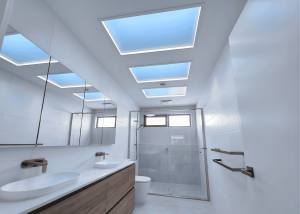
The AuraGlow LED skylight range addresses that situation. It creates the appearance of overhead daylight and shifts colour temperature through the day to resemble the sky outside. It does not replace real glazing where a true skylight can be installed, but it is a useful option for internal bathrooms, walk-in robes, hallways, and other enclosed spaces where natural roof light is off the table.
If the room cannot take a proper roof opening, the better decision is to choose a lighting product designed for that constraint.
Vivid Skylights offers fixed double glazed skylights, electric and solar operable models, and AuraGlow LED units with Australia-wide delivery.
Vivid Skylights at a Glance Fixed vs Operable
| Feature | Fixed Skylight | Electric/Solar Operable Skylight |
|---|---|---|
| Main purpose | Daylight | Daylight plus ventilation |
| Best suited to | Living rooms, hallways, stairwells, kitchens | Bathrooms, kitchens, humid rooms, upper-storey spaces |
| Visual outcome | Minimal look, clean ceiling finish | Similar look with added opening function |
| Moving parts | No | Yes |
| Ventilation | No | Yes |
| Controls | Not required | Electric or solar operation |
| Storm convenience | Passive unit | Can include rain-sensing automation |
| Budget position | Usually simpler specification | Usually higher specification because of automation and venting |
Glazing and Performance in the Sunshine State
Brisbane buyers usually ask one sensible question. Will the skylight make the room hotter in summer? The answer depends less on the word "skylight" and more on the glass specification and roof detailing.
What U-value and SHGC mean in real life
A published technical sheet for a flat-roof skylight lists a U-value of 2.18 W/m²K and an SHGC of 0.61, with suitability for roof slopes from 0° to 5° and a slight pitch recommended to reduce ponding risk (flat roof skylight technical data).
You don't need to memorise those numbers. You do need to know what they tell you.
U-value is about insulation. Lower heat transfer helps the skylight behave more like a considered building element and less like a weak point in the roof.
SHGC is about solar heat gain. It tells you how much solar energy comes through the glazing.
Low-slope tolerance matters because a unit that can work on near-flat roofs has been designed with that condition in mind.
For Brisbane, the right balance matters more than chasing the brightest possible glass. A room that gets excellent daylight but overheats by lunch isn't well designed.
Why low-pitch engineering matters as much as glass
Glazing performance only tells part of the story. The unit also needs to handle local rain, strong UV exposure, and a roofline that may have very little fall.
That's why it pays to look at double glazed skylight options for Australian homes with the whole assembly in mind, not just the pane itself. In practice, homeowners should look for double glazing, a roof-compatible flashing approach, and a form that keeps the external line tidy without creating places for water to linger.
In Brisbane, a skylight earns its place by doing two jobs at once. It has to improve daylight and stay disciplined about heat and water.
If you're comparing products, ask for the glazing build-up, not just a brochure image. That's where the actual performance story sits.
Navigating Brisbane's Building Codes and Permits
A skylight can be beautifully designed and still be wrong on paper. Compliance isn't a side issue in Brisbane. It changes what glass you can use and where the unit can go.
The two compliance points that catch people out
One Brisbane skylight compliance source notes that AS 1288 requires high-performance laminated glass for skylights or roof windows installed 3 m or more above floor level. The same source states that a non-combustible rating is needed for builds within 900 mm of a property boundary in typical residential situations (Brisbane skylight compliance requirements).
That means two things for homeowners.
First, glazing selection isn't only about comfort or appearance. It can be a mandatory safety requirement. Overhead glazing has to be treated differently because breakage risk carries different consequences.
Second, dense suburban sites need early attention to boundary conditions. If your extension sits close to the fence line, fire-separation requirements can affect product selection before the opening is even framed.
Questions to settle before ordering
A straightforward pre-design discussion avoids expensive changes later. The main points are:
Height above floor level: this affects whether laminated overhead glazing is required.
Distance to boundary: this affects fire-separation decisions.
Roof geometry: flat and low-pitch details need to line up with the selected system.
Approval pathway: your builder, certifier, or designer should confirm what documentation is needed for your specific job.
If you want a local overview of planning and compliance considerations, Brisbane City Council skylight regulations explained is a useful starting point.
Set compliance early. It's easier to alter a specification on paper than after the roof cut-out is done.
Installation Costs and Your Options
Homeowners frequently ask about cost before they ask about glazing. That's fair. The installed price can shift a lot depending on the roof, the ceiling, and whether the job is part of a larger renovation or a retrofit.
What affects price
The biggest variables are size, glazing type, automation, roof access, and how complex the roof build-up is. A simple low-pitch opening with clear access is one kind of job. A finished ceiling, difficult access, and extra electrical work is another.
The pricing range noted earlier gives a broad starting point, but your quote should reflect more than the unit itself. It should cover the roof interface, any internal finishing work, and whether the flashing kit matches the roofing material.
A useful early step is checking skylight cost and installation options so you can budget around the full job rather than only the product.
DIY or professional install
Both routes can work. The right one depends on your skill level and the roof type.
DIY makes sense when:
You have renovation experience: especially with roof penetrations and weatherproofing details.
The build is straightforward: simple access and a compatible roof assembly reduce risk.
You're working with clear product documentation: flashing details and installation support matter.
Professional installation makes sense when:
The roof is flat or technically complex: waterproofing detail becomes less forgiving.
The ceiling finish is high-end: you want the internal trim and shaft detail to match the architectural finish.
The unit is operable: electrical or solar integration adds coordination.
The mistake is treating a skylight as a simple hole in the roof. On a flat-roof extension, the installation quality decides whether the result feels polished or patched in.
Your Pre-Purchase Checklist for a Brisbane Skylight
Before you buy, bring the decision back to a short list of essential requirements. This keeps the conversation focused and stops you comparing products on looks alone.
The checks worth making
Confirm it's built for low-pitch use: not every skylight suits a flat roof, even if the brochure photo looks convincing.
Ask how drainage is handled: integrated pitch, curb detail, flashing, and membrane compatibility should be clearly explained.
Review the glazing specification: ask for U-value and SHGC information where available, and make sure the product suits Brisbane conditions.
Check compliance requirements: overhead laminated glass and boundary-related fire rules need to be resolved before installation.
Match the unit to the room: fixed for pure daylight, operable for daylight plus ventilation, alternative lighting where a roof opening isn't possible.
Look at the finish quality: the inside view matters as much as the roof view. A sleek profile outside and a clean internal trim line make the installation feel intentional.
Ask about warranty and support: know what is covered, what flashing is included, and who is responsible for each part of the job.
Use flat-roof specific guidance: flat roof skylight installation guidance is worth reviewing before you commit.
A good skylight doesn't fight the roof. It works with the roof, the room, and the climate.
If you're planning a flat-roof extension or trying to brighten a dark Brisbane room, Vivid Skylights offers fixed, electric, solar-powered and AuraGlow LED skylight options with Australia-wide delivery. Start with the roof type, the room function, and the glazing spec, then narrow the product around those facts.