

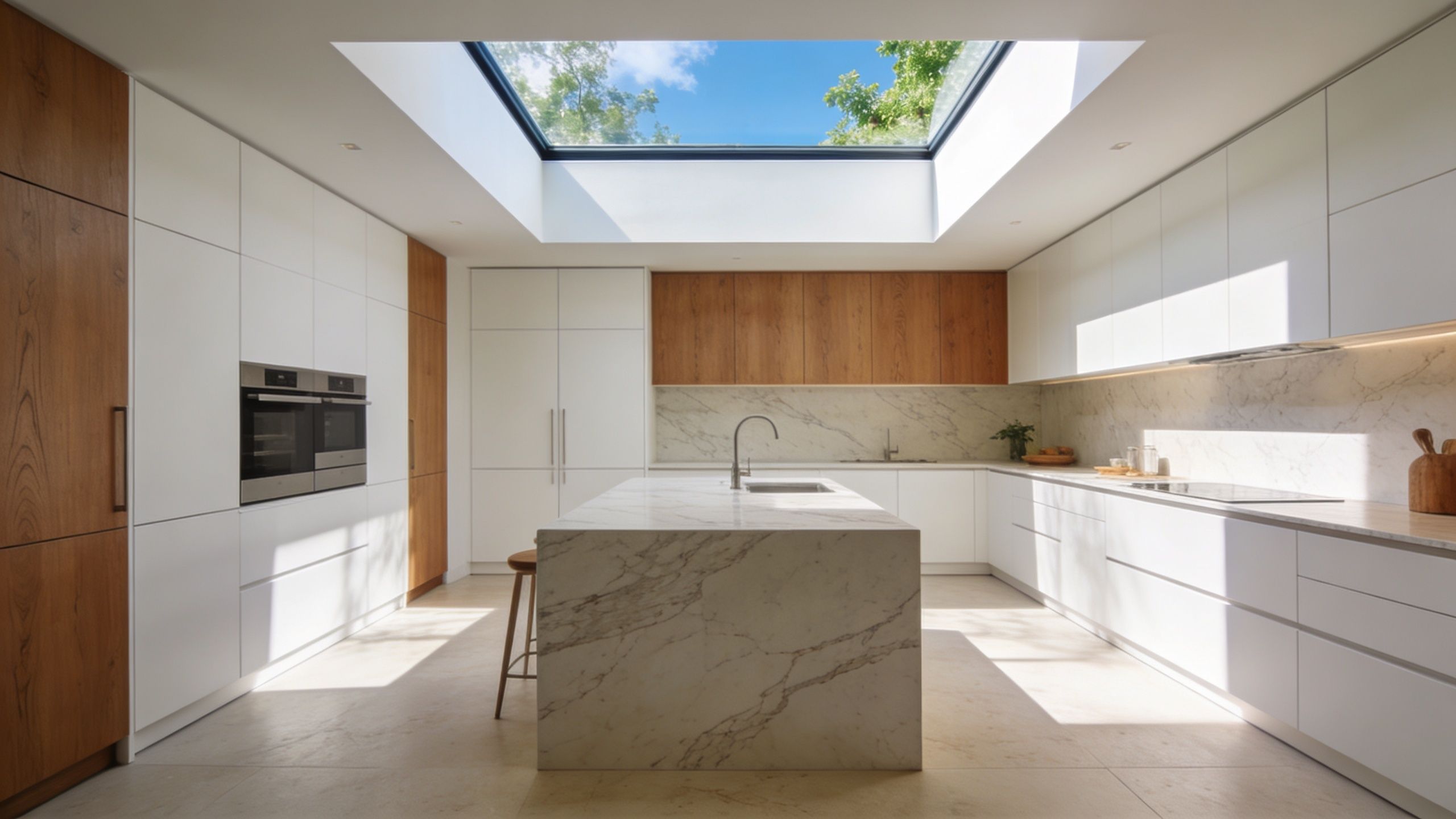
A lot of Brisbane kitchens look fine on paper and disappointing in daily use. The cabinetry is new, the benchtops are sharp, the appliances are expensive, yet the room still feels dim in the middle of the day. Then the opposite mistake happens. A skylight goes in, the room gets bright, and by summer the kitchen feels hotter, glarier, and harder to work in than before.
That’s why the best kitchen skylights for natural light in brisbane aren’t the brightest units you can buy. In this climate, the right choice has to deliver useful daylight while controlling heat, glare, moisture, and sudden weather changes. In a kitchen, that matters more than almost anywhere else in the house because you’re already adding heat through cooking, steam, and appliances.
Good natural light changes how the room works. You can prep food with fewer shadows, the island becomes a proper task zone, and finishes like stone, timber, and splashbacks read more accurately through the day. If you’re weighing up renovation ideas, skylights are one of the few changes that affect both function and atmosphere. For a deeper look at what daylight does inside a home, this guide to the benefits of natural light is a useful starting point.
Table of Contents
Transform Your Brisbane Kitchen with Natural Light
Most kitchen renovations start with surfaces. People choose the joinery profile, tapware finish, stool style, and pendant shape first. Then they stand in the room at noon and realise the island still sits in a patch of flat, uneven light.
A skylight changes that immediately, but the Brisbane version of this decision needs a bit more discipline. In this market, a lot of buyers think in terms of “more light”, when the actual question is how that light behaves across a hot day, through storm season, and during busy cooking hours. One industry guide puts it plainly: in Brisbane kitchens, the primary purchase driver is balancing daylight against summer glare and heat load, and the better choice may be the skylight that limits heat while preserving daylight rather than the one that merely maximises brightness, as noted by Sunshine Skylights’ discussion of thermal control and daylight balance.

What natural light fixes in a kitchen
Natural light earns its place in a kitchen because it improves work, not just appearance.
Task visibility: Over a bench or island, overhead daylight reduces the shadowing you get from downlights behind you.
Food presentation: Fresh ingredients and finished meals look clearer and more accurate in daylight than under warm artificial light alone.
Room feel: A kitchen with top light tends to feel taller, cleaner, and more connected to the rest of the home.
Practical rule: If a kitchen needs the lights on through the middle of the day, the layout usually isn’t making the most of available daylight.
There’s a running cost angle too. If you’re trying to cut daytime power use across the home, skylights work best when they’re part of a wider efficiency mindset. AdVoltage Electrical’s energy saving tips are worth reading alongside any kitchen lighting plan because they show how small design and usage choices add up.
Brisbane kitchens need controlled light
Brisbane’s climate punishes poor specification. A skylight that works beautifully in a cool-climate showroom can become a summer problem over a Queensland kitchen. That’s why the best result usually comes from thinking about the skylight as both a daylight source and a climate-control component.
If you get that balance right, the kitchen doesn’t just look brighter. It works better through breakfast prep, late-afternoon cooking, and humid weather when the room would otherwise hold heat.
Understanding Your Skylight Options
Not every kitchen requires the identical skylight model. Your ideal selection hinges on the specific deficiencies of the current space. Certain kitchens require daylight. Others demand natural light along with a method to vent heat and moisture. Some installations cannot accommodate a conventional unit because the roof cavity is congested or the ceiling configuration presents an obstacle.
For a broad overview of styles and formats, this guide to skylight types gives a useful summary of what’s available.
Fixed skylights for pure daylight
A fixed skylight is the cleanest solution when your priority is light and the room already has adequate ventilation. In kitchen renovations, these suit homes with good crossflow from nearby doors or windows, or layouts where the skylight’s job is mainly to brighten an island, sink run, or dining edge.
Fixed units also tend to suit design-led kitchens because they create a strong architectural opening in the ceiling. If you want the skylight to feel like part of the room rather than an accessory, a rectangular full-frame skylight usually gives a more deliberate result than a smaller light tube.
Operable skylights for light and ventilation
An operable skylight does two jobs. It brings in daylight, and it gives warm air somewhere to go. That matters in kitchens because steam, odours, and trapped heat collect high in the room, especially in homes with raked ceilings or limited wall openings.
There are two main powered approaches:
Electric operable skylights: These connect to home wiring and are controlled electronically.
Solar powered operable skylights: These run through integrated solar components and internal battery systems, so they don’t require internal wiring installation.
The practical difference often comes down to installation preference and access. Functionally, both suit kitchens far better than a sealed unit when the room regularly gets hot.
In a Brisbane kitchen, ventilation isn’t a bonus feature. It’s often the difference between a bright room that feels comfortable and a bright room that feels stuffy.
Tubular systems and where they fit
Roof space sometimes decides the product before aesthetics do. For constrained roof areas, tubular daylighting systems can still be useful. One Brisbane supplier lists Solatube 160 DS units at 14–19 m² coverage and 290 DS units at 23–28 m² coverage in kitchen-style applications, which makes room-size matching easier when planning daylight spread, according to Brisbane Skylights’ daylighting systems guide.
For primary living spaces like kitchens, though, larger full-frame skylights generally give better light quality and stronger visual impact than the spot-lighting effect of a tube. Tubes make sense when structure limits your options. They’re rarely the first design choice for a feature kitchen.
When a traditional skylight can’t go in
Some ceilings won’t accept a conventional skylight without major structural work. That’s where an AuraGlow LED skylight-style fitting makes sense. It doesn’t replace real daylight, but it can create a skylight effect in locations where roof access, framing, or services make a true roof opening impractical.
That makes it a useful fallback for apartments, lower-storey internal rooms, or renovation layouts where you want the visual softness of overhead light without changing the roof.
Glazing Glare and Heat Control for Brisbane’s Climate
The most important skylight decision in Brisbane usually isn’t the opening method. It’s the glazing specification. If the glass isn’t suited to a subtropical kitchen, the rest of the product won’t rescue it.
That’s why double glazing with Low-E coating matters. In Brisbane’s climate, double-glazed skylights with Low-E coatings can significantly reduce summer heat gain by reflecting solar radiation, which is especially important in kitchens where cooking adds more internal heat. The same source notes these glazing systems can also reduce air-conditioning costs, as explained in Skylights Australia’s Brisbane energy efficiency guide.
Why glazing matters more in kitchens
A bedroom can often tolerate a bit of extra warmth during the day. A kitchen can’t. Ovens, cooktops, dishwashers, and people all add heat fast, and the room often peaks at the same time outdoor conditions are hardest.
The glazing choice affects whether the skylight behaves like a controlled light source or a heat entry point. In practice, that means you should be looking for:
Double glazing as a baseline: Better thermal separation than single glazing.
Low-E coated glass: Helps reduce solar heat transfer.
Quality seals and compliant glazing: Important for weather performance and longevity.
For readers comparing products in this climate, energy-efficient skylights for Queensland conditions is the right lens to use, because “bright” on its own isn’t a useful performance category in Brisbane.
Glare control matters as much as heat control
Heat gets most of the attention, but glare ruins a kitchen just as quickly. A skylight positioned over glossy stone, polished cabinetry, or reflective splashbacks can create hard visual hotspots if the glazing and orientation aren’t handled well.
That’s why the best kitchen skylights for natural light in brisbane are usually the ones that deliver softer, workable daylight rather than the most aggressive overhead brightness. Good kitchens need visual comfort. You should be able to stand at the island at midday without squinting or feeling like the ceiling is pushing light directly into your eyes.
A skylight should brighten surfaces and work zones. It shouldn’t create a glare patch that competes with the rest of the room.
Think beyond the glass unit itself
Good performance also depends on the full assembly. Proper sealing, suitable flashing, and glazing that complies with Australian requirements matter just as much as the glass spec on paper. In Brisbane, heavy rain and strong sun expose shortcuts quickly. A skylight for this market has to handle both.
Designing with Light Skylight Placement and Integration
Placement changes everything. The same skylight can feel deliberate and elegant in one kitchen, then awkward in another because it sits in the wrong part of the ceiling plane. In renovation work, the best results come from aligning skylight placement with how the kitchen is used.

Rectangular skylights over islands and walkways
A rectangular skylight over a kitchen island is one of the strongest design moves in a Brisbane renovation. It gives the island visual importance, improves task lighting for prep and serving, and helps the centre of the room feel intentional rather than dependent on perimeter windows.
That same idea works over a butler’s pantry. Pantries are often enclosed, highly functional zones with limited wall glazing. Adding top light there makes the space easier to work in and stops it feeling like a service room tucked behind the main kitchen.
Placement tends to work best when it supports one of these uses:
Island-centred layouts: A long rectangle can track the main prep zone.
Galley kitchens: A centred opening can reduce the tunnel effect.
Pantry corridors or sculleries: Top light can transform enclosed utility areas.
A good visual reference helps here. Watch how overhead light shapes joinery lines and working zones in real interiors:
Integrated joinery and lighting
The strongest kitchen designs don’t treat skylights as separate from the rest of the lighting plan. They’re integrated with the joinery, pendants, under-cabinet strips, and circulation zones.
That matters most in modern kitchens where the ceiling, cabinetry, and island all work as one composition. A skylight can reinforce the geometry of tall joinery, line up with a run of overhead cupboards, or bring daylight exactly where darker finishes need relief. In practical terms, integrated joinery and lighting means the skylight should support the kitchen’s daily rhythm, not fight it.
Here’s what usually works:
Pairing skylights with layered artificial lighting: Use pendants for evening mood and a skylight for daytime task light.
Aligning with cabinetry modules: A centred opening often feels calmer than a randomly placed one.
Supporting material selection: Dark timber, charcoal joinery, and stone all benefit from balanced top light.
Treat the skylight opening like part of the joinery layout. Once it lines up with the room’s geometry, the whole kitchen feels more organised.
When placement is right, food looks better, finishes read better, and the kitchen feels broader without expanding the footprint.
Comparing Skylight Solutions for Brisbane Kitchens
Selecting between skylight types becomes simpler when comparing them against how a Brisbane kitchen behaves. Heat build-up, steam, storms, and daily task lighting should shape the decision more than brand browsing.

Quick comparison table
| Solution | Natural light quality | Ventilation | Heat and glare control potential | Installation fit | Best use case |
|---|---|---|---|---|---|
| Fixed skylight | Strong, broad daylight | None | Good when specified with suitable glazing | Straightforward where access and framing suit | Kitchens that already ventilate well |
| Electric operable skylight | Strong, broad daylight | Yes | Strong overall package when paired with heat-control glazing | Suits renovations where wiring is planned | Busy kitchens with regular cooking and steam |
| Solar operable skylight | Strong, broad daylight | Yes | Strong overall package when paired with heat-control glazing | Useful where avoiding internal wiring is preferred | Kitchens needing ventilation with simpler power setup |
| AuraGlow LED skylight-style option | Simulated overhead light effect | None | Not a thermal daylight solution | Useful where roof installation isn’t practical | Internal areas or layouts where true skylights can’t be installed |
For a side-by-side look at rooflight formats, this comparison of solar tubes and skylights is a practical reference.
Which option suits which kitchen
For most Brisbane kitchens, operable skylights are the smartest functional choice because they handle both daylight and thermal management. Research specific to Australian conditions notes that ventilated skylights allow hot air to escape, reducing reliance on air conditioning, and that solar-powered operable models are particularly useful because they operate off-grid and often include rain sensors that close the unit during sudden storms, as outlined in Luminous Skylights' guide to choosing the right skylight.
That recommendation gets stronger if your kitchen has any of the following traits:
Heavy cooking load: Frequent use of ovens, gas, or multiple appliances.
Limited cross-ventilation: Few operable windows nearby.
High or raked ceilings: Warm air collects and lingers.
A fixed skylight still makes sense in the right room. If the kitchen already breathes well and the brief is mainly to improve natural light over an island or dining edge, a fixed double-glazed unit can do that cleanly.
There are also cases where a product outside the traditional daylight category is the practical answer. A skylight supplier such as Vivid Skylights offers double-glazed fixed and operable units, including electric and solar opening models, and also supplies an AuraGlow LED range for spaces where a standard roof opening isn't feasible. That's useful in renovation planning because not every kitchen ceiling gives you the same installation options.
Installation Compliance and Maintenance
A kitchen skylight only performs as well as it's installed. That's especially true in Brisbane, where strong sun and hard rain both test the opening. A neat plaster finish means very little if the flashing, sealing, or roof detailing is wrong.
What a proper installation has to get right
Before any unit is ordered, the installer needs to assess the roof structure, pitch, ceiling layout, and skylight position. Kitchens often compete with rafters, services, rangehood ducting, and upper-level framing constraints, so the opening has to be planned around what the roof will permit.
The compliance side matters too. In Brisbane, homeowners should confirm local requirements before cutting the roof. Brisbane City Council skylight regulations are a sensible reference point when you're checking approvals, placement constraints, or project scope.
The practical checklist usually includes:
Roof compatibility: The unit and flashing must suit the roof type and pitch.
Weatherproof detailing: Seals and flashings need to be installed for local rain conditions.
Glass compliance: Quality skylights should comply with AS 1288 glazing standards.
Access for operation and servicing: Important for opening units and accessories.
The expensive part of a bad skylight job isn't the skylight. It's fixing the roof, ceiling, paintwork, and frustration that follow.
Simple maintenance that prevents bigger problems
A well-installed skylight shouldn't become a high-maintenance fixture. Most of the ongoing care is basic inspection and common sense.
Focus on these habits:
Check seals and surrounding ceiling lines: Look for signs of moisture after major weather.
Keep the glass surface clear: Dirt buildup reduces light quality over time.
Test opening functions periodically: Especially for operable units and rain-sensor features.
Clear roof debris nearby: Leaves and grime can interfere with drainage paths.
Some modern units include self-cleaning glass, which helps reduce upkeep. That won't replace inspection, but it does make long-term maintenance easier.
Warranty support matters here as well. A 10-year leak-free warranty gives homeowners a clearer level of protection, but it still depends on proper installation and sensible care.
Your Brisbane Kitchen Skylight Checklist
The easiest way to make a good skylight decision is to narrow the brief before you start comparing models. Brisbane kitchens reward specific choices. They punish vague ones.
Run through this checklist before you commit.
The shortlist that actually matters
Define the job first: Do you only need more daylight, or do you need light plus ventilation for heat and steam?
Choose the working zone: Over the island, sink run, dining edge, or butler's pantry usually makes more sense than a random ceiling centre point.
Match the skylight to the room type: Full-frame skylights generally suit kitchens better than tube-style spot lighting when the kitchen is a primary living zone.
Check the glazing spec: For this climate, heat and glare control matter as much as brightness.
Think about storms: If you want an opening unit, automatic closure features are worth considering in Brisbane conditions.
Coordinate with the kitchen plan: The skylight should line up with joinery, pendants, and circulation paths.
Confirm the roof can take it cleanly: Structure and services often decide what's realistic.
What usually works best
For many Brisbane homeowners, the strongest outcome is an operable, well-glazed skylight positioned over the main working part of the kitchen. That combination addresses the two problems people usually feel most. Lack of natural light and trapped heat.
If ventilation isn't a priority, a fixed unit can still transform the room when it's sized and placed properly. And if the roof won't allow a conventional installation, a simulated skylight-style LED option can still improve the feel of an otherwise enclosed space.
The common thread is simple. Don't buy for brightness alone. Buy for how the kitchen will feel on a hot afternoon, during a storm, and while you're cooking in it.
If you're collecting ideas for a renovation, Vivid Skylights is one place to explore double-glazed fixed, electric opening, solar opening, and AuraGlow LED skylight options, with Australia-wide delivery available. Their gallery is also useful for seeing how skylights sit over islands, pantries, and open-plan kitchen layouts before you lock in your design.