

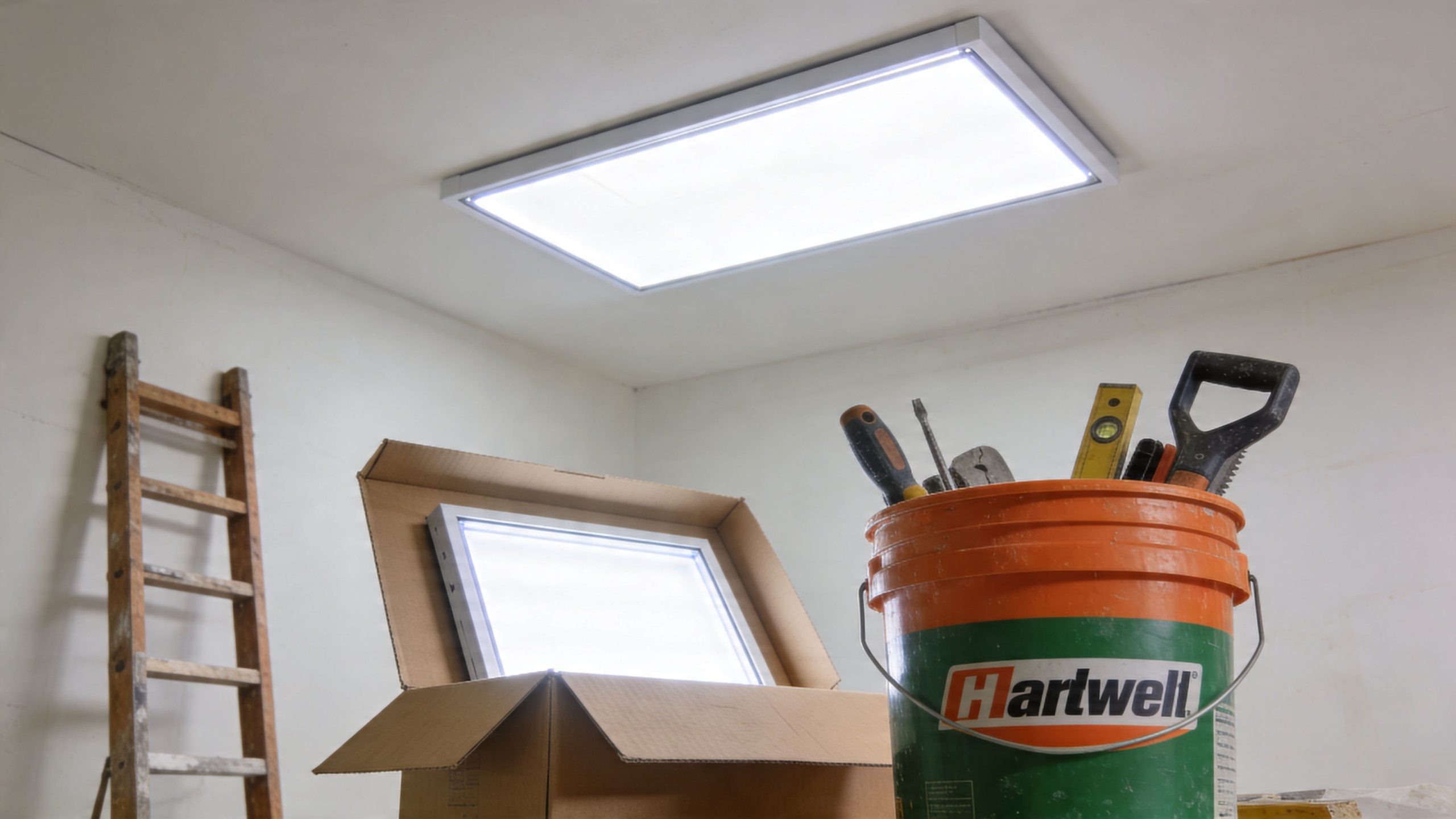
A lot of people start in the same place. There’s a hallway, bathroom, walk-in robe, laundry, internal kitchen, or ground-floor room that never feels bright enough, and the first search is usually artificial skylight bunnings.
That search makes sense. Bunnings is familiar, easy to access, and full of DIY-friendly lighting products. But once you get past the product listings, the key question isn’t just “Can I buy a fake skylight?” It’s “Will it suit my room, my roof, and the result I want to live with every day?”
Some spaces only need a clean, simple light source that looks better than a standard ceiling panel. Other spaces need something that feels closer to daylight. And if the roof allows it, a real skylight can change a room in a way no LED panel can. If you're weighing those options, it helps to start with a clear breakdown of what’s available through Bunnings skylight options and alternatives, then sort out what works and what falls short.
Table of Contents
Searching for Light The 'Artificial Skylight Bunnings' Quest
The usual scenario is straightforward. You’ve got a room in the middle of the house, no usable window, and the existing light feels flat. During the day it still needs the switch on, which gets old quickly.
That’s why people type artificial skylight bunnings into Google instead of starting with a roofing specialist. They want something practical, something available now, and ideally something they can install without opening up half the ceiling.
In many cases, that instinct is reasonable. Some homeowners don’t have roof access above the room. Others are dealing with concrete slabs, upper-floor apartments, awkward truss layouts, or spaces where a traditional skylight just isn’t realistic. In those situations, an artificial skylight can be a sensible answer.
The mistake isn’t starting with a big-box option. The mistake is assuming every product that looks like a skylight will perform like one.
There’s a big difference between a basic illuminated panel, a solar-powered simulated skylight, and a premium artificial system designed to mimic the rhythm and feel of daylight. There’s also a big difference between a room that needs “more light” and one that needs a genuine architectural upgrade.
Homeowners usually care about four things:
Brightness: Will it lift the room, or just replace one ceiling light with another?
Appearance: Does it look like a skylight, or does it look like a lit panel?
Practicality: Can it be fitted without roof penetrations, plaster repairs, or electrical complications?
Long-term satisfaction: Will you still like it after the novelty wears off?
If you’re serious about improving a dark room, those trade-offs matter more than the product category name.
What You'll Find The Common Types of Artificial Skylights
Walk through a retailer like Bunnings and you’ll usually find a mix of products that sit under the “artificial skylight” label, even though they work very differently. Some are flat LED ceiling lights styled to resemble a skylight. Others are more advanced and use a separate solar component to change light output through the day.

A good starting point is to understand the broader types of skylights used in Australian homes, because not every “skylight-style” product is solving the same problem.
The basic LED panel option
The simplest version is the flat LED panel. It sits flush in the ceiling and gives a diffused, even spread of light. It’s neat, low-profile, and often suits laundries, pantries, hallways, and utility spaces.
The upside is easy installation. There’s no roof opening, no flashing, and no weather risk. If your main goal is to brighten a dim area and keep the ceiling clean-looking, these can do the job.
The downside is realism. Most basic panels don’t create any real sense of depth, sky, or daylight progression. They illuminate the room, but they rarely change the way the room feels.
Solar-powered simulated skylights
A more interesting category is the solar-powered artificial skylight. Illume LED light panels, often sold as artificial skylight alternatives, use an individual solar panel mounted on the roof to drive the internal light panel. They can provide up to 1000 lumens per panel without drawing grid electricity and without any roof penetrations, according to Illume demonstration specifications.
That setup appeals to homeowners who want a daylight-linked result without cutting a full skylight opening into the roof. The internal panel brightens and dims in line with available sunlight, which makes it feel more natural than a fixed-output light.
Still, there are limits:
Output depends on available sun: It behaves more like daylight because it follows daylight, but it also depends on that roof-mounted solar input.
It doesn’t provide a sky view: You get the look of a frosted opening, not the experience of seeing outside.
It won’t ventilate a room: For bathrooms, kitchens, and upper-floor spaces, that can matter.
Practical rule: If the room needs daylight simulation only, a solar-powered panel can make sense. If the room also needs air movement, outlook, or a stronger architectural effect, it’s the wrong tool.
DIY sheet materials and custom builds
Some renovators also look at DIY builds using translucent sheeting and framed light boxes. Polycarbonate sheets sold through Bunnings can transmit up to 90% of visible light while blocking 99% of harmful UV rays, based on supplier specifications referenced here. They’re also described as up to 200 times stronger than glass in the same source.
That makes polycarbonate useful for pergolas, covered outdoor zones, and some custom light-diffusing applications. But it’s important not to confuse a durable sheet material with a finished skylight system. A panel material can be part of a build. It isn’t the same as a sealed, well-detailed skylight designed for long-term weather performance inside a home.
For most homeowners, the common options break down like this:
| Option | Best for | Main strength | Main weakness |
|---|---|---|---|
| Basic LED panel | Utility rooms | Simple and tidy | Doesn’t feel like daylight |
| Solar-powered panel | Internal rooms needing a daylight effect | Follows natural brightness | No sky view or ventilation |
| DIY light box build | Custom projects | Flexible design approach | Depends heavily on build quality |
Artificial vs Natural Skylights A Head-to-Head Comparison
Most comparisons online stop too early. They show the artificial option, mention that it’s easy to install, and leave it there. That doesn’t help much when you’re deciding between a quick lighting fix and a real long-term upgrade.

A more useful benchmark is to compare the two side by side. If you’re exploring artificial skylight bunnings options, it also helps to see how they differ from more advanced artificial skylight solutions and real skylight alternatives.
Where artificial skylights win
Artificial skylights are easier to place almost anywhere. You don’t need the room to sit directly under a suitable section of roof, and you don’t need to deal with roofing, flashing, or structural framing changes in the same way.
They also suit properties where a roof opening isn’t practical. Apartments, lower-level rooms under another storey, and some renovation layouts fall into that camp. In those spaces, a high-quality artificial unit can do something a real skylight can’t, because a real skylight isn’t physically possible.
Then there’s control. Many artificial systems can be dimmed, colour-adjusted, or scheduled. That matters if the room is used at night as much as during the day.
Where natural skylights still lead
Natural skylights win on one thing that no imitation fully replaces. They bring in actual daylight. The light has movement, variation, softness, and intensity that changes naturally with weather and time.
They also change the architecture of a room. A real shaft of daylight from above can make a ceiling feel higher and the whole room feel more open. That’s hard to replicate with a surface-mounted fitting, no matter how well designed it is.
There’s also the long-term property question. According to a content analysis focused on this search gap, double-glazed real skylights can reduce daytime power use by up to 25% and increase home value by 5-7%, while basic fake skylights are more of a short-term DIY solution, as noted in this comparison on artificial and real skylights.
A ceiling light can brighten a room. A well-placed natural skylight can change how that room is used.
A practical comparison
Here’s the trade-off in plain terms.
Light quality: Artificial units can look good, especially premium ones, but real skylights still deliver the richest daylight.
Installation: Artificial units are usually easier and less invasive.
Ventilation: Natural operable skylights can help release heat and stale air. Artificial units can’t.
Weather exposure: Artificial systems avoid roofing complexity. Natural skylights need correct design and installation.
Long-term value: Real skylights usually contribute more to the home itself, not just the room’s lighting.
If you want convenience first, artificial often wins. If you want the strongest overall result and the roof allows it, natural usually wins.
Introducing AuraGlow A New Era for Artificial Lighting
There’s a category gap between a cheap fake skylight and a real window in the roof. That’s where a premium simulated skylight earns its place.
AuraGlow sits in that middle ground. It’s designed for rooms where a traditional skylight can’t be installed, but where a plain LED panel would feel underwhelming. That’s a very real category in Australian homes. Internal bathrooms, hallways, treatment rooms, lower-floor spaces, and converted areas often need more than brightness. They need atmosphere.
Why advanced artificial skylights feel different
The better systems don’t just push light down into a room. They try to recreate the visual behaviour of daylight. Advanced artificial skylights can use Rayleigh scattering principles to produce a realistic blue-sky effect, and AuraGlow applies that idea with circadian cycles running from a warm 1800K dawn to a bright 8000K midday, with smart customisation built in, according to these technical specifications for advanced artificial sky lighting.
That matters because people don’t respond to light as a single on-or-off event. We notice warmth, coolness, contrast, softness, and changes across the day. A flat white panel can brighten a room, but it doesn’t mimic the rhythm of natural light in any convincing way.
AuraGlow is built around that rhythm. Instead of giving you one static light condition, it can move from soft morning tones to crisper midday light and then into warmer late-day ambience. In practical terms, the room feels less like it’s lit by a fitting and more like it’s influenced by a changing skylight above.
Trade insight: The biggest upgrade in premium artificial skylights isn’t raw brightness. It’s believable light behaviour.
What separates AuraGlow from basic fake skylights
The feature set is where this category starts to make sense for design-conscious homeowners.
Dynamic circadian lighting: AuraGlow shifts from 1800K to 8000K, which gives the room a more natural daylight pattern rather than one fixed colour temperature.
Smart control options: It works through a mobile app and can integrate with voice control through Amazon Alexa or Google Assistant.
Strong output and efficient design: The range is specified with up to 12000 lumens, 100 lm/W luminous efficacy, and a 50,000-hour lifespan.
Flexible fit-out: Suspended ceilings, surface mounting, pendant options, and recessed applications give it reach in rooms where roof glazing isn’t an option.
Build quality: Aerospace-grade aluminium alloy and an IP66 rating make it a more serious product than decorative LED panels.
If a home already has integrated scenes for lights, blinds, audio, or climate, it also makes sense to look at smart home services that unify lighting so the skylight effect isn’t operating in isolation from the rest of the room.
Where it fits best
AuraGlow works best when the room needs a design-led solution without structural disruption. That includes:
Windowless bathrooms where you want a brighter, cleaner feel overhead
Hallways and corridors that otherwise rely on downlights all day
Converted rooms where the roof space above isn’t available
Ground-floor spaces under another level where a real skylight isn’t possible
Interiors needing mood control as much as illumination
For those rooms, a premium artificial skylight makes more sense than forcing a compromise. If you can’t install real roof glazing, the next best option is a simulated skylight that looks and behaves like it belongs there. That’s why many homeowners looking for LED skylight-style lighting solutions move past entry-level fake panels and into this newer category.
When a Natural Skylight Is the Unbeatable Choice
Artificial skylights solve real problems, but there are still rooms where the best answer is a genuine opening to the sky.
If the room sits under a suitable roof area, and the project allows proper flashing and installation, natural skylights deliver something artificial systems still can’t. They don’t imitate daylight. They bring it in directly.
The rooms that justify the real thing
Top-floor living rooms, kitchen extensions, raked ceilings, stair voids, attic conversions, and large open-plan areas are prime candidates. In those spaces, natural overhead light changes the whole room volume. Surfaces read differently. Shadows soften. The ceiling stops feeling like a lid.
Natural skylights also make more sense when the room is occupied for long periods. A hallway can get by with a simulated effect. A kitchen, family room, or upstairs retreat usually benefits more from real daylight and a stronger visual connection to outdoors.
The energy side matters too. Solar-powered operable skylights can cut daytime lighting bills by 25% on sunny days, according to this Australian skylight comparison focused on solar operable models. In a house where daylighting is part of the design, that isn’t just about aesthetics. It affects how often lights need to be switched on in the first place.
Fixed or operable matters
A fixed skylight is the cleanest choice when all you want is daylight. It suits voids, living zones, and circulation areas where ventilation isn’t a priority.
An operable skylight is different. It’s worth considering in bathrooms, kitchens, and upper-level rooms that trap heat. Electric and solar-powered opening models add another layer of usability because they don’t just brighten the space. They help the room breathe.
Here’s the simple decision filter:
| Room need | Better fit |
|---|---|
| Pure daylight in a main living space | Fixed natural skylight |
| Daylight plus airflow | Operable natural skylight |
| No viable roof access | Premium artificial skylight |
If the roof and room both allow it, a real skylight is usually the strongest overall investment. It improves the light source and the space itself.
Key Buying and DIY Installation Considerations
Buying the right product is only half the job. The other half is making sure the room, ceiling, and roof can support the result you expect. A lot of frustration comes from choosing a skylight-style product first and asking site questions later.
If you’re weighing a self-install project, this practical guide to a DIY skylight approach is worth reading before you cut anything.
Check the room before you buy anything
Start from inside the room, not from the product listing.
Ask yourself:
What is the actual problem? If the room is dark but otherwise fine, an artificial option may be enough.
Do you need a skylight look or genuine daylight? Those aren’t the same outcome.
Is there roof space above? Upper-storey and slab conditions can rule out a natural skylight immediately.
Does the room need ventilation? If yes, a non-operable artificial unit won’t solve the full issue.
A laundry, robe, or corridor often has lower expectations. A kitchen or bathroom usually has higher ones.
Low-pitch roofs need extra caution
Roof pitch is where many DIY plans come unstuck. It’s one of the least understood parts of skylight selection, and it matters a lot for waterproofing.
A commonly missed issue is that low-pitch roofs are present in 30% of Melbourne homes, and standard Bunnings kits may not meet NCC 2022 water pooling standards for those applications, according to this discussion of low-pitch roof skylight challenges. That doesn’t mean low-pitch roofs can’t take skylights. It means the flashing design and product choice have to suit the roof.
Don’t assume a skylight kit that works on a steeper tiled roof will behave the same way on a low-pitch roof. Water moves differently, and ponding risk changes the whole install detail.
Know when DIY is fine and when it isn't
There are projects a careful DIY renovator can handle well. Surface-mounted artificial skylights, ceiling panel upgrades, and some non-structural lighting swaps can be straightforward.
Real skylights are different. Once the job involves roofing, flashing, weatherproofing, structural trimming, plaster finishing, and electrical work for controls or blinds, the margin for error narrows quickly.
A useful rule is to divide projects like this:
Reasonable DIY territory: Interior artificial skylight installations with clear instructions and no major structural alteration.
Proceed carefully: Products that involve roof-mounted solar components, because placement and sealing still matter.
Call in a professional: Any natural skylight install where poor flashing or incorrect pitch detailing could lead to leaks.
The right choice isn’t always the cheapest unit or the fastest install. It’s the option that suits the room, the roof, and how long you want the result to last.
If you're comparing artificial skylight bunnings products with more refined options, Vivid Skylights is worth a close look. They supply double glazed fixed and operable skylights, including electric and solar powered opening models, with Australia-wide delivery. For spaces where a traditional skylight can't be installed, their AuraGlow LED skylight range offers a high-end simulated skylight effect with changing daylight tones, smart controls, and a clean architectural finish.