

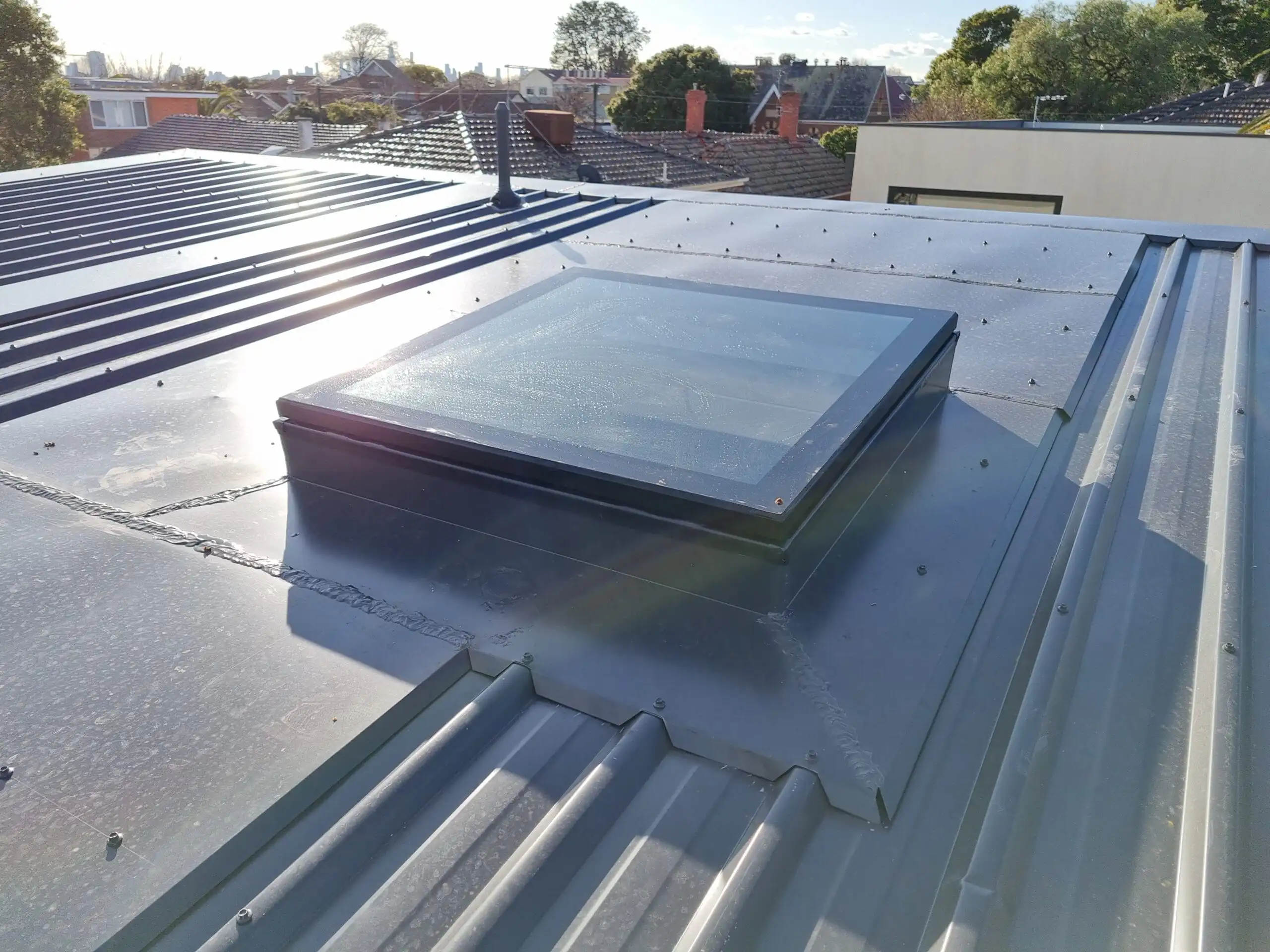
You're planning a clean modern roofline, a bright kitchen or stair void, and a skylight that brings daylight deep into the house. Then the same concern always comes up. If the roof is flat, won't the skylight end up leaking?
That concern is reasonable. Builders hear it from clients. Homeowners hear it from cautious trades. And a lot of the confusion starts with the word “flat”. In practice, the issue usually isn't whether the roof looks flat from the street. It's whether the skylight has been given a proper drainage path, a proper upstand, and proper flashing integration so water moves away instead of sitting against glass edges and seals.
If you're weighing up a flat roof skylight pitch for a new build or renovation, the answer isn't to avoid skylights. It's to get the rooflight assembly right from the start, including the artificial fall that helps the unit shed water reliably. If you want a broader overview of daylighting benefits before getting into the detailing, this skylight benefits guide is a useful place to start.
Table of Contents
The Modern Homeowner's Dilemma Natural Light vs Water Leaks
A common job starts the same way. The house has a low-slope extension, a flat roof over a living area, or a renovation where vertical windows won't reach the middle of the plan. Everyone wants more natural light. Nobody wants the call-back for a leak.
That's where flat roof skylight pitch becomes the primary conversation. Not the sales brochure version. The buildable version. The question isn't “can a skylight go on a flat roof?” It's “how are you making sure rain drains off the glazing and away from the perimeter before it has time to sit there?”
Homeowners usually focus on the skylight itself. Builders tend to focus on the penetration. Both are right, but only partly. The watertight result comes from the assembly as a whole. Roof fall, upstand height, membrane turn-up, flashing sequence, and skylight design all have to work together.
Water doesn't care whether the roof is labelled flat, low-pitch, modern, or architectural. It only follows gravity and finds the weakest detail.
That's why so many problems blamed on the skylight are really drainage-detail problems. If you're dealing with an existing issue and want a practical reference on how to protect your home from skylight water damage, that guide is worth reading because it keeps the focus on the building envelope, not just the glass.
The good news is that low-slope roofs can take skylights very well when the fall is deliberate and the waterproofing is treated as part of the roof system, not an afterthought. Clean architecture and reliable weathering can absolutely live together. But the roof can't be allowed to behave like a tray.
Why Even Flat Roofs Need a Skylight Pitch
The phrase “flat roof” causes more trouble than the roof itself. It suggests a perfectly level surface. That's not how a roof should be built if it needs to shed water.
A flat roof is never the goal
Set a dinner plate on a bench and pour water on it. If the plate is level, water spreads, lingers, and collects at any low point. Dust sticks to it. Debris sits in it. If there's a joint or edge, the water stays in contact with it for longer.
A roof behaves the same way, and so does skylight glass. Without fall, rainwater doesn't clear quickly. It ponds, dirt builds up at the perimeter, and the seals and edges stay wet for longer than they should.

That's why products sold for low-slope work aren't all designed around one fixed condition. One architect-facing guide lists flat-roof skylight systems for 0°–60° roof pitch and notes that some frames are built to create about 5° of slope automatically, which shows that drainage strategy matters more than the label “flat roof” (architect guide for flat-roof skylights). If you're comparing options for a low-slope build, this guide to skylights on flat roofs helps frame the product side of that decision.
What the slope actually does
A small artificial pitch does three jobs at once:
Moves rainwater off the top surface so it doesn't sit on the glazing edge.
Reduces grime build-up because dust and organic matter don't stay trapped in shallow puddles.
Takes pressure off vulnerable details such as seals, corners, and frame junctions.
The mistake is thinking pitch is a cosmetic tweak. It isn't. It's a drainage control.
Practical rule: If a roof surface is exposed to weather, it needs a plan for water movement. A skylight opening doesn't change that rule. It makes it more important.
Builders who get this right don't treat the skylight as a separate item dropped into the roof late in the job. They decide early where the water will go, what the finished fall will be, and how the upstand and membrane will support that direction of flow.
The Golden Rule Minimum Pitch for Skylights
Once you accept that “flat” can't mean dead level, the next question is straightforward. How much fall is enough?
Where the minimum pitch for skylight guidance comes from
For low-slope applications, a commonly cited minimum is 3° so water can drain off the glazing, while traditional roof windows are typically specified for 15° and above. Guidance also notes that a flat-roof upstand should be at least 150 mm above the roof covering level to support weather resistance and drainage performance (minimum pitch rooflight and roofwindow guidance).

In practical site terms, that's why many builders work around a 3° to 5° target for a flat roof skylight pitch on fixed glazed units. It's enough to help break pooling behaviour and let gravity do its job without changing the overall look of the roof.
Here's the distinction that matters:
| Installation type | Typical guidance |
|---|---|
| Traditional roof window | Usually suited to steeper roofs, commonly 15° and above |
| Low-slope flat-roof skylight | Often designed around a small fall, commonly 3° or around 5° depending on system |
| Specialty flat-installed systems | Some are designed to sit completely flat, but only where the product and waterproofing method specifically allow it |
If you need to check an existing roof before fabrication or ordering, a roof pitch calculator can help translate what you measure on site into a usable figure.
Why the upstand matters as much as the glass
A lot of people talk about pitch as if it exists in the skylight alone. On site, the pitch often gets created by the upstand or curb.
That raised frame does more than lift the skylight off the roof. It helps set the fall, keeps the glazing above the finished roof surface, gives the membrane a proper turn-up, and creates space for the flashing detail to work.
A sound low-pitch installation usually depends on these decisions:
Build the curb to create fall. Don't rely on a roof that is visually flat but practically uneven.
Keep the skylight high enough above the roof finish. The cited 150 mm upstand guidance matters because splash-back and slow drainage are real issues on low-slope roofs.
Match the product to the roof condition. A unit intended for steeper pitches isn't automatically suitable for installing skylight on a flat roof.
The safest mindset is simple. Don't ask how little detail you can get away with. Ask how clearly you can direct water away from the opening.
Installation and Flashing The Key to a Leak-Free Finish
Pitch helps. Bad integration still causes failures.
Most flat roof skylight leaks start at the junctions
Independent Australian guidance on flat roofs points out that leaks often come from poor flashing integration rather than the skylight itself, and that the question involves what the specific skylight-and-flashing assembly requires for the roof type and climate (Australian flat roof skylight guidance). That lines up with what experienced roofers see on remedial work. The glass gets blamed. The failure is usually in the perimeter detailing.
A skylight leaking flat roof is often one of these problems:
Membrane termination done poorly so water tracks behind the flashing.
Curb detail too low or awkwardly shaped so runoff hesitates at the edge.
Product mismatch where a pitched-roof unit gets forced into a low-slope application.
Site-made flashing with no clear sequence between roofing, curb, and skylight frame.
If you want to see how manufacturers approach the fitting sequence, installation details for skylights are worth reviewing before the roof is closed in.
What good integration looks like on site
Good flashing isn't one strip of metal doing all the work. It's a sequence. The roof covering or membrane turns up correctly. The curb is wrapped and weathered properly. The flashing directs water outward. The skylight frame finishes the assembly without creating a trough where water can sit.
This installation video is useful because it helps visualise how those layers come together in practice.
On larger sites, access and roof safety details matter too. If the project includes service traffic or maintenance access around penetrations, procedures like commercial building anchor inspections show the broader mindset professionals use when roof work has to stay safe after handover.
A watertight skylight isn't the result of one good part. It's the result of a roof, curb, membrane, flashing, and frame all being detailed in the right order.
That's why the cleanest jobs are usually the ones where the builder, roofer, and skylight supplier agree on the detail before anyone cuts the opening.
Vivid Skylights Solutions for Low Pitch and Flat Roofs
Product design has improved a lot in this category. The market has moved toward skylights engineered for 0°–15° roof pitches, including standardised curved-glass and dome-top options, which makes low-slope installations more predictable than the old custom-only approach (flat roof skylight product development).

Choosing the right unit for the roof you have
For Australian residential work, the product choice usually comes down to three things. Fixed or operable. Framed or frameless-looking top glazing. Standard flashing or custom low-pitch detail.
One option in that space is Vivid flat roof skylights. The range includes double glazed fixed and operable units, with electric and solar powered opening models, and delivery is available nationwide in Australia. For low-pitch applications, the relevant point isn't branding. It's that the skylight, curb detail, and flashing approach must suit the roof you have.
When I'm reviewing low-slope selections with a builder, the practical checklist is short:
Pick the opening function based on room use. Fixed units suit pure daylighting. Operable units help where ventilation matters.
Check the top glazing profile. Cleaner drainage lines usually mean less water and debris lingering at exposed edges.
Confirm the flashing path early. On flat and low-pitch roofs, custom integration matters more than catalogue assumptions.
When a traditional skylight isn't possible
Some spaces can't take a conventional roof penetration at all. Structure gets in the way. Services crowd the roof. The ceiling zone doesn't cooperate. In those rooms, an LED daylight-style fitting can be the smarter solution.
AuraGlow LED skylights suit that niche well. They're used where traditional skylights can't be installed, and the effect is designed to resemble a skylight with light that changes colour through the day to create the impression of an evolving sky. That makes them useful in internal rooms, apartments, corridors, or retrofit situations where a roof opening isn't practical.
That's an important distinction for homeowners. Sometimes the right answer is a glazed skylight. Sometimes it's a daylight effect that avoids structural waterproofing altogether.
Frequently Asked Questions About Flat Roof Skylights
How do I check roof pitch before ordering a skylight
Use a straight edge, a level, and a tape measure. Set the level horizontally on the roof surface or on a known reference line. Measure the vertical difference over that horizontal distance, then convert it into degrees with a pitch tool or an online calculator.
If the roof is supposed to be flat, don't assume it is. Measure it. A roof can look level and still have enough fall to affect product choice, curb design, and drainage direction. For more general product questions, the skylights FAQ is a handy reference.
Does pitch solve condensation as well as rainwater
No. Pitch helps manage external water on the outside surface. Condensation is an internal moisture issue.
That's where glazing performance and ventilation matter more. Double glazing helps with thermal performance, and operable skylights can help release warm moist air from kitchens, bathrooms, and high-ceiling spaces when the room needs purge ventilation.
Do I still need to check local requirements
Yes. Some systems are designed to sit completely flat, but guidance often suggests that fixed rooflights on flat roofs should have at least a 3-degree pitch to improve drainage and support compliance decisions on site (minimum pitch discussion for flat roof rooflights).
For Australian projects, check local council requirements, the roof waterproofing method, and the manufacturer's installation requirements together. The important thing is consistency. The product, curb, and flashing detail all need to agree with each other.
If you're planning a low-slope roof build or trying to avoid a skylight leaking flat roof detail on a renovation, speak with Vivid Skylights early in the design stage. It's much easier to get the flat roof skylight pitch, upstand, and flashing strategy right before the opening is cut than to fix a drainage problem after the roof is finished.