

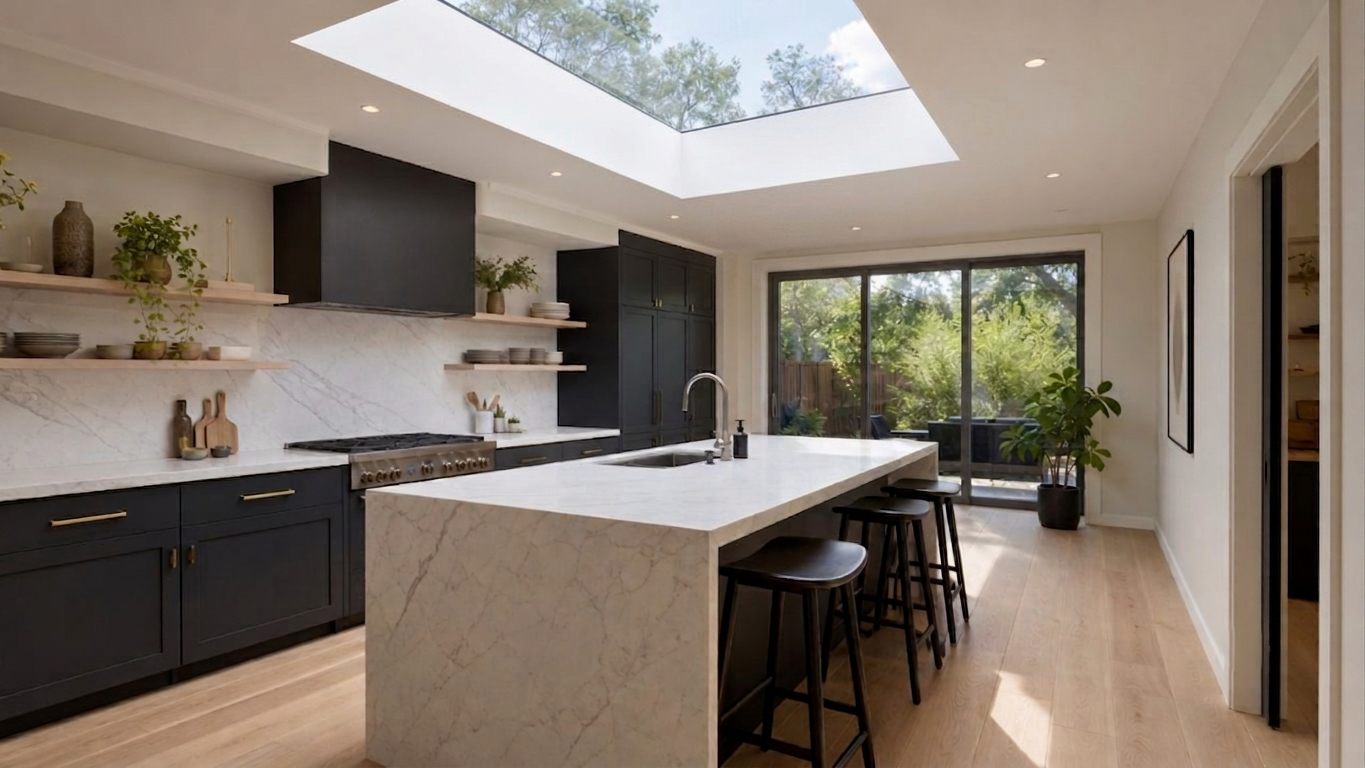
You know the moment. Dinner's done, the pans are off, but the kitchen still feels heavy. Steam hangs near the ceiling, yesterday's fish curry seems to have moved into the curtains, and the rangehood has done only part of the job.
That's where kitchen skylight ventilation changes the experience of the room. A skylight that opens at roof level doesn't just add daylight. It gives hot, stale, moisture-laden air somewhere to go. In a working kitchen, that matters more than is generally understood.
For many homes, the key upgrade isn't more extraction at benchtop height. It's creating a high-level escape point so heat and odours can leave naturally while fresh air comes in below. That's why an electric venting skylight suits kitchens so well.
Table of Contents
Beyond the Rangehood A Smarter Way to Ventilate Your Kitchen
The Secret to a Fresh Kitchen Understanding the Stack Effect
Beyond the Rangehood A Smarter Way to Ventilate Your Kitchen
A rangehood is important. It captures grease, smoke, and some of the mess right where cooking starts. But anyone who cooks often knows the limitation. The room can still stay warm, damp, and stale long after the cooktop is off.
That happens because the air that escapes the rangehood doesn't vanish from the rest of the kitchen. Steam drifts upward. Heat collects at ceiling level. Odours spread beyond the immediate cooking zone and settle into soft furnishings, hallways, and adjoining living spaces.
What a high-level opening changes
An operable skylight deals with the part of the problem a rangehood misses. It vents from the highest point in the room, where warm, moist air naturally gathers. That makes it a practical partner to a standard exhaust system, not a replacement for one.
Independent research into natural ventilation and cooking emissions found that fully opened windows and internal doors reduced average cooking-related PM2.5 exposure by up to 58% under the best-ventilated setup, supporting the value of stronger air pathways during and after cooking (research on natural ventilation and cooking-related PM2.5). An operable skylight follows the same logic, but adds a direct high-level outlet where polluted warm air wants to rise anyway.
Practical rule: Source capture handles the cooking surface. High-level venting clears the rest of the room.
That distinction is why kitchens feel different once roof-level ventilation is added. The room doesn't just smell better. It resets faster between meals.
Better comfort, not just less smell
Most homeowners start by asking about odours. The bigger win is often comfort. A kitchen that can dump trapped heat and moisture feels easier to work in, especially in homes where cooking, dining, and living areas all connect.
If you're already thinking about the wider issue of home air quality, a kitchen is one of the first rooms worth fixing because it generates heat, moisture, particles, and smells every day. A roof opening gives those byproducts a clear exit path without relying only on a wall fan or an open back door.
For examples of how this works in rooflight design, skylight ventilation options show the kind of high-level opening that suits active rooms like kitchens.
The Secret to a Fresh Kitchen Understanding the Stack Effect
The reason operable kitchen skylights work so well is simple physics. Warm air is lighter than cool air, so it rises. In a kitchen, that rising air carries steam, heat, and cooking odours with it.
Open a skylight at the top of the room and you create an escape route exactly where that air is already heading. Fresh air then enters from lower openings such as a window, door, or adjoining room. That movement is called the stack effect.

How the airflow cycle works
Think of it as a loop:
Cooking warms the air near the cooktop, oven, and benchtops.
That air rises and gathers near the ceiling.
An open skylight releases it at the highest point.
Replacement air enters below, which keeps the cycle moving.
The result is a quiet, natural exchange of air. You're not trying to force everything sideways. You're working with the way a kitchen already behaves.
Hot, damp air doesn't need convincing to leave. It needs an opening in the right place.
Why roof-level venting feels more effective
Low-level openings help, but they don't remove ceiling-level heat nearly as efficiently. That's why some kitchens still feel stuffy even with a window open. The cooler incoming air may help the room, yet the warmest air can still sit above head height unless there's somewhere high for it to escape.
That's also why an operable ventilating skylight changes the feel of the room so quickly. You're giving the hottest, wettest air the shortest path out.
Mechanical extraction still has its place. But for general room freshness, the stack effect is one of the smartest forms of kitchen skylight ventilation available because it uses the room's natural air movement rather than fighting it.
Why an Electric Opening Skylight Is Your Best Choice
Not every skylight solves the same problem. Some add daylight only. Some open when needed. Some suit low-use spaces better than busy kitchens. If ventilation is the priority, the decision becomes much clearer.
A fixed skylight improves brightness and visual openness, but it won't release steam or cooking smells. A solar operable unit adds ventilation and can be a smart option where solar operation suits the home. In kitchens, though, many people want instant control every time they boil pasta, sear meat, or run the oven hard. That's where an electric venting skylight stands out.
Kitchen Skylight Options at a Glance
| Feature | Fixed Skylight | Solar Operable | Electric Operable (Recommended) |
|---|---|---|---|
| Daylight | Yes | Yes | Yes |
| Ventilation | No | Yes | Yes |
| Immediate opening during cooking | No | Yes | Yes |
| Best suited to active moisture and odour control | No | Yes | Yes |
| Push-button convenience | No | Yes | Yes |
| Strong fit for busy kitchens | Limited | Strong | Strong |
Why electric suits the kitchen routine
Kitchens are reactive spaces. You don’t always know in advance when you’ll need extra venting. Steam can build quickly. A smoky pan can happen in seconds. A room that felt comfortable five minutes ago can suddenly feel hot and damp.
That’s why electric operation is so practical. Press a button and the skylight opens immediately. You’re not relying on manual access, and you’re not treating ventilation as something you’ll deal with later.
For homes considering a purpose-built option, electric opening skylight models are designed for this kind of convenient day-to-day control. Vivid Skylights supplies double-glazed fixed and operable skylights, including electric and solar-powered units, with Australia-wide delivery.
Where fixed and alternative options still fit
Fixed skylights still make sense when the room already has strong ventilation and the main goal is daylight. They’re also useful when budget, roof layout, or existing extraction already solves the airflow issue.
There’s another category worth mentioning when a traditional roof opening isn’t feasible. An LED skylight effect can still improve the feel of the space. Vivid’s AuraGlow LED range is intended for locations where a conventional skylight can’t be installed, creating a skylight-like light effect that changes colour through the day. It won’t provide airflow, but it can soften the compromise when structure prevents a real roof penetration.
In a kitchen, convenience isn’t a luxury feature. It’s what determines whether ventilation gets used every day.
Designing for Performance Skylight Placement and Sizing
A venting skylight does its best work when placement supports the stack effect. Warm, moisture-laden air rises. Give it a high exit point, and the kitchen clears faster and feels less heavy after cooking.
Put the opening where rising air can actually escape
The highest practical point in the ceiling usually gives the strongest result. In a raked ceiling, that often means near the top of the slope. In a flat ceiling, a central position can work well, provided the opening still sits where heat and steam collect rather than off to one side for symmetry.
I see one mistake often. The skylight gets positioned mainly for the view from the island or to centre it over cabinetry. That can look tidy, but kitchens are working rooms. If the opening sits too low, or too far from the hottest part of the air mass, you lose a good part of the ventilation benefit.
A few placement rules help keep the design honest:
Choose height first: Higher openings release trapped heat and steam more effectively.
Map the airflow path: The skylight works best when air can enter from a lower window, door, or nearby opening.
Keep some distance from the cooktop unless there is a clear reason to centre it there: You reduce grease build-up on the glass and frame.
Consider the whole room volume: In open-plan kitchens, place the skylight to pull stale air from the broader space, not only the bench zone.
For practical examples, skylights in kitchen layouts show how location changes both daylight spread and ventilation performance.
Size for airflow and comfort, not just daylight
A larger skylight brings in more sky, but size has to match the room and the exposure. Too small, and the ventilation effect is modest. Too large, and the kitchen can pick up more glare and solar heat than you want, especially on western or unshaded roof planes.
Earlier guidance from the U.S. Department of Energy suggests keeping skylight area modest in bright rooms and allowing a larger proportion in darker rooms. That principle still holds. The target is balance. In kitchens, the best results usually come from sizing the unit around how much air you want to exhaust, how much daylight the room lacks, and how much summer sun the glazing will catch.
A good design review looks at these trade-offs:
Window-rich kitchen: Keep the skylight moderate and let the opening function do more of the work.
Internal or darker kitchen: A larger unit may be justified, but glazing and blinds matter more.
High sun exposure: Solar control glass can matter as much as venting capacity.
Large open-plan area: Size for the air volume you are trying to purge, not only the cooking footprint.
If you are weighing glass performance at the same time, SouthRay’s advice on window replacement is a useful reference point for understanding how better glazing affects heat transfer and day-to-day comfort.
This walkthrough gives a useful visual sense of how roof openings can shape the room:
Roof pitch changes the result
Roof geometry affects both light and heat. A skylight on a low-pitch roof receives sun differently from one on a steeper plane, and the shaft depth below it can change how light spreads into the kitchen. Those details also influence how naturally the opening will sit at the high point of the room, which matters for stack-effect ventilation.
For solar performance, standard skylight guidance often points to a slope roughly 5° to 15° greater than local latitude. In Melbourne, that works out to roughly 42.8° to 52.8°. It is a useful benchmark, not a fixed rule. On real projects, ceiling form, orientation, roof framing, and how the kitchen is used usually decide the final setup more than any single number.
Essential Features for a Flawless Kitchen Installation
A kitchen installation succeeds or fails on details. The opening function matters, but so do the accessories and glazing choices around it. Without those, a skylight can solve one problem while introducing another.
The features that solve real kitchen problems
For kitchens where steam and humidity build quickly, an opening skylight with a rain sensor is the most practical setup because the unit can ventilate unattended and close automatically in bad weather (kitchen skylight rain-sensor guidance).
That one feature changes how people use the skylight. They’ll leave it open during normal kitchen activity because they aren’t worried about a sudden shower while they’re busy elsewhere in the house.

Other features matter just as much in Australian conditions:
Fly screens: These stop ventilation from becoming an open invitation to insects.
Block-out blinds: Useful where sun exposure is harsh and you want better control over glare and warmth.
Double glazing: Helps moderate temperature swings and supports a more stable indoor feel.
Self-cleaning glass and water-shedding design: These reduce maintenance headaches on roof glazing.
The right kitchen skylight doesn’t just open. It manages weather, insects, light, and day-to-day upkeep.
Why glazing and accessories matter together
A common under-answered question is whether a kitchen skylight improves ventilation or just adds heat and glare. The honest answer is that it can do either, depending on specification. Large glazed areas can contribute to overheating unless solar control, blinds, or other ventilation paths are part of the design.
That’s why the full system matters more than the opening panel alone. Good ventilation performance should be paired with controls that make the skylight comfortable in summer, practical in rain, and easy to live with all year.
If you’re comparing overhead glazing with vertical window upgrades, SouthRay’s advice on window replacement is a useful parallel because it highlights how glass specification affects comfort, insulation, and condensation behaviour across the home, not just in one opening.
Installation Codes and Common Questions
Most homeowners ask the same final questions. Will it leak. Will it make condensation worse. Can it work with the roof I already have. Those are sensible questions, because kitchens are demanding spaces.
The practical answer is that product choice and installation quality do most of the heavy lifting. A well-designed skylight system with the correct flashing, glazing, and opening controls is a very different thing from an old acrylic dome or a poorly detailed retrofit.
Does a skylight make condensation worse
In a kitchen, condensation usually starts with warm moist air from cooking meeting a cooler surface. An opening skylight helps by giving that moisture a way out. Guidance on kitchen and bathroom skylights notes that a venting skylight can reduce this problem because it provides an escape path for the warm, damp air that causes condensation on windows and other cool surfaces.
That doesn’t mean a skylight should be treated as the only moisture-control tool in the house. Condensation management works best when the whole system is considered. Rangehoods, exhaust fans where needed, vented appliances, and usable roof-level ventilation all play a part.
What about installation and homes that can’t take a traditional skylight
Roof type, ceiling construction, and local requirements all affect installation. Many units are supplied with flashing kits for tiled roofs, and some projects suit a capable DIY installer while others are better handled by a roofing or building professional. For Australian homeowners trying to understand broader compliance issues, roof ventilation requirements in Australia are worth reviewing alongside the skylight decision.
If a conventional skylight can’t be installed because of structure or access, that doesn’t mean the room has to stay gloomy. A non-venting alternative such as an LED skylight effect can still improve the feel of the kitchen, even though it won’t provide the airflow benefits of an operable unit.
The bigger point is simple. If your kitchen regularly traps steam, cooking smells, and heat, an electric opening skylight is one of the most effective upgrades you can make because it tackles the problem at ceiling level, where the stale air is already collecting.
If you’re weighing options for a brighter, fresher kitchen, explore the range at Vivid Skylights. You can compare fixed, solar-powered, and electric opening skylights, look at installation examples, and use the online pricing estimator to work out what suits your home.