

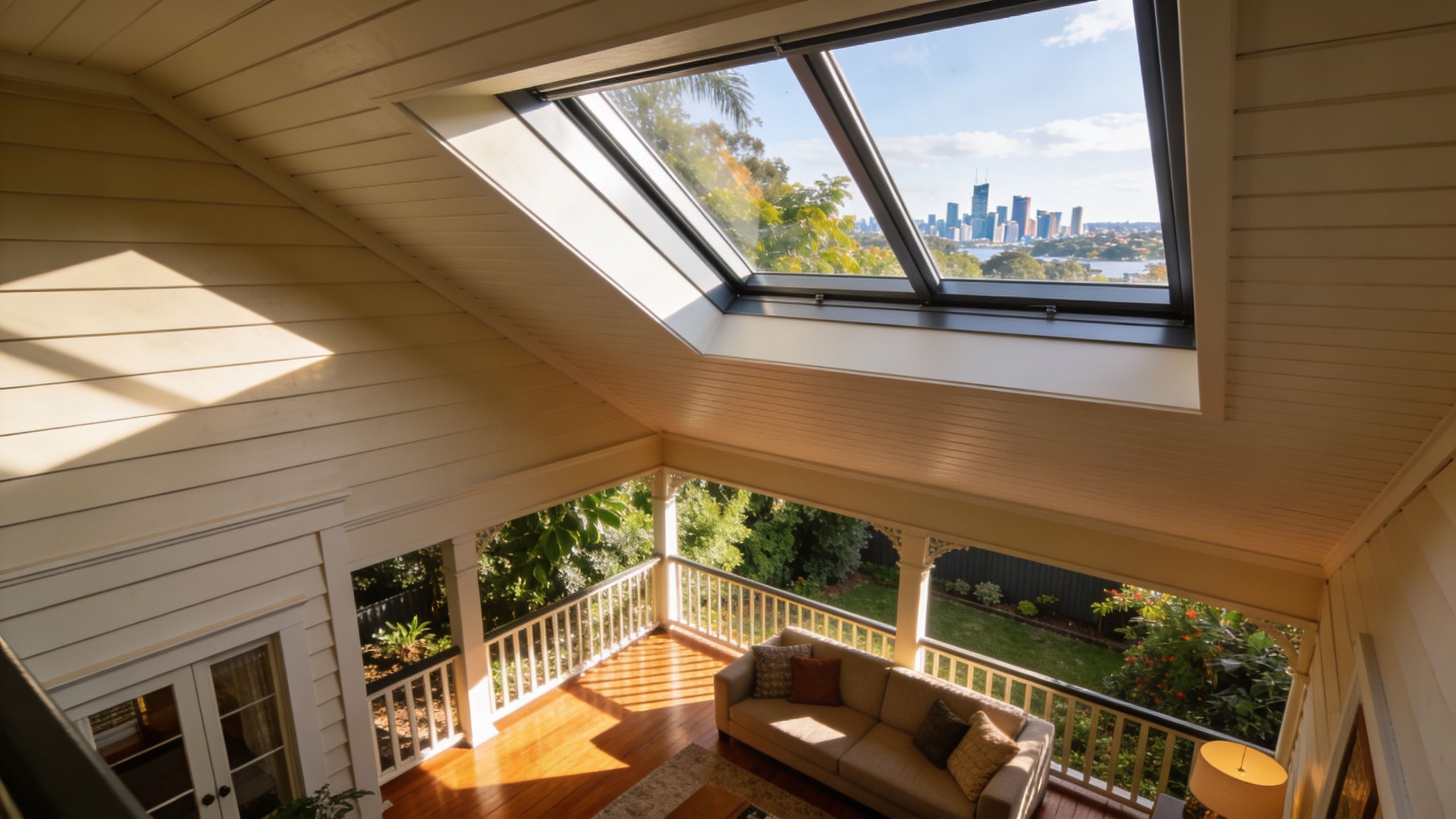
If you're in Ascot, Hendra, Chermside, or nearby Northside suburbs, there's a good chance your home has one beautiful feature and one frustrating flaw at the same time. Queenslanders, post-war cottages, and extended family homes often have great street appeal, but the middle of the house can stay dim all day. Hallways need lights on at noon. Bathrooms feel closed in. Kitchen renovations fix finishes, but not the lack of daylight.
That's where good skylight design changes the feel of the house without changing its character. Done properly, skylight installation Brisbane Northside homeowners benefit from isn't about cutting a hole and hoping for the best. It's about matching the unit to the roof type, protecting the weatherproofing, and respecting older architecture so the result looks intentional, not tacked on.
Table of Contents
Brightening Your Brisbane Northside Home
Northside homes have their own rhythm. A raised Queenslander in Ascot might have deep rooms under a broad roofline. A post-war cottage in Chermside often has practical additions at the back that leave the centre of the floorplan short on daylight. Even renovated homes can end up with bright perimeter rooms and gloomy internal zones.
That's why skylights work so well in this part of Brisbane. They bring light into the middle of the home, where side windows can't help much, and they do it without asking you to give up privacy or wall space.

Why Northside homes often feel darker than they should
Older Brisbane houses weren't always designed around today's open-plan living. Many were built for cross-ventilation, verandah shade, and practical room separation. Once those homes are enclosed, extended, or reconfigured, the original light balance changes.
Skylights have been part of Brisbane homes for over 30 years, with early tubular systems in use since 1993. Modern double-glazed units build on that history and can offer 80% heat reduction, which matters in Brisbane's subtropical climate where solar gain can quickly make a bright room uncomfortable, as noted by Brisbane skylight specialists.
Practical rule: In older Northside homes, the best skylight position is rarely the biggest open roof area. It's the part of the roof that feeds light into the darkest part of the plan without fighting the structure.
For homeowners who are still weighing up whether the change is worth it, these practical skylight benefits line up closely with what most Northside renovations are trying to achieve. More usable light, less daytime reliance on switches, and a home that feels more open without losing privacy.
Retrofitting without stripping the home of character
The concern I hear most with Queenslanders and character homes is simple. Will it look wrong?
A well-planned retrofit shouldn't. On a traditional roof, the skylight should sit comfortably within the roof geometry, not dominate it. Inside, the shaft depth, ceiling finish, and trim matter just as much as the unit itself. If the detailing is clumsy, even a high-quality skylight can feel out of place.
On heritage-sensitive homes in Hendra or Ascot, subtle placement is usually the smart move. Rear roof planes, lower-visibility sections, and restrained sizing often preserve the street presentation while still giving you real daylight where you need it most.
Choosing the Perfect Skylight for Your Home
Not every room needs the same kind of skylight. A hallway has different needs from a kitchen. A bathroom in a post-war cottage has different constraints from a raked-ceiling living room in a renovated Queenslander. If you match the unit to the room, the result feels effortless. If you don't, you'll either overspend or live with a compromise.

Fixed skylights for clean daylight
A fixed skylight is usually the right starting point when your goal is simple. Bring in strong, even light and keep the roof assembly straightforward. In living rooms, kitchens, stairwells, and central corridors, fixed double-glazed units often give the cleanest finish.
In Brisbane's climate, SHGC matters. High-performance fixed double-glazed skylights with a U-value below 2.0 W/m²K can cut cooling bills by 15% to 25% through daylight harvesting, with a payback of under 5 years in NatHERS modelling, according to The Roofing Group's Brisbane skylight guidance.
That's one reason fixed units often make more sense than homeowners expect. They don't just brighten a room. They can also be the more efficient long-term option when selected properly.
Operable skylights for airflow and humidity control
If the room traps heat or moisture, opening function starts to matter. Bathrooms, laundries, upper-level bedrooms, and kitchens benefit from ventilation, especially through a Brisbane summer when humidity lingers indoors.
There are a few practical trade-offs:
Manual opening units suit spaces where the skylight is within easy reach or where the budget needs tighter control.
Electric opening units make more sense in higher ceilings or where convenience matters day to day.
Solar-powered opening units are useful when homeowners want operability without chasing extra wiring complexity.
Some homeowners also want extras such as fly screens, block-out blinds, or rain-sensing operation. Those features can be worth it if the room is used every day. They're less important in a hallway or void where the unit is mainly there for daylight.
AuraGlow LED skylights where a roof window is not possible
Some rooms won't take a conventional skylight. That's common on lower floors, in apartments, under concrete slabs, or in renovation layouts where a shaft would be awkward, bulky, or visually messy.
That's where the AuraGlow LED skylight approach fits. It gives the visual effect of a skylight and shifts colour through the day to mimic the changing sky. It isn't a substitute for real roof daylight, but in the right location it solves a very real design problem. Bathrooms, dressing rooms, internal corridors, and rooms boxed in by structure are typical examples.
One option in this category is Vivid Skylights' range of fixed and operable skylights, which also includes electric, solar-powered, and AuraGlow LED models delivered across Australia. The key is choosing by room function first, not by catalogue appeal.
| Skylight Type | Best For | Key Feature |
|---|---|---|
| Fixed skylight | Living areas, kitchens, hallways | Consistent natural light |
| Manual opening skylight | Bathrooms, laundries, reachable ceilings | Ventilation with simple control |
| Electric opening skylight | High ceilings, premium renovations | Convenient remote operation |
| Solar opening skylight | Homes where wiring access is limited | Ventilation with less electrical disruption |
| AuraGlow LED skylight | Areas where roof installation isn’t feasible | Simulated skylight effect with changing colour |
A skylight should solve a room problem. If it only looks good on a brochure, it's the wrong unit.
Navigating Brisbane Council Rules and Building Codes
The right skylight can still become the wrong project if the planning side is ignored. That happens most often on character homes, homes in bushfire-affected areas, and renovations where nobody checks the roof conditions until after the product has been chosen.
Character homes and heritage-sensitive planning
Ascot and Hendra have plenty of homes where appearance matters just as much as performance. Some are formally heritage-listed. Others sit in traditional character areas where visible roof changes need a more careful approach. Even when formal approval isn't required, a poor placement decision can create unnecessary problems later.
For those homes, these checks come first:
Roof plane visibility: Front-facing roof changes attract more scrutiny than rear or concealed locations.
Existing structure: Older framing can be irregular, and that affects both placement and shaft design.
Ceiling form: Decorative ceilings, timber boards, and original cornices often limit where the opening should go.
Neighbour impact: Overlooking, reflected glare, and visual bulk can all matter on tighter sites.
If you're trying to keep the home's original feel, restraint usually wins. Smaller, well-positioned skylights often look far more sympathetic than oversized units dropped into the most obvious roof area.
Bushfire compliance on the Northside
Northside owners sometimes assume bushfire rules only apply further out. That's a mistake. In Moreton Bay and nearby areas, skylight installations may need to comply with AS 3959, and 40% of homes are in BAL-12.5+ zones, which can require non-combustible framing and ember screens, according to Roof Space Renovators' Brisbane North guidance.
That detail matters because many generic product listings don't explain it clearly. A skylight might look suitable on paper but still need different framing, screening, or documentation for local compliance.
If your home sits near bushland or in an overlay area, don't choose the skylight first and ask compliance questions later. Check BAL requirements before the roof opening is marked.
Homeowners who want a clearer starting point should review Brisbane City Council skylight regulations before ordering. It's much easier to adjust the specification early than to deal with a rejected plan or a non-compliant installation after the roof has been cut.
What to Expect from a Professional Installation
Most homeowners aren't worried about the glass. They're worried about leaks. Fair enough. In Brisbane, a skylight has to survive heat, storm pressure, and heavy rain. The installation standard decides whether it performs reliably for years or becomes the roof penetration everyone regrets.
How the opening is set out and framed
A professional job starts from inside. The installer marks the location carefully, confirms alignment with rafters and ceiling layout, then creates the opening without compromising the surrounding structure.
Local installer data shows 85% of skylight leaks in Australia stem from incorrect framing or flashing. Proper installation uses H3 treated pine for framing and step flashings overlapped by 150mm, delivering a 99.5% leak-free success rate under warranty, as outlined by Vivid Skylights' Brisbane installation guidance.
That's the difference between trade process and guesswork. A professional isn't just making the skylight fit. They're making the roof continue to work after the skylight goes in.
Why flashing quality matters more than most people realise
On tiled roofs common across post-war Northside suburbs, flashing has to work with the tile profile, not against it. On corrugated roofs, the challenge is different but just as critical. The flashing kit needs to shed water naturally, sit cleanly, and integrate with the roof finish without creating weak points.
A proper install usually includes:
Accurate rough opening preparation so the unit isn't twisted or stressed once fixed in place.
Correct sill, side, and head flashing sequence so water is directed away in the right order.
Clean roof integration with no forced cuts, loose edges, or improvised sealant-only fixes.
If you're managing a wider renovation, it's also worth understanding how site risk is handled on building materials and partially installed components. For that, construction installation floater policies are a useful reference, particularly when skylights are delivered before the roof work is fully completed.
A visual walk-through helps if you want to see how the process comes together on site.
What a tidy install day should look like
A good installer should leave you with clarity, not confusion. You should know where the unit is going, what internal disruption is expected, and whether plaster repair or painting is part of the scope.
For most homeowners, the signs of a professional approach are practical:
Clear internal protection: Floors and nearby furniture are covered before cutting starts.
Neat roof work: Tiles or sheets are handled carefully, not cracked, bent, or forced.
Defined handover: You're shown the opening function, any blinds or controls, and what to watch during the first rain event.
If you want the full process spelled out before you book, this installation overview is the right place to start.
Budgeting for Your Brisbane Northside Skylight
The first pricing question most homeowners ask is fair. What's this going to cost me?
The honest answer is that the final figure depends less on the word “skylight” and more on the roof, the room below, and the installation conditions. A fixed unit in a simple position is one thing. An operable unit in a steep older roof with shaft work, access constraints, and finishing trades is another.
What actually changes the final price
These are the factors that usually move the quote:
Skylight type: Fixed units are simpler than operable models with electrical or solar components.
Roof material and pitch: Tiled roofs, older corrugated profiles, and steep pitches take more care.
Structural adjustments: Older homes sometimes need framing changes before the opening can be formed properly.
Ceiling depth and shaft finish: A deep shaft with a good plaster finish takes more labour than a direct install into a simple ceiling line.
Access: Two-storey homes and awkward sites change installation logistics.
Heritage-sensitive homes can also cost more to handle properly, not because the work is impossible, but because the placement and detailing need more thought.
Why the cheapest quote often costs more later
A low quote usually strips out something important. Sometimes it's flashing quality. Sometimes it's interior finishing. Sometimes it's the time needed to deal properly with an older roof structure. Those shortcuts don't always show up on day one, but they tend to show up eventually.
The smarter way to budget is to compare scope, not just totals. Ask what's included, what roof type the quote assumes, whether plastering is covered, and who is responsible if structural changes are needed once the roof is opened.
If you want a clearer planning number before speaking to an installer, this skylight installation cost estimator is a practical next step. It helps narrow the range based on your roof and the type of unit you're considering, which makes early budgeting far more realistic than guessing from generic online figures.
Frequently Asked Questions
A few concerns usually come up right before someone is ready to book. These are the ones I hear most often on the Brisbane Northside.
| Question | Answer |
|---|---|
| Will a skylight make the room too hot in summer? | Not if the unit is chosen properly for Brisbane conditions and placed well. Glazing performance, roof orientation, and shaft design all matter. |
| Can a skylight be added to a Queenslander without ruining the look? | Yes, if the position is selected with the roofline and street presentation in mind. Rear roof planes and discreet placement usually work best. |
| Are operable skylights worth it? | They are in rooms that trap moisture or heat, such as bathrooms, laundries, and upper-level spaces. In rooms used mainly for daylight, fixed units are often the cleaner choice. |
| What if a normal skylight can’t be installed? | An AuraGlow LED skylight can suit rooms where a roof opening or shaft isn’t practical, while still giving the visual effect of overhead light. |
| Do I need council approval? | Sometimes. Character overlays, heritage issues, and bushfire-related requirements can affect the answer, so the property should be checked before work starts. |
| Can products be supplied outside Melbourne? | Yes. Some suppliers deliver skylights nationwide, which is useful if you’re organising your own installer in Brisbane. |
If you're planning skylight installation Brisbane Northside and want a practical next step, Vivid Skylights offers fixed, electric, solar-powered, and AuraGlow LED options with Australia-wide delivery. Start with the product range and pricing tools, then match the unit to your roof, your room, and the level of finish your home deserves.