

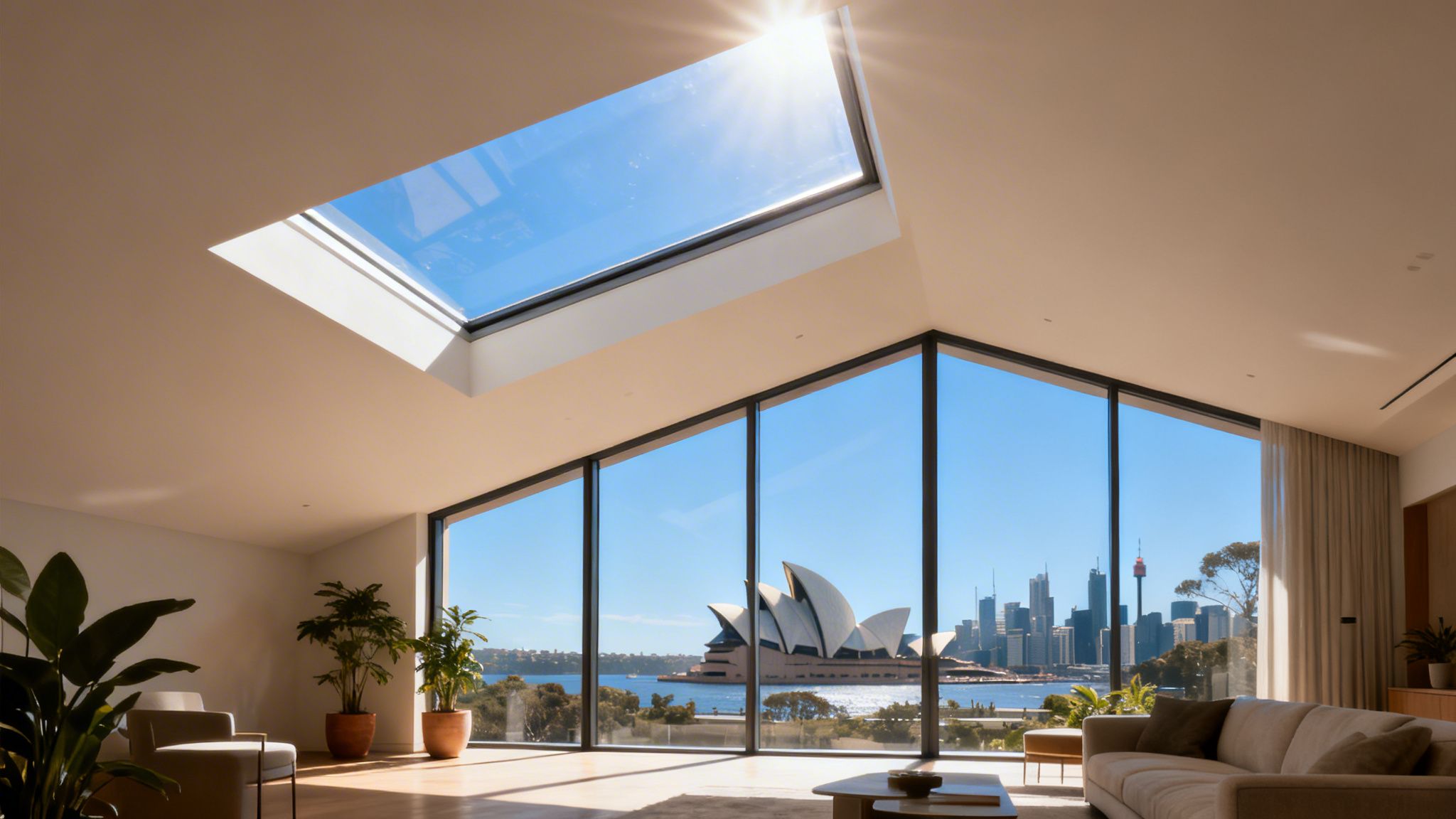
You want more daylight, but you don't want to turn the house into a hot box by November or deal with a ceiling stain after the first proper summer storm. That tension is exactly why so many Brisbane homeowners hesitate on skylights for too long.
It's simple: Best skylights Brisbane isn't really about finding the prettiest unit or the cheapest quote. It's about choosing a roof window system that suits a hot, humid climate, heavy rain, and the roof type already on your home. Done well, a skylight can make a dark hallway, kitchen or living area feel open and usable. Done badly, it can add glare, heat, and maintenance headaches.
Modern skylights are a different category from the old acrylic dome mindset. The better systems are engineered around glazing, frame performance, roof pitch, and flashing. If you're comparing options for a Queensland home, that's where the real decision sits, not in brochure photos.
Table of Contents
Choosing the Best Skylights for Your Brisbane Home
A lot of Brisbane homes have the same problem. The middle of the house is dim, the hallway needs lights on during the day, or the kitchen feels closed in despite having a decent footprint. A skylight looks like the obvious answer, but many homeowners worry it will also bring heat, glare, and leak risk.
That concern is reasonable. Roof glazing sits in the hardest-working part of the building envelope. It cops direct sun, wind-driven rain, leaf debris, and the movement that comes with Queensland roofs heating up and cooling down. That's why the right skylight behaves less like a simple pane of glass and more like a well-sealed roof system.

A good Brisbane installation starts with climate logic. You want daylight, but you want it filtered through materials and details that control heat and water. That's why homeowners comparing options often start with a Brisbane skylight guide rather than a style catalogue alone.
Practical rule: If a skylight is being chosen mainly by price or appearance, you're usually missing the two things that matter most in Brisbane, thermal performance and flashing quality.
The best result usually isn't the biggest unit you can fit. It's the unit that suits the room, the roof pitch, the roof covering, and the sun it will receive across the year. That's the difference between a skylight that improves the house and one that becomes something you manage.
Beyond Light Beating Brisbane's Heat and Humidity
Brisbane is unforgiving on weak skylight design. The roof plane takes much higher solar loading than a wall window, so any skylight that isn't specified properly can admit more heat than homeowners expect. That's the core trade-off in South East Queensland. You want usable daylight, not a bright patch on the floor that comes with a hotter room.
Australian product guidance aimed at Brisbane conditions makes that point clearly. In this climate, the better skylights are the ones that reduce unwanted solar heat gain while preserving daylight, and guidance also emphasises compliance with AS/NZS 4284 for weatherproofing in heavy rain conditions. The same guidance notes that high-performance systems commonly pair double glazing with thermally improved frames because skylights face higher solar loading than vertical windows, which is especially relevant in Brisbane's wet season and long warm periods (Brisbane climate skylight guidance).

Why standard units struggle here
A basic skylight often fails in three ways.
Heat gain: Single-skin or poorly insulated units let in daylight, but they also let the roof's solar load push deeper into the room.
Condensation and humidity stress: In humid weather, weak thermal separation can create moisture issues on cooler internal surfaces.
Storm vulnerability: A skylight is only as good as its flashing and roof integration when the rain turns sideways.
Think of glazing as sunscreen for the opening in your roof. Clear light still gets through, but the wrong glass lets too much heat ride in with it. Think of flashing as the raincoat. If it doesn't fit the roof properly, water will eventually find the gap.
What works better in South East Queensland
For most Brisbane homes, high-performance skylights need to do four jobs at once:
Bring in daylight without excessive solar load
Seal reliably during heavy rain
Suit the actual roof material and pitch
Hold up in a humid environment over time
That is why many homeowners look specifically at energy-efficient skylights for Queensland climate conditions. The climate is doing the screening for you. If the product isn't built for heat, moisture and storm-proofing, it isn't the right product.
A skylight in Brisbane should never be treated as a decorative cut-out in the roof. It has to perform like part of the roof.
Fixed vs Operable Skylights What's Right for You
The best skylight type depends less on taste and more on what the room needs to do every day. Some spaces only need daylight. Others need daylight plus airflow. And some areas can't take a conventional roof opening at all, which is where alternative ceiling light systems become useful.

A straightforward way to sort it is to match the skylight to the room problem. If you want more detail on that decision, this guide to fixed vs opening skylights for Brisbane homes is a useful reference.
Fixed skylights for pure daylight
Fixed skylights are usually the cleanest answer when ventilation isn't the goal. They're well suited to hallways, stairwells, living spaces, and parts of the home where you mainly want to replace daytime artificial lighting with natural light.
Their strength is simplicity. Fewer moving parts generally means a cleaner visual line and a simpler roof penetration. In practical terms, fixed units make sense when the room already has decent airflow from windows, doors, or mechanical systems.
Use a fixed skylight when the room needs:
Consistent daylight: Hallways and central living zones benefit most.
Minimal interaction: No opening hardware means nothing for the homeowner to operate day to day.
A simpler roof solution: This can be useful on straightforward roof sections where access is awkward but not impossible.
Operable skylights for airflow and moisture control
If the room gets steamy, stuffy, or overheated, a venting skylight earns its keep. Bathrooms, laundries, kitchens, and upper-level rooms are the obvious candidates because warm air naturally rises. Opening the roof glazing gives that hot air somewhere to go.
Electric and solar-powered units are particularly practical. Ceiling height matters. If the skylight is out of reach, a manual winding mechanism quickly becomes something people stop using. Remote operation is easier, so it gets used.
Later in the decision process, it's worth watching a real installation overview:
Some homeowners also want rain-sensing operation. That feature matters in Queensland because a venting skylight that stays open in a sudden storm can undo a lot of good planning very quickly.
On-site advice: If a room regularly traps heat or moisture, a fixed skylight solves only half the problem.
LED alternatives for difficult spaces
Not every dark room can take a traditional skylight. Roof framing conflicts, service runs, apartment conditions, or ceiling layouts can rule it out. In those cases, an LED skylight-style fitting is often the more realistic answer.
Vivid Skylights offers double-glazed fixed and operable skylights, including electric and solar-powered opening models with Australia-wide delivery, and it also offers the AuraGlow LED skylight range for spaces where a conventional skylight can't be installed. AuraGlow is designed to project light in a way that reads similarly to a skylight and changes colour through the day to create the impression of an evolving sky.
That last category isn't a substitute for roof glazing in every room, but it is a practical design tool. If you have a walk-in robe, internal corridor, lower-floor room, or a location blocked by structure, it's often better to use a convincing ceiling light solution than to force a poor skylight installation.
Key Features for a High-Performing Brisbane Skylight
A skylight quote can look impressive while hiding the details that decide whether the installation performs well in Queensland. The parts that matter most aren't always the parts that get the biggest marketing headline.
Start with glass area, not guesswork
Sizing should begin with the room, not with what seems visually balanced from the street. For residential sizing in Australia, skylight selection is commonly benchmarked by room area and required glass area. One Australian guide gives a useful reference point. A 10 m² room may need roughly 1.0 to 2.0 m² of skylight glass area, with examples including 78 x 140 cm or 114 x 118 cm units, while a 25 m² room may require two 94 x 160 cm units (Australian skylight sizing guide).
The same guide also notes representative size and price bands. Fixed skylights commonly range from about 550 mm x 700 mm to 1140 mm x 1180 mm, with estimated unit prices around AUD 700 to 1,500, while electric-opening models generally span 550 mm x 780 mm to 1140 mm x 1400 mm and cost about AUD 2,000 to 3,000+ in that guide.
That doesn't mean bigger is better. More glass increases daylight, but it also increases the importance of glazing quality, orientation, and installation detail. In Brisbane, one oversized skylight can create a harsher result than two smaller, better-positioned units.
The features that actually matter
If you're reviewing product specs, focus on these items first.
| Feature | Why it matters in Brisbane |
|---|---|
| Double glazing | Helps reduce heat transfer through the roof opening |
| Low-e coating | Cuts radiant heat gain while preserving useful daylight |
| Thermally improved frame | Reduces the weak points around the glass edge |
| Roof-specific flashing | Essential for tiled and corrugated metal roofs |
| Pitch compatibility | Makes sure water sheds properly instead of lingering around the unit |
Flashing deserves extra attention. A good flashing kit should suit the roof covering and fall. Corrugated iron and tiled roofs behave differently when water runs across them, so the waterproofing detail needs to match the profile rather than being adapted on the fly.
Frame finish also matters more than people think. In Brisbane's humid conditions, powder-coated aluminium is usually the sensible choice because it handles exposure better than flimsy or poorly finished alternatives.
Don't judge a skylight by the glass alone. In Queensland, the frame and flashing often decide whether the installation stays trouble-free.
Why Modern Skylights Outperform Traditional Options in QLD
When homeowners compare products, they often think they're choosing between brands. In many cases, they're in fact choosing between generations of skylight technology.
Traditional skylights in Queensland usually means older acrylic domes, single-pane units, or simple roof lights that prioritise daylight entry but do little to control heat or improve sealing. Modern skylights are built around a different brief. They aim to manage comfort, not just brightness.
A common gap in Brisbane skylight information is that many pages talk about bright interiors without addressing whether a skylight will increase summer heat gain or cooling costs, especially in north- and west-facing rooms where limiting unwanted heat matters most in South-East Queensland (Brisbane skylight performance gap).

Durability and weather exposure
Acrylic and lightweight traditional units can be serviceable in the short term, but Queensland's sun and weather are hard on exposed materials. Over time, homeowners often notice yellowing, brittleness, or a generally tired look in older dome-style products.
Modern roof windows and skylights typically use tougher glazing systems and stronger frame materials. They also tend to integrate better with contemporary flashing kits, which matters on roofs that see intense rain and leaf build-up.
Light quality and comfort
Traditional skylights often produce harsher light. You get brightness, but not always comfort. Rooms can feel patchy, glary, or warmer than expected during peak sun.
Modern double-glazed units usually deliver a softer result. The daylight feels more controlled, more architectural, and less like direct sun has been poured through the ceiling. In real homes, that changes how often the room is used, especially in kitchens, family areas and upstairs spaces.
Installation on common Queensland roofs
Queensland homes commonly present two installation realities: corrugated metal roofs and tiled roofs. A modern skylight system is easier to integrate cleanly when it has flashing designed around those roof types. A generic or improvised solution can work for a while, but it leaves less margin for movement, water, and long-term wear.
Here's the honest comparison:
Traditional units often win on upfront simplicity.
Modern units usually win on comfort, weather sealing, and long-term liveability.
Poor installation can undermine both, regardless of product type.
That last point matters most. Even a good skylight becomes a bad investment if it isn't integrated correctly into the roof.
Your Guide to Installation and Choosing a Supplier
A skylight is one of those products where the buying decision and the installation decision are tied together. You aren't just selecting a unit. You're selecting a roof opening, a flashing method, a glazing specification, and the people responsible for fitting all of it without creating future problems.
If you're planning a local project, start with practical installation information for Brisbane skylight installation. Then assess whether your roof and room are straightforward enough for a simple install or whether the job needs a more experienced hand.
What to check before install day
Before anything is ordered, confirm these site conditions:
Roof type: Tiled and corrugated roofs need different flashing approaches.
Roof pitch: The skylight must suit the slope so water drains correctly.
Ceiling construction: Flat ceilings may need a shaft, while raked ceilings may not.
Room use: A bathroom, hallway and kitchen all place different demands on the unit.
Orientation: North- and west-facing roof sections need more care around heat and glare.
DIY can be viable for some experienced renovators, especially with simpler fixed units and accessible roofs. But if the roof is steep, the ceiling build-up is complex, or the flashing detail is non-standard, professional installation is usually the safer decision.
Questions worth asking any supplier
Not every quote answers the questions that matter. Ask these directly:
What glazing is included? Ask whether the unit is double glazed and whether it includes low-e glass.
Is the flashing roof-specific? "Universal" can sound convenient, but roof profile matters.
What roof pitch is the unit designed for? Compatibility affects drainage and waterproofing.
What is covered by warranty? Separate product and installation coverage if needed.
What accessories are available? Think blinds, fly screens, and powered opening options if relevant.
A supplier who can't explain flashing, glazing, and roof pitch in plain language usually isn't ready to advise on a Queensland install.
What a proper quote should include
A useful skylight quote should identify the unit type, size, glazing, flashing, roof compatibility, accessories, and installation scope. It should also make clear whether plastering, electrical work, painting, and internal shaft finishing are included or separate.
That's where many homeowners get tripped up. Two quotes can look similar at the top line, but one may exclude important work around finishing, electrical connection for powered units, or roof-specific flashing components.
Clarity matters more than a low first number. Skylights are visible every day. You want the finished result to look intentional from inside and remain secure from above.
Your Brisbane Skylight Decision Checklist
If you're narrowing down the best skylights Brisbane homeowners should consider, keep the decision practical.
Choose for climate first: In Brisbane, heat control and storm-proofing matter as much as daylight.
Match the skylight to the room: Fixed for light-only spaces. Operable for rooms that trap heat or moisture. LED alternatives where roof installation isn't realistic.
Check glazing before style: Double glazing and the right glass specification do more for comfort than cosmetic upgrades.
Insist on proper flashing: The roof type should drive the waterproofing detail.
Size by room area, not impulse: Oversized roof glass can create as many problems as it solves.
Read the maintenance side too: Cleaning access matters. If you want a practical reference, these Sparkle Tech Window Washing solutions are useful for understanding skylight cleaning considerations.
Confirm local requirements: Before you lock anything in, review Brisbane City Council skylight regulations so there are no surprises around approvals or compliance.
A good skylight should feel quiet in use. No drip worries in summer storms, no constant blind adjustment, no regret about where it was placed. That's the standard worth aiming for.
If you're comparing options for your home, Vivid Skylights is one place to review fixed, electric-opening, solar-powered, and LED skylight solutions, along with sizing information, installation guidance, and pricing tools for Australian homes.