

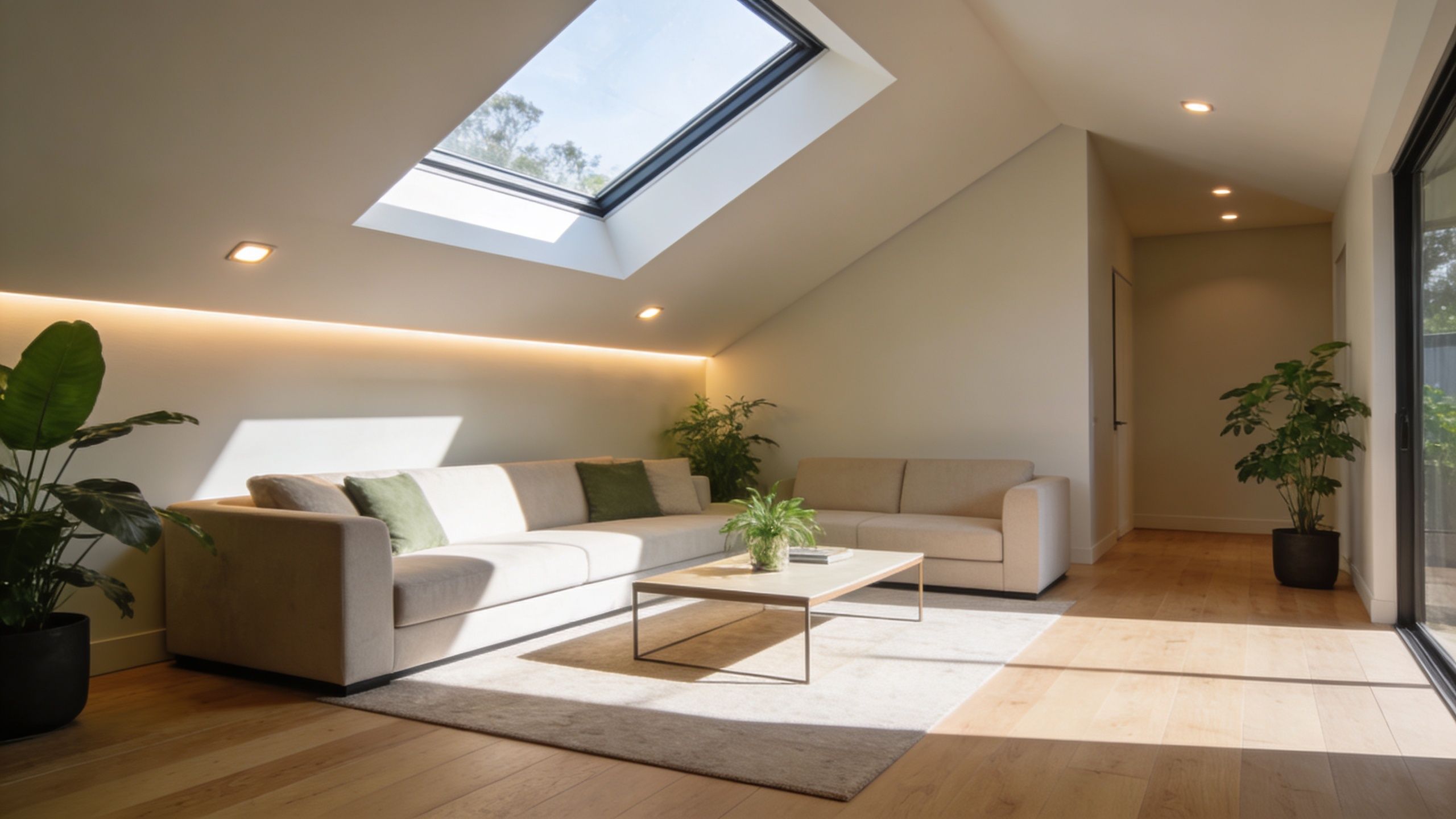
A lot of Australians start looking at lighting when a room feels wrong rather than when a fitting fails. It’s the hallway that stays gloomy all day. The kitchen island that looks flat by late afternoon. The bathroom with no window that always feels a bit boxed in, even after a renovation.
That’s why the best approach to lighting options australia isn’t picking one fitting and hoping for the best. It’s building layers. Daylight does the heavy lifting when the sun’s up, then efficient artificial light fills the gaps at night, in winter, and in task zones. Done well, the house feels brighter, calmer, and more expensive without looking overlit.
Table of Contents
Transforming Your Home from Dim to Dazzling
Most dim rooms have the same problem. They rely on one type of light to do everything. A single ceiling fitting is expected to handle daytime mood, night-time function, colour accuracy, and visual comfort. It can’t.
The better answer is a hybrid plan. Use natural light as the base layer where possible, then add artificial light where control matters. That usually means daylight for broad ambient light, LEDs for evening use, and targeted fittings for benches, vanities, desks, and feature areas.
That approach also lines up with where the Australian market is heading. The Australia lighting market was valued at AUD 13.51 billion in 2025 and is projected to reach AUD 30.55 billion by 2035, driven by stronger uptake of energy-efficient LED solutions and sustainable options such as skylights, according to Expert Market Research’s Australia lighting market report. Homeowners aren’t just buying fittings now. They’re making longer-term decisions about energy use, comfort, and resale appeal.
Start with the room, not the product
When I assess a home lighting plan, I usually look at three things first:
How the room is used. A kitchen needs different light from a retreat, even if they’re the same size.
When the room feels darkest. Some spaces are gloomy all day. Others only fail in the early morning or late afternoon.
What the ceiling and roof allow. A raked roof, a low-pitch section, or an internal room changes the shortlist quickly.
Practical rule: If a room is dark in the middle of the day, adding more downlights won’t solve the core problem. It will only make the ceiling busier.
Natural light also changes how finishes read. Timber looks warmer. Stone shows more depth. White paint stops looking dull. If you’re renovating and want ideas that improve daylight before you start cutting into ceilings, this guide on how to increase natural light in house is a useful place to begin.
Harnessing the Sun with Modern Skylights
Artificial light can make a room usable. Natural light can make it feel alive. That’s the difference homeowners notice straight away when a dark kitchen, hallway, or living zone gets daylight from above.
A ceiling fitting throws light into a room. A skylight changes the character of the room itself.

Why daylight changes a room faster than any fitting
Daylight from above spreads differently from light emitted by a globe. It reaches further into the centre of the room, lifts shadowy corners, and gives surfaces a cleaner, more natural look. That matters in homes where perimeter windows can’t adequately light the middle of the floorplan.
Modern double-glazed skylights stand apart from older acrylic domes and basic roof penetrations. Better glazing improves comfort. Better framing improves weather performance. Operable models also add ventilation, which can make a big difference in bathrooms, kitchens, and upper-floor rooms where heat builds up.
The financial case is stronger than many people expect. Integrating natural daylight solutions like double-glazed skylights can cut daytime lighting costs by up to 20 to 30%, and enhanced natural light can increase home value by 15 to 25% in markets like Melbourne’s bayside, as noted in this Australian natural light and skylight article. For homeowners, that means skylights aren’t just aesthetic. They can be a practical upgrade with ongoing value.
Daylight is the only light source that improves both visibility and atmosphere at the same time.
Where skylights work best
Some rooms benefit more than others. In practice, skylights tend to have the biggest impact where wall windows are limited or where the room sits deep inside the house.
Common high-impact locations include:
Internal bathrooms where privacy limits window size
Hallways and corridors that stay dark even on sunny days
Kitchens where island benches need broad, even light
Stairwells that otherwise rely on switched lighting
Living zones under pitched roofs where overhead daylight can become an architectural feature
Fixed skylights suit spaces where the goal is pure daylight. Operable skylights suit rooms that also need airflow. Electric opening units are handy when the skylight sits out of reach. Solar-powered operable models are a strong fit when homeowners want convenience without adding another hardwired ceiling control.
Good skylight design avoids common regrets
The skylight itself matters, but placement matters just as much. Too small, and the result feels token. Poorly positioned, and you get light in the wrong part of the room. Wrong shaft detailing, and the daylight doesn’t spread as well as it should.
This is also where many homeowners start appreciating more contemporary ideas, especially when they want the skylight to feel integrated with the architecture rather than bolted on after the fact. For useful examples, modern skylight design is worth reviewing before finalising room layouts and ceiling details.
Comparing Your Key Lighting Options
Homeowners usually compare products by price first. That’s understandable, but it often leads to the wrong choice. The better way is to compare lighting options by what job they need to do.

A practical side by side view
| Lighting type | Best use | Where it works well | Main strength | Main trade-off |
|---|---|---|---|---|
| Skylights | Daytime ambient light | Dark internal rooms, kitchens, hallways, living spaces under roof | Natural overhead light and strong aesthetic impact | Depends on roof access and suitable placement |
| Solar tubes | Bringing daylight to compact spaces | Small bathrooms, robes, tight corridors | Useful where roof space is limited | Less architectural presence than a full skylight |
| LED downlights | General night-time lighting | Most rooms, especially low and flat ceilings | Clean look and flexible layout | Can feel flat or clinical if overused |
| Track lighting | Directional light | Kitchens, art walls, studies, sloped ceilings | Adjustable beam direction | More visible as a fixture |
| Pendants and decorative fixtures | Feature lighting and atmosphere | Dining areas, islands, entries, bedrooms | Adds style and focal points | Usually not enough on their own |
| Standard older-style artificial lighting | Basic illumination | Existing homes with legacy fittings | Familiar and straightforward | Less efficient and often poorer light quality |
Skylights and LEDs aren’t competing options in a well-designed home. They solve different problems at different times of day. That’s the point many generic guides miss.
What usually works best in real homes
If you want the simplest way to think about lighting options australia, use this split:
Use daylight for volume. It’s best for making a room feel open, balanced, and naturally lit.
Use LEDs for control. They take over after dark, during storms, and for task-based work.
Use decorative fittings for identity. Pendants, wall lights, and feature fittings give the room personality.
Use specialist products only where needed. Track heads, under-cabinet strips, or surface-mounted fittings should solve a clear problem, not just fill a catalogue list.
A room with only downlights often feels like an office. A room with only decorative fittings often looks good but works poorly. The best rooms do both, then add daylight if the structure allows it.
There’s also a growing interest in combining skylights with electric lighting rather than treating them as separate decisions. This overview of skylight artificial lighting captures that hybrid thinking well, especially for homes with dark centre zones.
Choosing the Right Artificial Lighting
Artificial lighting still matters, even in homes with excellent daylight. The goal isn’t to replace the sun. It’s to support the house when the sun isn’t doing the job.
That’s where LEDs dominate the conversation now. The Australian electrical and lighting retail sector generated $2.6 billion in 2024-25, and the market is shifting toward residential renovations that want decorative and smart lighting integrated with IoT for customisable moods and energy savings, according to IBISWorld’s Australian electrical and lighting stores industry data. In plain terms, homeowners want efficiency, better control, and fittings that don’t look dated in five years.
What to look for in LED lighting
Start with function, then tune the look.
Lumens, not watts. Watts tell you power use. Lumens tell you how much light you’ll get.
Colour temperature affects mood. Warmer light suits bedrooms and living areas. Cooler light can work in laundries, bathrooms, and task zones if used carefully.
CRI matters. A good Colour Rendering Index helps food, skin tones, timber, and paint colours look right.
Dimming is worth it. Even a strong fitting becomes more flexible when you can dial it back at night.
A common mistake is flooding every ceiling with evenly spaced downlights. That can make a home bright but not pleasant. Light should support how you use the room, not turn every surface into a stage.
A simple room by room lighting mix
Here’s a practical baseline that works in many Australian homes:
Kitchen. Use broad ambient LED lighting, then add focused task light over prep zones.
Bathroom. Prioritise mirror lighting that flatters faces, not just overhead light that creates shadows.
Living room. Layer ambient ceiling light with lamps or wall lights so the room can shift from cleaning mode to relaxed mode.
Bedroom. Keep the ceiling light gentle and let bedside lighting do the detailed work.
Hallway. Use simple, efficient fittings with good spacing and avoid harsh glare.
If you’re trying to connect daytime skylight performance with night-time LED planning, skylight LED lighting is a sensible reference. It helps homeowners think in a full-day lighting cycle rather than isolated products.
The Vivid Skylights Advantage and AuraGlow Innovation
A lot has changed in roof lighting. Older products often forced homeowners to choose between light, weather protection, and appearance. Modern systems don’t need that compromise.
The best current designs solve multiple issues at once. They bring in daylight, manage heat more effectively, suit different roof conditions, and feel cleaner from both inside and out.
Why modern skylight design has changed
There’s a clear reason frameless tops, better glazing, and smarter controls have gained traction. Roof products now need to do more than let light in. They need to suit modern insulation expectations, changing compliance requirements, and homeowners who expect convenience as standard.
That shift is reinforced by regulation and product development. With 2025 MEPS updates mandating higher efficacy for lighting and the rise of smart controls, solutions such as rain-sensing skylight motors for automated daylight harvesting are becoming more important. The same trend also highlights the advantage of frameless skylights on low-pitch roofs because they help prevent water pooling, as discussed in this article on outdoor lighting and evolving Australian requirements.
That matters on real jobs. A low-pitch roof isn’t rare in Australian homes. Neither is a hard-to-reach skylight above a stair void or ensuite. In those situations, rain-sensing operable units and better external detailing aren’t luxury features. They’re practical features.
When a traditional skylight is not possible
Not every room can take a conventional skylight. Ground-floor internal rooms, apartments, some retrofits, and areas under another storey can rule them out completely. That’s where imitation daylight products need to do more than just emit bright white light.
A good example is an LED skylight-style fitting that creates the visual effect of a roof window rather than acting like a standard panel light. The strongest versions change colour through the day, which helps the light feel less static and more like the sky outside.
On-site reality: homeowners usually don’t ask for “a better LED panel”. They ask for a room that stops feeling closed in.
That’s why products in the AuraGlow range are interesting. They’re aimed at rooms where a real skylight can’t be installed but the owner still wants the feeling of daylight overhead. In practical terms, that means internal bathrooms, corridors, studies, treatment rooms, and lower-level spaces that often end up relying on flat artificial light.
The smart part isn’t just the fitting. It’s the problem it solves.
Planning, Installation, and Australian Compliance
Lighting projects go wrong early. Not because the products are poor, but because the planning is loose. Homeowners choose fitting styles before they’ve checked roof structure, ceiling depth, switch locations, or how the room performs through the day.
A cleaner process saves money and avoids awkward fixes later.

The planning decisions that matter early
Before ordering anything, lock down these points:
Roof type
Tiled and metal roofs need different detailing. Pitched and low-pitch roofs also affect product choice and flashing.Ceiling condition
Flat plaster ceilings are usually straightforward. Raked ceilings, bulkheads, and multi-level ceilings need more thought about shaft design and light spread.Room purpose
A kitchen, ensuite, robe, and hallway don’t need the same light character.Control method
Manual, wall-switched, remote, electric opening, solar powered, blind control, and sensor-based options should be decided before install day.Access and install path
Some products are reasonable for experienced DIY renovators. Others are better left to roofers, carpenters, plasterers, and electricians working together.
A practical budget should also include finishing work. Cutting the opening is only one part of the job. Internal plaster returns, painting, and switch integration affect the final result just as much.
DIY or professional install
DIY can work when the product is designed well, the roof condition is straightforward, and the installer understands flashing, weatherproofing, and ceiling finishing. It stops being a good DIY job when access is poor, the roof is complex, or electrical work is involved.
A good rule is simple:
DIY suits confident renovators with the right tools and a clean roof scenario.
Professional installation suits anyone dealing with operable units, tricky roof geometry, or a premium finish expectation.
Compliance isn’t just a paperwork issue. It affects comfort. Bad lighting plans create glare, dark patches, and rooms that still need lights switched on during the day.
That’s where Australian standards matter. The AS/NZS 1680 Series defines specific illumination levels for residential spaces, and skylights can contribute significantly to meeting those requirements during the day while reducing reliance on artificial lighting, as explained in this summary of Australian lighting standards. For homeowners, the takeaway is simple. Good daylight design supports visual comfort. It isn’t just about aesthetics.
Your Home Lighting Questions Answered
A few practical questions always come up once homeowners start comparing products and planning rooms. These are the ones I hear most often.
| Question | Answer |
|---|---|
| Are skylights better than downlights? | They do different jobs. Skylights are best for daytime ambient light and changing the feel of a room. Downlights are best for controlled artificial light at night or for tasks. |
| Do operable skylights make sense in a home? | Yes, if the room also needs ventilation. Bathrooms, kitchens, and upper-floor rooms often benefit most from opening models. |
| Can skylights work on low-pitch roofs? | Yes, but product design and flashing matter. Low-pitch roofs need solutions designed to manage water properly. |
| What if my room can’t take a real skylight? | A skylight-style LED product can be a strong fallback for internal spaces where roof access isn’t possible. The best ones create a more natural overhead-light effect than a standard ceiling panel. |
| Will a skylight make the room too bright? | Not if it’s sized and positioned properly. Problems usually come from poor planning, not from the concept itself. |
| Are block-out blinds worth adding? | In bedrooms, media rooms, and some west-facing spaces, yes. They give you control when full daylight isn’t wanted. |
| Do I need an electrician? | You’ll need one for electrical connections, motorised functions, and some integrated controls. Fixed daylight-only units may involve different trades depending on the install. |
| How much maintenance do skylights need? | Usually less than people expect. Modern designs with self-cleaning glass reduce upkeep, but it’s still smart to inspect surrounding roof areas as part of normal home maintenance. |
| Do skylights suit renovations as well as new builds? | Absolutely. In many renovations, they have even more impact because they fix dark spots in older floorplans that weren’t designed around modern living. |
If you’re weighing up the best lighting options australia for your home, start with the room that annoys you most during the day. That’s usually where the best lighting upgrade reveals itself fastest.
If you want a practical way to brighten dark rooms with double glazed fixed or operable skylights, Vivid Skylights offers electric and solar powered opening models, Australia-wide delivery, and an AuraGlow LED skylight range for spaces where traditional skylights can’t be installed. It’s a smart place to start if you want natural-looking light, cleaner roof integration, and options that suit both renovations and new builds.