


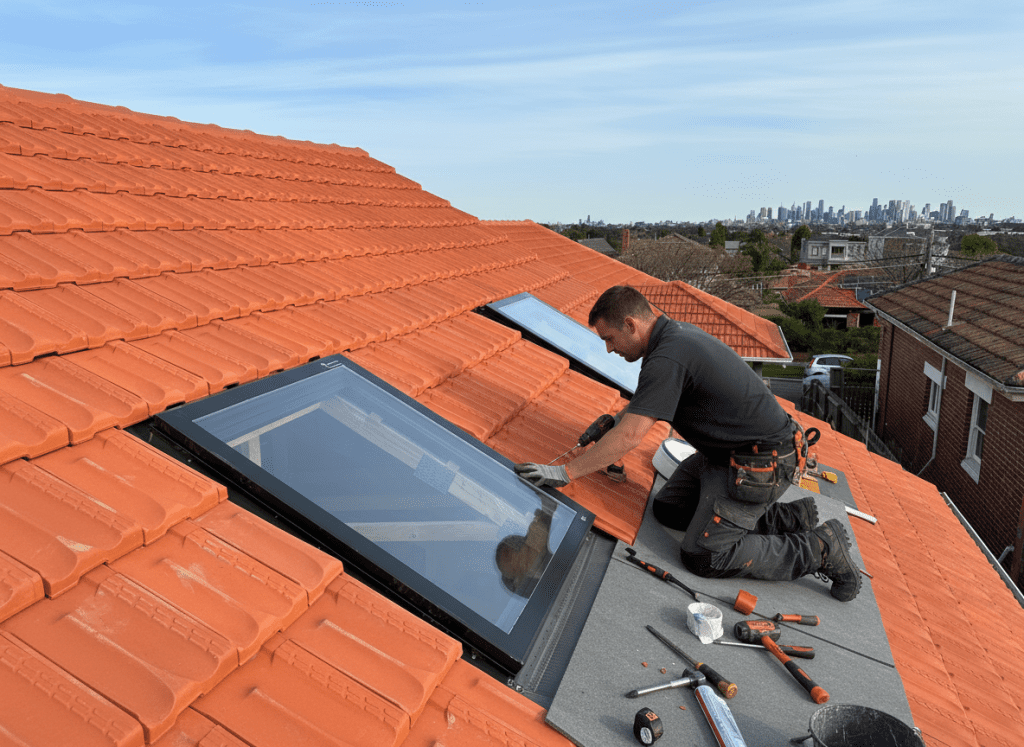
Bringing natural light into your home with skylights on a roof can completely change the feel of a space, turning dark corners into bright, welcoming areas and even helping with energy bills. As Vivid Skylights, a leading Australian supplier, we provide a range of high-quality double glazed fixed and operable skylights, with nationwide delivery so any home can benefit.
Planning Your Perfect Skylight Installation
Before you even think about picking up a tool, a bit of careful planning goes a long way. This is the stage where you make the smart decisions that will ensure you’re happy with your new skylight for years to come. It’s all about matching your home’s layout and your family’s needs with the right product.
First up, think about where the skylight should go. It’s not just about finding the centre of the ceiling. You need to consider the sun’s path. In Australia, a north-facing skylight generally gives you consistent, soft light all day, which is perfect for living areas. An east-facing one, on the other hand, will catch that beautiful morning sun. It’s about maximising light without creating uncomfortable glare.
Choosing Your Vivid Skylight Model
Finding the right skylight depends entirely on the room and how you use it. We’ve designed our models specifically for the Australian climate, so you’re getting a product built to last. As a leading supplier of double glazed skylights, we offer both fixed and operable models to suit any need. Our operable range includes both electric and solar-powered options.
Our leading skylight models are designed to meet different needs, from simple illumination to advanced ventilation and automation. This table breaks down the key differences to help you find the perfect match for your home.
Choosing Your Vivid Skylight Model
| Feature | Fixed Skylight | Electric Operable Skylight | Solar Operable Skylight |
|---|---|---|---|
| Best For | Maximising light in any room | Ventilation in kitchens/bathrooms | Eco-friendly ventilation |
| Ventilation | No | Yes, with remote control | Yes, with remote control |
| Power Source | N/A | Mains power | Integrated solar panel |
| Installation | Simple | Requires a licensed electrician | No hardwiring needed |
| Rain Sensor | N/A | Included | Included |
Whether you choose a Fixed, Electric, or Solar Operable model, you’re getting a premium double glazed skylight designed for performance. All our skylights feature a sleek, frameless top that helps water and leaves slide right off, meaning a cleaner look with less hassle.
A well-placed skylight does more than just brighten a room; it makes it feel larger and more open. By drawing the eye upward, you create a sense of spaciousness without undertaking a major structural renovation.
Budgeting and Compliance
Knowing your numbers upfront is crucial for any home improvement project. A great starting point is our online estimator, which can give you a clear idea of the product cost and an estimate for professional installation. This makes it easier to weigh up a DIY job versus hiring a trade professional.
The demand for daylighting solutions is growing fast. The global skylight market, valued at USD 3.08 billion in 2022, is on track to hit USD 4.44 billion by 2028, and Australia is a big part of that. Homeowners are looking for features like motorised openers with rain sensors and a solid 10-year warranty. It’s no surprise, especially when effective daylighting can slash a home’s electricity use for lighting by up to 25%.
Lastly, always have a quick chat with your local council before you start. While most skylight installations are pretty straightforward, it pays to double-check any specific building codes or requirements. Getting that sorted from the get-go avoids any headaches later on.
With our nationwide delivery across Australia, getting the right skylight for your project is simple. To learn more about our different models, have a look at our guide on the types of skylights we offer.
Once your plan is locked in, it’s time to get everything ready for the installation. A successful skylight project is all about the prep work. Getting your tools, materials, and workspace organised before you start makes the whole process smoother, safer, and a lot more professional.
The last thing you want is to be scrambling for a tool or making extra trips up and down a ladder. This is especially true when you’re working at height. A bit of time spent preparing now will protect your home from mess and set you up for a flawless finish.
Essential Safety Equipment
Let’s be clear: working on a roof isn’t a task to take lightly. Your safety has to be the number one priority. A fall from even a single-storey house can cause serious, life-changing injuries, so don’t even think about starting without the right personal protective equipment (PPE).
This is the safety gear that is absolutely non-negotiable:
Safety Harness and Anchor: This is a must-have for any work on a pitched roof. Make sure it’s fitted correctly and anchored securely, following the manufacturer’s instructions to the letter.
Sturdy, Non-Slip Footwear: Roof surfaces can be surprisingly slick, especially with a bit of morning dew or dust.
Impact-Resistant Safety Glasses: You need to protect your eyes from dust, wood splinters, and roofing debris that will inevitably fly around.
Work Gloves: A decent pair will save your hands from sharp roofing materials and splintered timber.
Gathering Your Tools and Materials
Having the right tools for the job can make all the difference between a frustrating experience and a satisfying one. Most of these are standard for any serious DIYer, but a few are essential for a clean skylight installation. We’ve designed our skylights to be installer-friendly, but a well-stocked toolkit is still your best friend.
Here’s a look at the core tools you’ll need:
Measuring & Marking: A tape measure, chalk line, spirit level, and a good old-fashioned pencil.
Cutting Tools: You’ll want a circular saw for making clean, straight cuts on the roof deck and a reciprocating saw for getting through rafters and the internal ceiling plasterboard.
Fastening & Sealing: A power drill with a good set of bits, a hammer, a pry bar for lifting tiles, and a high-quality caulking gun are all essential.
General Hand Tools: A sharp utility knife and a pair of tin snips often come in handy for trimming the roof underlayment or flashing if needed.
One of the biggest advantages of choosing Vivid Skylights is that our kits come with the custom-designed flashing you need for standard tiled roofs. This saves you from having to source or fabricate these critical waterproofing components yourself, simplifying one of the most important parts of the installation.
Preparing the Work Area
A bit of prep work inside and outside the house will save you a massive cleanup job later. Cutting into a ceiling and roof is a messy business, and dust will get everywhere if you let it.
Start by clearing the room directly underneath where you’ll be installing the skylight. Cover any furniture left in the room and the floor with heavy-duty drop cloths. You can even create a temporary dust barrier with plastic sheeting and painter’s tape to contain the mess to one area.
Up on the roof, make sure you have a safe and stable area to work from. Carefully remove the tiles or roofing sheets in an area slightly larger than your planned opening. Stack them securely somewhere they won’t become a trip hazard.
Finally, it’s time to double-check everything. Remember the old saying: measure twice, cut once. Mark your cutting lines clearly on both the interior ceiling and the exterior roof deck. Getting the roof angle right is crucial, so if you’re not 100% sure, you can learn how to use our roof pitch calculator to confirm your measurements before making that first cut.
Cutting the Opening and Installing the Flashing
Alright, this is where the real work begins. Getting the opening cut precisely and the flashing installed correctly are the two steps that make or break a skylight installation. Get these right, and you’ll have a leak-free skylight for decades. It definitely requires a steady hand and attention to detail, but the end result is well worth the effort.
Let’s walk through the process, from that first cut in the ceiling to fitting the last piece of flashing. As a leading Australian supplier, Vivid Skylights is focused on making this critical stage as straightforward as possible with our range of double glazed fixed and operable skylights, which we deliver nationwide.
This flowchart gives you a quick rundown of the prep work you need to do before you even think about picking up a saw.

Following this simple flow—gear up, measure twice, and protect your home—ensures the most technical part of the job starts on the right foot.
Creating the Openings in Your Roof and Ceiling
With your lines marked and the area prepped, it’s time to cut. Always start inside with the ceiling. Grab a reciprocating saw and carefully follow your marked lines on the plasterboard. Keep an eye out for any hidden electrical wires or plumbing that might be lurking in the ceiling cavity.
Next, you’ll head up to the roof. A circular saw is your best bet here for cutting through the roofing material and any sarking underneath. It is absolutely crucial that this cut is perfectly square and matches the exact dimensions for your skylight model. Any mistakes here can seriously compromise the weather seal. Once the hole is clear, you can get started on building the light shaft.
A common scenario is installing a skylight between rafters spaced at standard intervals. If your desired location lines up perfectly, you might only need to add simple timber framing for support. However, if a rafter is in the way, it will need to be cut and supported with a doubled-up header and footer frame to transfer the load correctly.
Building the Light Shaft for Maximum Impact
The light shaft is the tunnel that connects the skylight on your roof to the ceiling inside. How you construct it has a huge impact on the quality of light entering the room. A shaft with straight, vertical sides will give you a very direct, concentrated beam of light.
If you’re after a more diffused, room-filling glow, splaying the sides of the shaft is the way to go. Flaring out the top and bottom sides, in particular, will help spread sunlight across the entire room, making the space feel bigger and brighter. After you’ve framed the shaft, line it with plasterboard and give it a couple of coats of bright, reflective white paint to bounce as much daylight as possible into your home.
Installing the Flashing Kit Correctly
This is the moment of truth. A proper flashing installation is what guarantees your skylight will be completely weatherproof. As a leading supplier, Vivid Skylights provides custom flashing kits designed for a perfect, seamless fit, which takes a lot of the guesswork out of this vital step.
Whether you’re working with a standard tiled roof or a low-pitch metal one, the basic principle is the same. The flashing pieces must be installed in a specific sequence, always starting from the bottom and working your way up.
Sill Flashing: This piece sits along the bottom edge of the skylight frame. It always goes over the course of tiles or the sheet of roofing material directly below the opening.
Side Flashing: These run up the sides of the unit, overlapping the sill flashing and weaving in with the surrounding tiles or roofing sheets.
Head Flashing: This is the final piece that goes across the top. It slides under the course of tiles or roofing material above the skylight, ensuring any water running down the roof flows over and around the entire unit.
For a more detailed look, our comprehensive roof flashing installation guide has all the diagrams and step-by-step instructions you’ll need.
The robust, powder-coated aluminium frames on all Vivid Skylights add another layer of serious durability, built to withstand the harsh Australian sun and rain. Combined with features like the frameless top glazing and self-cleaning glass, you get a system designed to prevent water pooling and keep maintenance to a minimum. It’s no surprise that Australian homeowners are demanding better quality; the advanced glass market in Australia is projected to grow to USD 2,294.88 million by 2034, driven by the construction boom and a push for sustainable building. A premium Vivid Skylight can even boost your property value by an estimated 5-10%, making it a fantastic investment.
Wiring an Operable Skylight and Final Waterproofing
Now that your skylight is fixed in place, it’s time for the finishing touches that bring it to life and make it completely weathertight. If you’ve chosen one of our fantastic operable models, you’ll have some wiring to do. After that comes the final, all-important waterproofing that ensures your installation will stand up to anything the Australian weather can throw at it.
At Vivid Skylights, as a leading supplier, we deliver both electric and solar-powered operable skylights right across Australia. Each is a premium double glazed unit built for our climate, but the wiring process is quite different for each.
Connecting Your Operable Skylight
How you wire up your new skylight really comes down to which model you went with. One is a job strictly for the pros, while the other is a surprisingly straightforward DIY task.
Our electric operable skylights are designed to connect directly to your home’s mains power. This is non-negotiable: the work must be carried out by a licensed electrician. They’ll handle running the wiring from your switchboard to the wall switch and up to the skylight’s motor, making sure everything is safe and compliant with Australian standards. You can get a closer look at all the features in our guide to the Vivid Electric Skylight.
On the other hand, our solar-powered operable skylights are built for simplicity. Because the whole unit runs off its own solar panel and integrated battery, there’s no need to connect it to your mains power at all. The motor, remote, and rain sensor are all pre-synced and ready to go straight from the box. It’s a genuine plug-and-play solution.
A brilliant feature included with both our electric and solar operable models is the smart rain sensor. It’s pre-installed and automatically closes the skylight the moment it senses rain. This gives you the freedom to leave the skylight open for fresh air without ever having to worry about a sudden downpour.
The Final Waterproofing Seal
With the wiring done, the last job is to apply the final waterproofing seal. The flashing kit has already done the bulk of the work, but this last step is what gives you that extra layer of security and backs our 10-year leak-free warranty. This is where a little bit of care goes a long way.
Grab a high-quality, neutral-cure roofing silicone and a caulking gun. The idea is to run a clean, unbroken bead of sealant into any small gaps or joins left around the flashing and the skylight frame.
Be extra thorough in these spots:
Flashing Corners: Apply a tidy bead where the side flashing meets the sill (bottom) and head (top) flashing pieces.
Under Tiles or Sheeting: If you can, run a line of sealant under any cut roof materials that sit alongside the flashing. This stops wind-driven rain from sneaking underneath.
Screws and Fixings: Make sure to seal over the top of any visible fasteners you used to secure the flashing or frame.
This final sealing job is what truly fortifies your installation against the tough Aussie climate. It’s not just about adding skylights on a roof; it’s about doing it right. This combination of smart design and meticulous installation is why so many people are turning to these solutions.
In fact, demand for advanced products like our electric opening skylights is soaring in Australia, as they can slash the need for artificial lighting by 30-50%. It’s also why our DIY-friendly kits, which can cut labour costs by 20-30%, are proving so popular with homeowners looking for a smart, valuable upgrade.
Deciding Between DIY Installation and Hiring a Pro
So, you’re ready to bring beautiful natural light into your home with a skylight on your roof. One of the first big decisions you’ll face is whether to roll up your sleeves and install it yourself or call in a professional. There’s no single right answer—both routes have their merits, and the best choice really comes down to your skills, budget, and the specifics of your project.
As a leading supplier, our goal at Vivid Skylights is to make incredible natural light accessible to every Aussie home. That’s why we deliver our premium double glazed fixed, electric, and solar-powered operable skylights nationwide, right across the country. And part of that commitment means giving you the straight-up advice you need to get the installation right.
The Case for a DIY Installation
If you’re a handy home renovator, tackling the installation yourself can be incredibly rewarding. The most obvious win is the cost saving—the money you don’t spend on labour can go towards another part of your reno or just stay in your back pocket.
We’ve designed our skylights with the capable DIYer in mind. Every unit is an all-inclusive kit, and it even comes with the custom-sized flashing needed for a standard tiled roof. This takes a lot of the guesswork and complexity out of the equation, making a DIY install a very achievable goal for anyone with decent carpentry skills and a healthy respect for working at heights.
The feeling of standing in a room you’ve personally transformed with natural light is unbeatable. It’s more than just a home improvement project; it’s a genuine achievement that you get to enjoy every single day.
Think a DIY install might be for you? Run through this quick checklist:
Your Skills: Are you genuinely comfortable with power tools, taking precise measurements, and doing basic framing work?
Your Roof: Is your roof a fairly standard pitch and made of a common material like tiles? Are there any weird angles or structural quirks to worry about?
Your Confidence: Do you feel completely confident working safely at height and following detailed instructions to the letter?
When to Call a Professional
While the satisfaction of DIY is great, there are plenty of times when calling in a professional is the smarter, safer, and ultimately better move. An experienced installer brings a level of speed and expertise that’s tough to replicate. They’ve seen it all before and can navigate any unexpected hiccups that might pop up during the job.
This is especially true for more complex projects. If your roof is particularly steep or has a low pitch, if the structure is a bit tricky, or if you need to modify roof trusses, a professional’s experience is worth its weight in gold. Plus, their work almost always comes with a workmanship guarantee, which adds an extra layer of peace of mind.
It’s also not just a recommendation in some cases—it’s the law. If you’ve opted for one of our brilliant electric operable skylights, you must have a licensed electrician handle the connection to the mains power. While our solar-powered operable skylights are designed for a straightforward DIY setup, any mains-powered model needs a pro.
Ultimately, the decision might come down to the numbers. You can get a detailed breakdown of what to expect in our guide to skylight installation costs. Our online estimator is another fantastic tool that gives you a cost for professional fitting. This lets you see the real-world difference and decide if the savings from a DIY job are worth your time and effort.
Long-Term Skylight Care and Troubleshooting
Your new Vivid Skylight is engineered for durability, using premium materials like double glazed glass and robust aluminium frames specifically to minimise your to-do list. We believe a quality product shouldn’t just perform well—it should be easy to live with. With just a little bit of care now and then, you can expect your skylight to keep your home filled with beautiful natural light for years to come.
One of the smartest features is the self-cleaning exterior glass. It uses the sun’s UV rays and the rain to naturally break down and wash away dirt. For the inside pane, a quick wipe with a soft cloth and a gentle glass cleaner is all it takes to keep it sparkling. We also recommend a quick visual check of the external seals and flashing from the ground every year or so, just to make sure no leaves or debris have collected.
Simple Troubleshooting for Common Questions
Even with a flawless installation, you might have a question or two as you settle in with your new skylight. Here are a few quick tips for our popular operable models, whether you’ve gone with an electric or solar-powered option.
Problem: My remote isn’t working for my electric or solar skylight.
- Solution: The first port of call is always the simplest: check the batteries in the remote. This fixes it most of the time! If fresh batteries don’t do the trick, make sure nothing is blocking the signal between the remote and the skylight. For solar models, a long stretch of cloudy weather can drain the battery, but it will recharge itself after a few hours of good sun.
Problem: The rain sensor is closing the skylight when it’s not raining.
- Solution: Things like heavy morning dew, high humidity, or even a nearby garden sprinkler can sometimes trick the sensor. A quick wipe with a dry cloth is usually enough to clear the moisture. If you find it’s consistently too sensitive, the user manual has easy-to-follow steps for adjusting its sensitivity settings.
Even perfectly installed skylights can need a bit of attention over time. For more complex issues, you may want to look into professional skylight repairs.
We stand behind our quality with a comprehensive 10-year leak-free warranty on every skylight we supply. This is our promise to you that our products are engineered and tested to handle Australia’s tough climate, giving you total peace of mind in your investment.
This warranty covers the entire unit against leaks, as long as it has been installed according to our guidelines. It’s a guarantee that reflects our confidence in our double glazed skylights. As a leading Australian supplier, we proudly deliver these high-performance units nationwide, so every Australian home can enjoy the benefits of natural light without a worry.
Answering Your Top Skylight Questions
Thinking about bringing more natural light into your home with a skylight? It’s a brilliant idea, but we know it comes with a few questions. As a leading Australian supplier of premium double glazed fixed and operable skylights, we’ve helped countless homeowners navigate their options, and we’ve heard just about every question in the book.
One of the first things people ask is whether a skylight will actually work on their roof. The short answer is, almost certainly, yes. Our skylights are designed with Australia’s diverse homes in mind, fitting both pitched roofs (up to 60°) and low-pitch roofs (2-15°). We even include flashing kits for tiled roofs, and they install just as easily on metal roofs.
Will a Skylight Make My Home Hotter?
This is probably the most common—and most valid—concern we hear. With older-style plastic domes, the answer was often yes. But thanks to modern glazing technology, that’s no longer the case.
Every single one of our skylights features high-performance double glazing with a special Low-E coating. This is a game-changer. It works by significantly reducing heat transfer, helping to keep your home much cooler in summer and locking in warmth during winter. For those who want the ultimate say over light and temperature, our custom-fitted blockout blinds can shut out up to 98% of external light and heat.
A single skylight can provide up to three times more light than a vertical window of the same size. By choosing the right model—like our fixed, electric, or solar-powered operable skylights—you get all that beautiful light without the unwanted heat.
We deliver our full range of fixed and operable models right across the country, making sure any Australian home can enjoy the benefits of beautiful, energy-efficient natural light.
Ready to transform your home with light? Explore the full range of options at Vivid Skylights and find the perfect fit for your project.