

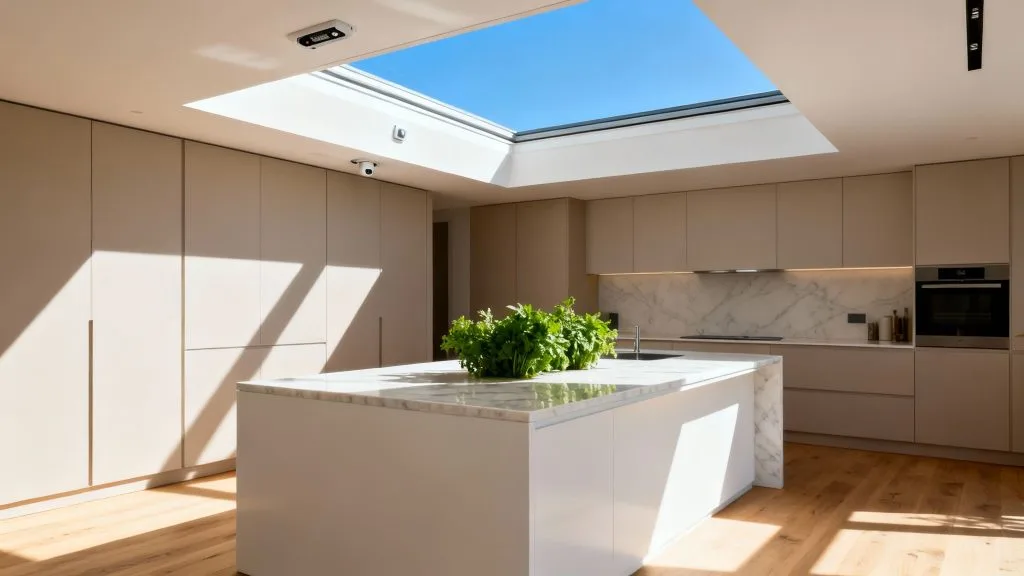
Adding a skylight to your kitchen is one of the most powerful design moves you can make. It’s not just about popping a window in the roof; it’s about fundamentally changing how the heart of your home feels and functions, making it feel larger, brighter, and far more inviting.
A well-placed skylight can slash your reliance on artificial lighting and completely elevate the atmosphere of the busiest room in the house.
Transform Your Kitchen with Natural Light
Picture this: your kitchen, the hub of daily life, bathed in warm, natural sunlight from above. A skylight doesn’t just add a bit of light; it creates a genuine connection to the outdoors, making the whole room feel more spacious and airy.
The benefits go well beyond looks. Flooding the space with consistent daylight can have a real impact on the mood and energy of the place where your family cooks, eats, and connects. Plus, there’s a huge practical upside: cutting down on your power bill during the day.
The Practical Perks of a Brighter Kitchen
The change you’ll see after installing a kitchen skylight is immediate. Homeowners are often surprised by how much it alters the room’s entire vibe, turning what was once a dim corner into a vibrant, usable part of the home. This isn’t just a feeling—it translates into real savings.
A well-placed skylight isn’t just a design upgrade—it’s an investment in your home’s atmosphere, your daily well-being, and your energy efficiency. It redefines the character of your kitchen from the ceiling down.
For Australian homeowners, these benefits are especially significant. Daylighting strategies are known to reduce electricity used for lighting by roughly 20–40% in residential homes. Kitchens, being high-traffic areas during the day, see some of the biggest savings, which is why they’re the most popular spot for a new skylight. You can explore more data on the Australian lighting market.
By choosing the right skylight, you’re not just fitting a window. You’re making a deliberate upgrade that delivers:
- An Enhanced Atmosphere: Creating a welcoming, open, and genuinely cheerful environment.
- Greater Functionality: Pouring clear, natural task lighting over benchtops and islands where you need it most.
- Improved Well-being: Boosting mood and helping to sync your body with the natural daily cycle.
- Increased Property Value: Adding a premium feature that is a major drawcard for future buyers.
Finding The Perfect Skylight Type For Your Kitchen
Choosing the right skylight for your kitchen isn’t about finding the single “best” one, but rather the best fit for your home’s layout and your family’s lifestyle. It’s a bit like choosing a new window—some are just for the view, while others are designed to open and let in a fresh breeze.
Your main options boil down to fixed, ventilating, and tubular skylights. While they all bring glorious natural light into your kitchen, they each do it in a fundamentally different way. Getting to grips with these differences is the first real step toward making a confident choice you’ll love for years to come.
Fixed Skylights: The Picture Window For Your Ceiling
A fixed skylight is the simplest and most popular choice for a reason. Think of it as a sealed, non-opening window for your roof, designed with one clear goal: to let the maximum amount of daylight flood into a room.
If your kitchen already has decent ventilation from windows or an effective rangehood, a fixed model is a brilliant, cost-effective option. They are absolutely perfect for those dark spaces that just need to be brighter, creating that open, airy feeling without the extra mechanical parts of an opening unit. Their sealed design also makes them incredibly durable and low-maintenance.
Ventilating Skylights: For Light and Fresh Air
A ventilating skylight—often called an opening skylight—gives you the best of both worlds: beautiful light and fresh airflow. This makes it an ideal choice for a kitchen, where cooking can quickly generate steam, smoke, and lingering odours. With just the press of a button, you can open it up to let hot air escape and create a much more comfortable space.
This function is a game-changer in kitchens that tend to feel a bit stuffy or for anyone who loves to cook up a storm. Many modern versions come with motorised openers and even clever rain sensors that automatically shut the unit when bad weather rolls in, giving you complete peace of mind.
To help you decide, let’s look at the main types in a quick comparison.
Kitchen Skylight Types at a Glance
This table breaks down the most common skylight types, helping you quickly see which one might be the best match for your kitchen’s needs.
| Skylight Type | Best For | Pros | Cons |
|---|---|---|---|
| Fixed Skylight | Maximising daylight in well-ventilated rooms; creating a bright, open feel. | Cost-effective, very low maintenance, excellent durability. | Doesn’t offer ventilation. |
| Ventilating Skylight | Kitchens, bathrooms, or any area needing improved airflow and moisture control. | Provides both light and fresh air; helps remove steam and odours. | More complex mechanism; higher initial cost than fixed models. |
| Tubular Skylight | Bringing light into rooms without direct roof access, like pantries or hallways. | Highly efficient at channelling light; great for tricky installations. | Doesn’t provide a sky view; limited in size. |
Each type has its place, and the best one for you really depends on what you’re trying to achieve—pure light, fresh air, or a clever solution for a difficult space.
This decision tree can help you visualise which path might be best for your specific needs, focusing on space, daylight, and efficiency.
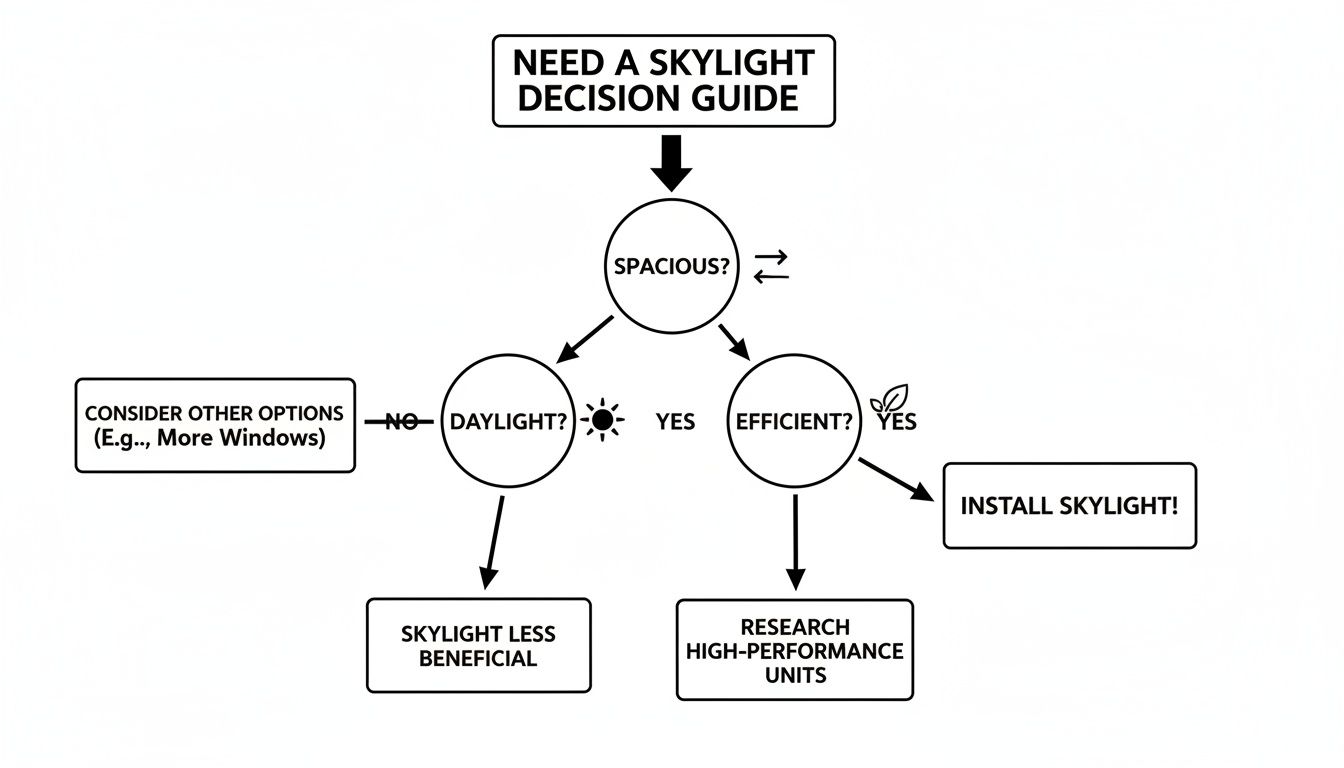
As the flowchart shows, your main goal—whether it’s making a small room feel bigger or improving airflow—will point you towards a specific type of skylight.
Tubular Skylights: A Smart Solution For Tricky Spaces
But what if your kitchen doesn’t have a direct roofline right above it? Perhaps there’s an attic or even a second storey in the way. This is exactly where a tubular skylight shines. It works like a sun funnel, using a highly reflective tube to pipe daylight from your roof down into the room below.
While you don’t get a direct view of the sky like you would with a traditional skylight, they are incredibly effective at illuminating smaller, targeted areas. Think of a pantry, a dark corner of the kitchen, or a small laundry room that would otherwise be impossible to brighten. They’re a truly clever fix for bringing light into those hard-to-reach spaces.
To see how these different models compare, you can explore the various types of skylights available.
Smart Design: Size, Placement, and Aesthetics
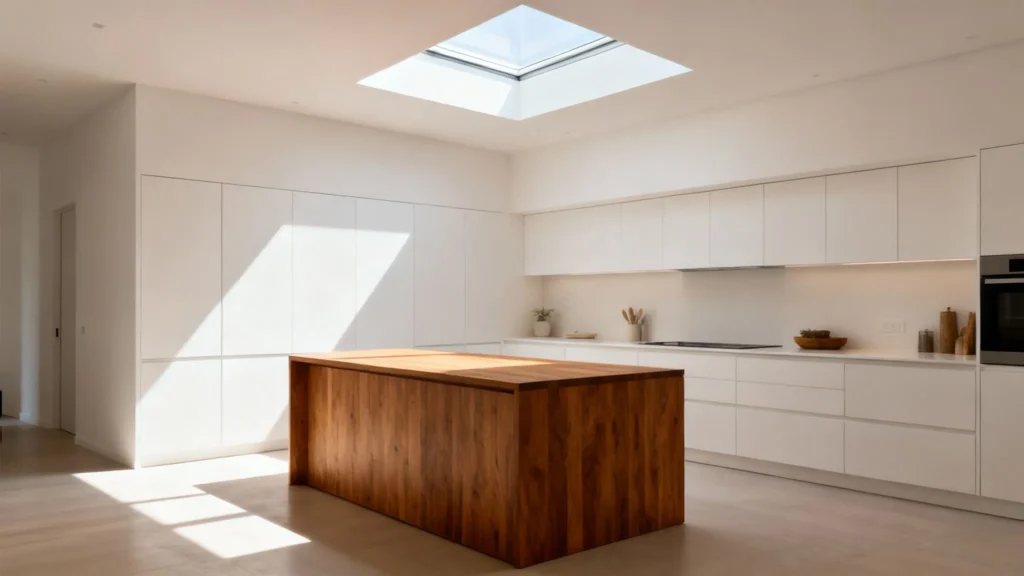
So, you’ve picked the perfect type of skylight for your kitchen. Fantastic. Now comes the really crucial part: deciding exactly how big it should be and where it should go. These aren’t minor details—they’re the decisions that will define the quality of light in your kitchen and shape the whole atmosphere of the room. Get it right, and the result is a space that feels perfectly balanced and beautifully lit.
Think of your skylight as a powerful, natural spotlight. Just like on a stage, its position determines what becomes the star of the show. If you put it in the wrong spot, you could end up with annoying glare on your benchtops or right in your eyes. But with a bit of thoughtful placement, you can create a kitchen that’s not just bright, but truly functional and stunning.
Finding the Right Size
Choosing the right size is all about finding that sweet spot. Go too small, and you’ll miss out on that “wow” factor you were hoping for. Go too big, and you could flood the room with too much light and heat, even with the best high-performance glass.
A good rule of thumb is to aim for a skylight that’s about 5% to 10% of your kitchen’s total floor area.
- For a 20-square-metre kitchen, a skylight of around 1 to 2 square metres is usually ideal.
- In smaller kitchens, it’s wise to stick closer to the 5% mark to keep the light from feeling overwhelming.
- If you’re blessed with high ceilings, you can lean towards 10% because the extra height helps diffuse the light beautifully.
Strategic Placement for Maximum Impact
Where you put the skylight is just as important as how big it is. The real goal here is to match the light to the way you use the space below.
Positioning a skylight directly over your kitchen island, for example, is a classic move for a reason. It floods your main prep area with crisp, clear task lighting, making everything from chopping vegetables to reading a recipe easier and safer.
On the other hand, placing a skylight in the centre of the room delivers a softer, ambient glow that lights up the whole kitchen more evenly. This is a great choice if you’re aiming for a generally open, airy feel. It’s also worth thinking about the sun’s path during the day to avoid casting unwanted glare across your appliances or TV screen.
Smart placement turns natural light into a functional design tool. It’s the difference between simply having a bright room and having a room that is beautifully and intentionally illuminated for how you live.
Matching Aesthetics to Your Kitchen Style
Finally, let’s talk looks. The skylight itself should feel like a natural part of your kitchen’s design. The interior frame and the light well—the shaft connecting the roof to your ceiling—can be styled to blend in or stand out. A clean, square skylight, for instance, has a contemporary edge that looks fantastic in modern kitchens.
You can paint the light well to match your ceiling for a seamless, almost invisible finish. Or, why not make a feature of it? Adding timber detailing can bring a touch of warmth that’s perfect for a more rustic or coastal vibe. The key is to see the skylight as an integrated piece of architecture, not just a window in the roof. To create a truly cohesive design, you’ll want to layer this natural light with other complementary kitchen lighting solutions for a perfect finish.
Understanding Installation on Different Roof Types
The thought of cutting a hole in your roof can be a little nerve-wracking, but rest assured, modern skylight installation is a highly precise and reliable craft. The secret to a perfect, leak-proof finish isn’t just about the skylight itself; it’s all about the flashing kit.
Think of a flashing kit as a bespoke raincoat for your skylight. It’s a set of engineered metal pieces designed to weave the skylight frame seamlessly into your specific roofing material. This creates an impenetrable, weatherproof seal that expertly directs water away, guaranteeing your kitchen stays bone dry for years to come. Whether you have classic tiles, corrugated metal, or a more contemporary low-pitch roof, there’s a flashing kit made for the job.
Pitched vs Low-Pitch Roofs
The angle of your roof—its pitch—plays a big part in how the installation is handled. Most Aussie homes have pitched roofs, and for an experienced pro, fitting a skylight here is a fairly straightforward affair. The natural slope does half the work, helping rainwater run off and working in tandem with the flashing to keep everything watertight.
Low-pitch or flat roofs need a slightly different approach. On these, the skylight is usually installed on what’s called a raised curb. This is just a small, built-up frame that elevates the skylight slightly, creating just enough of a slope to stop water from pooling around the edges and ensuring it drains away effectively.
A professional installation is more than just getting the skylight in place; it’s about protecting your home. Fitting the flashing kit correctly is absolutely essential for preventing leaks and is almost always a condition for keeping your manufacturer’s warranty valid.
Why Professional Installation Matters
While a seasoned DIYer might be tempted to give it a go, installing a skylight is one of those jobs best left to certified professionals. They have the know-how to properly assess your roof structure, make the cut with precision, and most importantly, install that crucial flashing kit perfectly. Even a tiny mistake here can lead to big problems with water damage later on.
Hiring a pro gives you complete peace of mind, knowing every component is working together exactly as it should. They understand the specific techniques needed for different materials. For a closer look at what’s involved, feel free to explore our guide on skylight installation for tile roofs.
Ultimately, a professional installer will stand by their work, protecting your home and ensuring your new skylight performs flawlessly from day one. You get all the incredible benefits of natural light, without any of the worry.
Getting to Grips with Glazing, Energy Efficiency and Airflow
A modern kitchen skylight is so much more than a simple window in your roof. It’s a highly engineered piece of tech designed for year-round comfort. Getting your head around a few key terms will help you understand just how much clever design is packed into one.
The term glazing just refers to the glass panel in the skylight. Today, double-glazing is the absolute standard, and for very good reason. Think of it as a thermal jacket for your roof—two panes of glass are separated by a sealed air gap, which acts as a powerful insulator, slowing down heat transfer in a big way.
This means that during a scorching summer, it helps keep the brutal heat out. On a frosty winter morning, it keeps your precious warmth right where it belongs: inside.
The Invisible Shield: Low-E Coatings
To take energy efficiency to the next level, any quality skylight you look at will feature a Low-E (Low Emissivity) coating. This is a transparent, microscopically thin layer of metal oxide applied directly to the glass.
The best way to think of it is as an invisible, intelligent heat shield. In summer, it reflects the sun’s harsh infrared heat away from your kitchen, letting in all that beautiful natural light without the unwanted temperature spike. Come winter, it does the opposite, reflecting your home’s internal heat back into the room instead of letting it escape through the glass. It’s a simple, brilliant feature that makes a massive difference to keeping your kitchen comfortable and your energy bills down.
If you’re keen to get into the nitty-gritty, you can learn more about how skylight energy efficiency is achieved with today’s materials.
Mastering Fresh Air and Comfort
Beyond just light and temperature, a kitchen absolutely needs top-notch ventilation. Steam from cooking, lingering food smells, and general moisture can build up fast, but an opening skylight is the perfect escape hatch.
Because hot air naturally rises, a ventilating skylight basically acts like a chimney, pulling steam, smoke, and stale air straight out of your kitchen. This is a game-changer for maintaining great air quality and a much more pleasant cooking environment. For the ultimate in convenience, motorised openers let you manage this airflow with the simple push of a button.
The ability to instantly vent steam and odours isn’t a luxury—it’s a functional necessity in a busy kitchen. A ventilating skylight transforms air quality management from a chore into an effortless part of your daily routine.
This dual focus on daylight and ventilation is a massive trend in Australian building. In fact, energy-efficient glazing with Low-E coatings is now used in over 50% of new residential skylight installations. It’s the go-to solution for managing heat in our wild climate, hitting both comfort and energy-saving goals. For more on these industry trends, check out the latest reports on Research and Markets.
Budgeting for Your Skylight and Boosting Home Value
Thinking about the cost of a new kitchen skylight means looking past the initial price and seeing it for what it truly is: a smart home improvement. The final figure will depend on a few things, like whether you choose a fixed or ventilating model, its size, and how tricky the installation is on your particular roof.
More often than not, the professional installation is the biggest slice of the pie. It’s absolutely essential for getting that perfect, leak-free fit that protects your home and keeps your product warranty valid. Think of it less as an expense and more as an investment in quality and your own peace of mind.
Calculating Your Return on Investment
Adding a skylight does more than just make your mornings brighter—it can offer a real financial return. A kitchen flooded with natural light is a huge selling point for potential buyers, often making a property the one that everyone remembers in a crowded market.
In Australia, industry estimates show that quality daylighting improvements can lift a property’s resale value by 2% to 5%. With a standard skylight installation typically costing between AUD 900 and AUD 3,500, the potential increase in home value makes it a seriously cost-effective upgrade.
While a skylight is a fantastic way to improve natural light, homeowners often tackle other upgrades at the same time. For a look into other renovation costs that can boost your home’s appeal, you might find details on kitchen cabinet refacing costs useful.
The Importance of a Solid Warranty
A strong warranty is your safety net, your guarantee of long-term performance and reliability. As you’re choosing a skylight, zero in on comprehensive coverage that protects you against defects in both the product itself and the installation.
A great warranty isn’t just a piece of paper; it’s a manufacturer’s promise of quality and durability. Look for a minimum 10-year guarantee against leaks and defects, as this reflects confidence in the product’s engineering and materials.
This kind of guarantee ensures your investment is protected from the elements, giving you the confidence that your beautiful new kitchen skylight will perform exactly as it should for many years to come.
Got Questions About Kitchen Skylights? We’ve Got Answers.
Even with all the benefits laid out, you probably have a few practical questions kicking around. That’s completely normal. Let’s tackle some of the most common things homeowners wonder about when thinking about adding a skylight to their kitchen.
Think of this as the final piece of the puzzle, giving you the clarity you need to move forward with confidence. We’ll cover everything from performance in the peak of an Aussie summer to how you’ll look after it long-term.
Will a Skylight Turn My Kitchen into an Oven in Summer?
Not a chance—at least, not with today’s technology. This is a common worry, but it’s based on old, single-pane plastic bubbles from decades ago. Modern skylights are a different beast entirely, engineered specifically for the harsh Australian climate.
High-performance units feature double glazing and special Low-E coatings. This combination is incredibly good at blocking solar heat from getting in, while still letting all that beautiful, natural light flood your space. The result? Your kitchen stays bright and welcoming, not hot and stuffy. For those extra scorching days, you can always add integrated blinds for another layer of control.
The fear of a hot kitchen comes from outdated products. A quality modern skylight is a complete thermal solution, designed to balance light and temperature all year round. The key to unlocking that performance is getting the installation right.
Are Kitchen Skylights Likely to Leak?
This is another myth that comes from old, poorly installed skylights. A high-quality, modern skylight that’s fitted by a professional is designed to be completely weathertight. End of story.
The secret weapon here is the flashing kit. It’s not just a generic part; it’s a custom-designed system that creates a bulletproof, impenetrable seal between the skylight’s frame and your specific roof material, whether you have tiles or metal sheeting. Nailing this installation is the single most important factor in guaranteeing a leak-free life for your skylight and keeping your warranty intact.
How on Earth Do I Clean a Skylight on the Roof?
It’s much easier than you might think. Cleaning the inside glass is no different from cleaning any other window in your house.
As for the outside, premium skylights often come with self-cleaning glass. It’s coated with a special finish that uses the sun’s UV rays to break down organic dirt, and then rainwater simply sheets off, washing the grime away. When you do need to give it a manual clean, it’s usually just a job for a soft cloth and some mild detergent—something you can easily do while you’re up there cleaning the gutters. Just remember to always prioritise safety when you’re working on the roof.
Ready to bring beautiful, natural light into the heart of your home? The team at Vivid Skylights is here to help you find the perfect solution for your kitchen. Check out our range of high-performance skylights and get a fast, accurate quote today at https://vividskylights.com.au.