

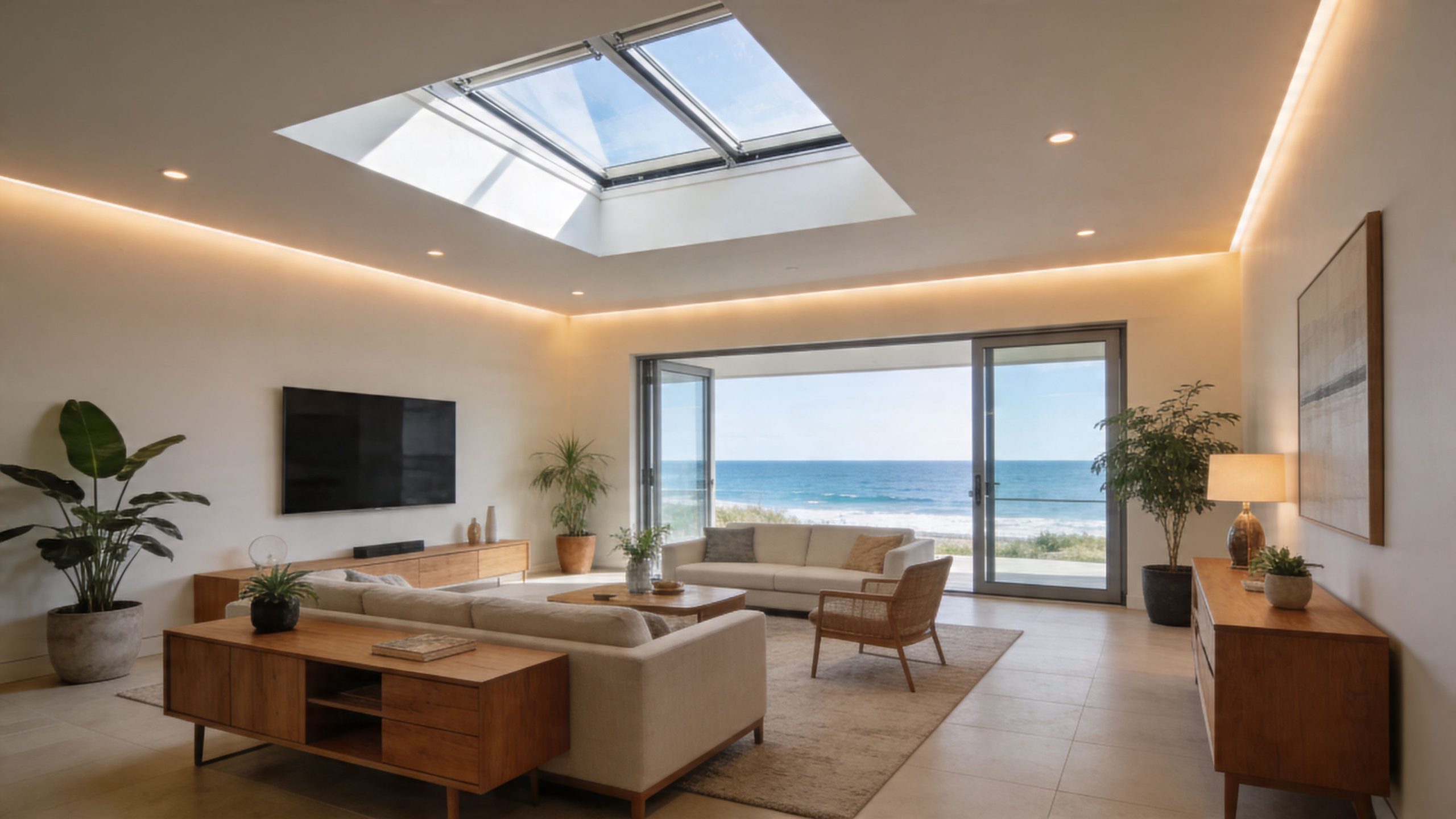
Some Mornington homes look bright on property listings, then feel flat the minute you live in them. The usual culprits are familiar. A long hallway that never sees enough sun, a kitchen that relies on one harsh ceiling fitting, or a bathroom in the middle of the floorplan that stays dim no matter how many globes you swap in.
That’s where good lighting options for Mornington homeowners start to separate into two paths. Bring in more natural light where the structure allows it, and use smarter artificial light where it doesn’t. The homes that feel calm, open and easy to live in rarely rely on a single fitting. They’re planned properly, room by room, with daylight, layered LEDs and practical control over glare, warmth and shadow.

If you’re weighing up skylights in Mornington, modern LED alternatives, or a full-home upgrade, the right answer depends on the room, the roof and how you use the space each day.
Table of Contents
Transforming Your Mornington Home with Light
Mornington homes have a particular mix of strengths and frustrations. You might have a beautiful coastal block, generous living zones and a strong indoor-outdoor connection, yet still end up with dead spots in the centre of the home. South-facing rooms can feel underlit all day. Older layouts often have internal bathrooms, corridors or walk-in robes that never become naturally inviting.
That’s why lighting options Mornington residents choose need to be more deliberate than “add a brighter downlight”. More output doesn’t always improve a room. In fact, one strong overhead fitting often creates exactly the problems people complain about most. Glare on benchtops, dark wall edges, unflattering shadows, and a space that feels hard rather than comfortable.
Light changes how a room feels
The biggest shift usually comes when you stop treating lighting as a fixture decision and start treating it as a room-design decision. Daylight opens a space up in a way artificial fittings can’t fully replicate. Good LEDs then support that daylight, rather than fight it.
A bright home doesn’t need every corner blasted with light. It needs light placed where your eye expects it, and softness where the room should feel calm.
In practical terms, that means asking better questions first:
Which rooms are naturally starved of daylight: Internal kitchens, laundries and hallways need a different approach from living rooms with large glazing.
Where does the room feel dull during the day: A room that’s gloomy at noon needs a different fix from one that only struggles after sunset.
What does the space need to do: Cooking, reading, bathing, dressing and entertaining all need different light quality.
What works better than a single fitting
The homes that read well during both day and night usually combine roof daylight, soft background lighting and targeted task lighting. That mix gives you control. It also avoids the common Mornington problem of a home that feels bright by the window and lifeless everywhere else.
If your current setup feels patchy, the fix usually isn’t one new pendant or another bank of downlights. It’s a better strategy.
The Daylight-First Approach with Premium Skylights
Natural light should lead the plan wherever the building allows it. It changes how materials look, improves visual comfort and reduces the need to run lights through the middle of the day. If a room can take a roof light, that should be assessed before you start adding more artificial fittings.

Why daylight should do the heavy lifting
A skylight doesn’t just make a room brighter. It changes the direction of light entering the space. Instead of relying on wall-side windows only, you bring illumination deeper into the room from above. That’s especially useful in open-plan kitchens, rear extensions, bathrooms and central corridors.
Double glazing matters here. In plain terms, it gives you an insulated glazing unit rather than a single pane exposed to the elements. That helps when you want the benefit of daylight without creating a room that feels thermally unstable. In practical residential work, that usually means the skylight becomes part of the home rather than a feature you notice for the wrong reasons in winter or summer.
For homeowners comparing products, double glazed skylights are worth focusing on first because the glazing specification affects comfort as much as brightness.
Practical rule: If the room can benefit from genuine daylight, choose the natural-light solution first. Add artificial light later to support it, not replace it.
Fixed or operable depends on the room
Fixed skylights suit spaces that need light more than airflow. Living rooms, stair voids, hallways and some bedrooms often sit comfortably in this category. They’re straightforward, visually clean and ideal when the brief is to brighten the space without adding moving parts.
Operable skylights make more sense in moisture-heavy or heat-prone rooms. Kitchens, bathrooms and upper-level spaces often benefit from controlled ventilation as much as light. Electric opening models suit homes where convenience matters, while solar-powered operable skylights are a sensible option when you want easier control without depending on a hardwired setup in the same way.
The extra ventilation can make a room feel less stale. That matters in a coastal area where homes are often closed up for part of the day due to wind, weather or privacy.
A closer look at product operation helps when you’re weighing those trade-offs:
The other point many people miss is distribution. One well-placed skylight can outperform a poor cluster of ceiling lights because it changes the room’s base level of illumination during the day. Artificial fittings still matter, but they stop carrying the entire load.
Navigating Roofs, Regulations, and Coastal Conditions
Choosing between lighting options Mornington homeowners see online is the easy part. The harder part is checking whether your house can take the product properly and whether the specification suits local conditions.
Start with the roof, not the brochure
Before choosing a skylight size or shape, check the roof form. A pitched roof gives you one set of installation options. A low-pitch or flat roof creates another. The opening, shaft depth, ceiling type and roof access all affect what’s practical.
If your home has a flatter roof profile, it helps to review purpose-built options such as a skylight for flat roof applications rather than trying to adapt a product meant for a steeper pitch.
A quick site assessment should answer these points:
Roof structure: Rafters, trusses and services can limit placement.
Ceiling relationship: A cathedral ceiling is different from a home with roof space above a flat plaster ceiling.
Room alignment: The ideal ceiling position isn’t always directly available above.
Access for installation: Some homes are simple to work on. Others need more planning.
Mornington conditions change the specification
Coastal homes cop more punishment than inland homes. Salt in the air, stronger UV exposure and wind-driven weather all push materials harder. That’s one reason finish quality matters. Frames, seals and external components need to be chosen with that environment in mind, not just for appearance in a showroom.
For readers comparing external fittings more broadly, these coastal lighting considerations give useful context on why corrosion resistance and finish durability matter near the coast.
In Mornington, a product that looks fine on day one can age badly if the material selection ignores salt exposure and weathering.
Heritage overlays and approvals need early attention
Some Mornington Peninsula homes sit in streets where planning controls or heritage overlays can affect what you’re allowed to alter externally. That doesn’t always rule out a skylight, but it can change where it goes, how visible it is from the street and what paperwork you need first.
The mistake is leaving that question until after you’ve chosen the product. Check early with your designer, builder or the local authority if your property has restrictions. It saves redesign, delays and unnecessary cost.
A straightforward sequence works best:
Confirm planning context: Check whether overlays or permit requirements apply.
Assess the roof and ceiling: Work out what’s structurally possible.
Match the product to the conditions: Don’t specify first and hope it fits later.
When a Skylight Isn't an Option Enter AuraGlow
Some rooms won’t take a traditional skylight. The roof line may be blocked by another storey. The space might sit in an apartment, a ground-floor internal room, or a part of the home where cutting through the roof isn’t realistic. In those cases, the answer isn’t to accept a gloomy room. It’s to use a lighting product designed for that exact problem.
Where AuraGlow makes sense
AuraGlow LED skylights are built for spaces where a conventional roof opening can’t happen. That includes internal bathrooms, basements, apartments, south-facing rooms that stay dull, and homes where structural or heritage constraints limit roof works.
That’s why the product works well as a design solution rather than a fallback. It creates a skylight-like visual effect in places where direct daylight isn’t available, with a much cleaner result than adding another flat panel or oversized ceiling fitting.

What the system actually offers
The standout feature is Dynamic Circadian Lighting. AuraGlow automatically shifts colour temperature from warm 1800K dawn tones through to bright 8000K midday light, giving the room a changing sky effect rather than a static artificial glow. In practical terms, that means the light feels more alive across the day.
Control is also more flexible than many homeowners expect. The system works through a 2.4G mobile app, and it supports Amazon Alexa and Google Assistant voice control. That matters in real homes because convenience determines whether people use lighting scenes properly or leave everything on one setting forever.
The build spec is strong as well:
Premium construction: Aerospace-grade aluminium alloy body with IP66 rating for durability.
High output: Brightness up to 12000lm.
Efficient performance: 100lm/W luminous efficacy.
Long service life: 50,000-hour lifespan.
Flexible fit-out: Suitable for suspended ceilings or surface mounting, with pendant and recessed options.
Warranty cover: 2-year warranty.
If you’re comparing product details directly, the AuraGlow LED skylight range is the relevant place to inspect mounting and control options.
The real value of an LED skylight alternative isn’t pretending it’s direct sun. It’s giving a difficult room a convincing, comfortable overhead light source that feels architectural rather than purely electrical.
Vivid Skylights vs. AuraGlow At a Glance
| Feature | Vivid Skylights (Fixed/Operable) | AuraGlow LED Skylight |
|---|---|---|
| Light source | Natural daylight from above | Simulated skylight effect using advanced LED |
| Best fit | Top-floor rooms and spaces with workable roof access | Internal rooms, apartments, basements and constrained areas |
| Ventilation | Available with operable electric and solar-powered models | No roof ventilation function |
| Structural impact | Requires roof and ceiling integration | No roof penetration required |
| Daytime experience | Authentic daylight | Dynamic circadian-style artificial light |
| Controls | Depends on model and accessories | App control plus Alexa and Google Assistant |
| Installation style | Roof-based installation | Suspended ceiling, surface, pendant or recessed mounting |
That comparison usually clarifies the decision quickly. If the room can take a proper roof opening, natural daylight is still the stronger move. If it can’t, AuraGlow gives you a refined overhead alternative that looks intentional and modern.
Creating a Whole-Home Integrated Lighting Plan
A good lighting scheme doesn’t depend on one product type. It combines daylight, background lighting and focused fittings so the house works at different times of day and for different tasks.
Layer the light properly
A well-designed layered lighting plan combines ambient, task, and accent light. For living areas in Mornington homes, using warmer colour temperatures of 2700K-3000K for ambient lighting can create a more relaxing environment and reduce eye strain, while still using energy-efficient LEDs, according to regional lighting guidance from Lighting Options.

The mistake I see most often is people trying to make ambient light do everything. It can’t. General room brightness helps orientation and mood, but it won’t give you clean prep light on a benchtop or flattering vertical light at a vanity.
A stronger plan usually looks like this:
Ambient light: The base layer that makes the room feel open and usable.
Task light: Focused light where hands and eyes need precision.
Accent light: Controlled highlights that add depth and stop the room looking flat.
Room by room combinations that work
In a living room, roof light or a skylight effect can handle much of the ambient layer during the day, with warm LED fittings taking over in the evening. In a kitchen, task light needs to be honest and shadow-free, especially over benches, cooktops and sinks.
Bathrooms need more care than people expect. The ceiling light alone rarely gives a good result at the mirror. If you’re planning a renovation, contemporary LED mirrors are worth reviewing because they add useful face-level illumination that downlights can’t replace.
For a simple whole-home check, ask these questions room by room:
What should light first: The floor, the work surface, the artwork, or the person using the room?
What time of day matters most: Morning use, daytime brightness, evening wind-down, or all three?
What needs control: Dimming, voice commands, scene settings, or just reliable switching?
Homes feel more expensive when the light is layered well, even if the fittings themselves are restrained.
That’s the true goal. Not more fixtures. Better light placement.
Installation Costs and Your Next Steps
The final decision usually comes down to installation pathway, scope and confidence. Some homeowners are comfortable managing part of the work themselves. Others want the certainty of a professional install from the start.
Choose the right install pathway
DIY can work if you’re experienced, understand the roof build-up and know where your limits are. Skylight systems that include flashing kits simplify the process, especially on tiled roofs, but cutting through a roof and finishing the shaft still needs care. A poor install can undo the value of a good product fast.
Professional installation suits most homeowners because it removes the guesswork around waterproofing, placement and interior finishing. It also helps when the home has awkward access, a complex roofline or approval questions that need to be addressed properly.
Get clarity before you cut anything
Don’t start with the product brochure alone. Start with sizing, location, roof type and the finish level you want inside. That gives you a realistic cost picture and avoids choosing a unit that doesn’t suit the build.
For that step, the practical move is to use the skylight cost and installation guide to estimate the likely scope before you lock anything in.
There are a few points homeowners usually want confirmed early:
Delivery availability: Nationwide delivery matters if your project isn’t in metro Melbourne.
Warranty detail: Skylight buyers often want leak-related reassurance before committing.
Accessories: Blinds, fly screens and opening options affect both use and install complexity.
If you’re planning lighting options Mornington wide for a renovation or new build, get the roof-light decision sorted before final electrical layout. It’s much easier to support daylight with LEDs than to retrofit daylight after the ceiling plan is already fixed.
Frequently Asked Questions
Do operable skylights make sense in bathrooms and kitchens
Yes, often they do. Those rooms benefit from both added light and airflow. If moisture and heat are part of the problem, an opening unit can solve more than a brightness issue.
Are solar-powered operable skylights reliable for Victoria homes
They can be a practical choice when you want operability without relying on the same wiring approach as an electric model. The suitability still depends on the specific location, roof setup and access to light for the solar component.
Can block-out blinds work with skylights
Yes, where compatible accessories are available, blinds are useful in bedrooms, media spaces and rooms where you want tighter control over glare and sleep conditions.
How does AuraGlow compare with a normal ceiling light
It’s closer to an architectural lighting feature than a standard fitting. The key difference is the skylight-like presentation overhead and the changing colour temperature effect, which gives the room a more natural rhythm across the day.
Is AuraGlow only for modern homes
No. It suits modern interiors well, but it also works in older homes where roof penetration isn’t practical or where you want a cleaner ceiling feature without major structural work.
Should I choose one lighting solution for the whole house
Usually not. Most homes work better with a mix. Some rooms deserve genuine daylight, others need targeted task lighting, and a few difficult spaces benefit from a skylight-style LED alternative.
If you’re ready to brighten a dark room properly, Vivid Skylights offers fixed, electric opening and solar-powered skylight options, along with AuraGlow LED skylights for spaces where traditional roof installation isn’t practical.