


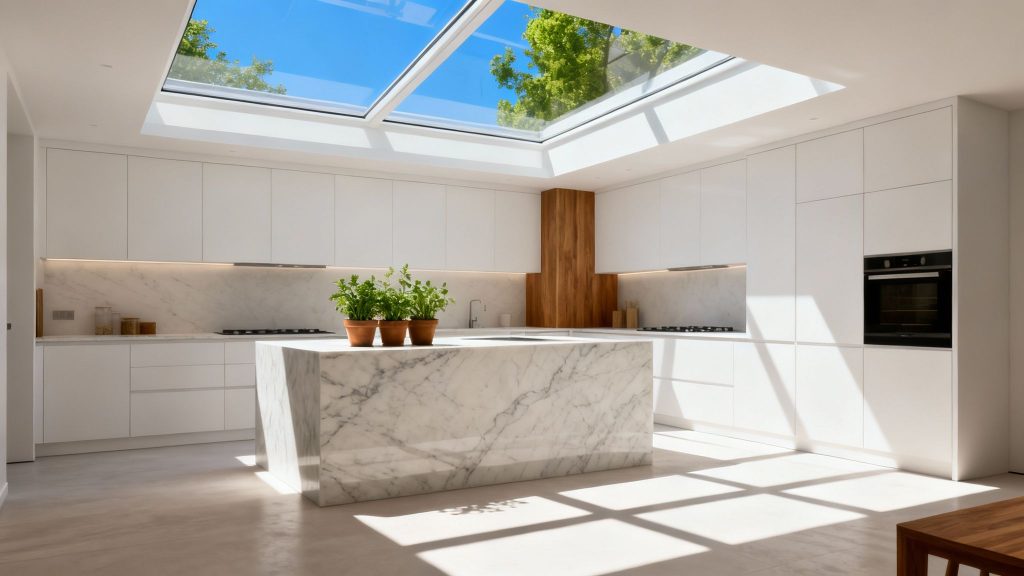
 Think of a kitchen skylight as more than just a window in your ceiling. It’s a game-changing architectural move designed to pour natural daylight right into the heart of your home. A skylight doesn’t just add light; it completely transforms the room, making it feel bigger, slashing your reliance on artificial lights, and just making it a nicer place to be.
Why a Kitchen Skylight Is More Than Just a Window
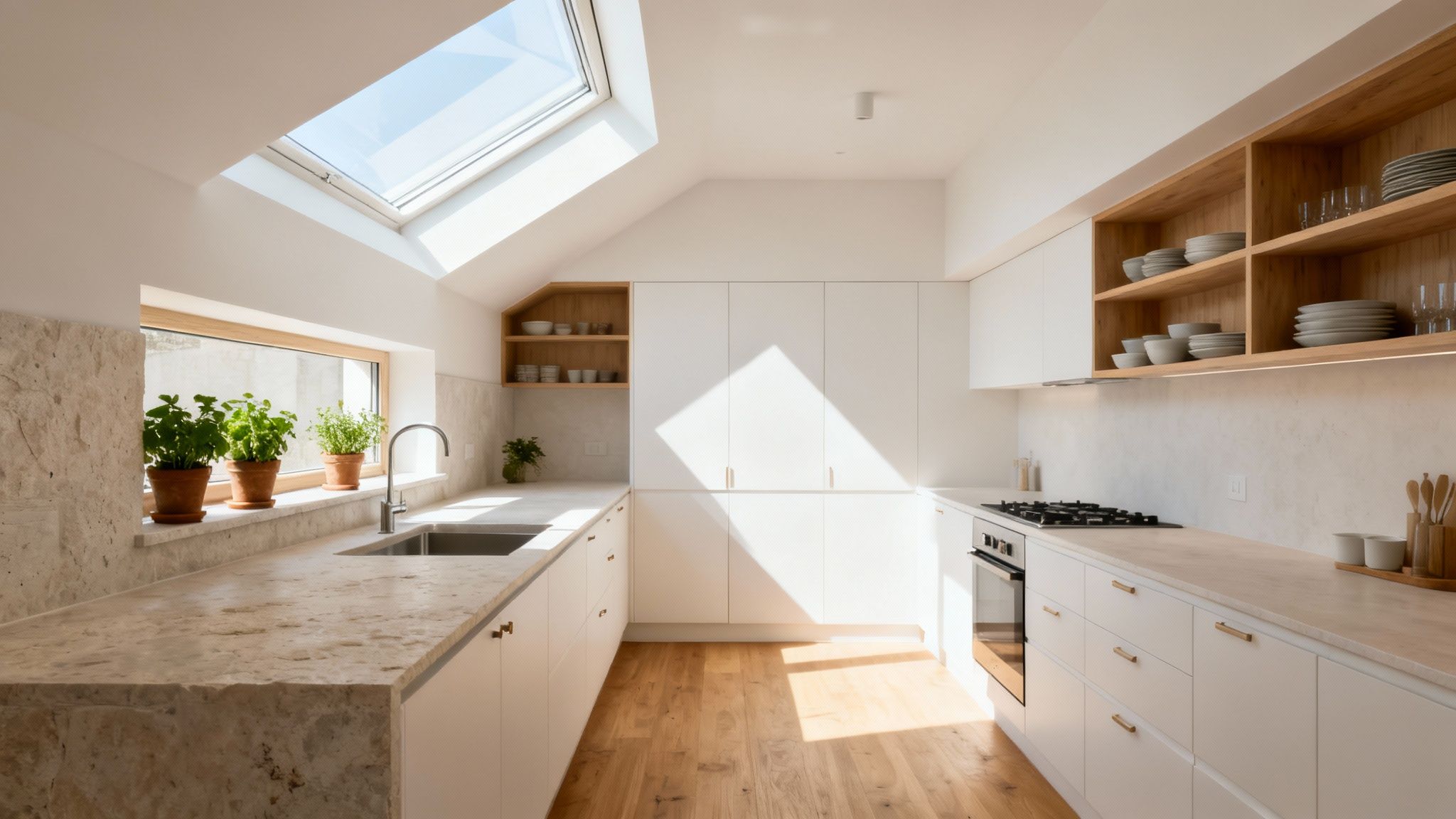
Imagine your kitchen suddenly feeling more alive, inviting, and spacious. That’s what a skylight does. It’s a powerful design choice that can genuinely boost your home’s mood, increase its value, and even improve its energy efficiency. It fundamentally changes how you feel and interact in what’s often the busiest room in the house.
This guide is your complete roadmap to getting that bright, beautiful kitchen you’ve been dreaming of. We’ll walk through everything, from the real-world benefits of daylight to the nitty-gritty of getting one installed. The key is to stop thinking of a skylight as an add-on and start seeing it as a core part of your kitchen’s design.
Reshaping Your Kitchen Environment
A skylight does so much more than just light up your benchtops—it reshapes the entire atmosphere of the room. It can take a cramped, dark kitchen and turn it into the vibrant hub of your home, perfect for cooking, eating, or just catching up.
The light from above is naturally more diffuse and pleasant than the harsh glare of artificial bulbs, creating a space that feels both calm and productive. A skylight can:
- Create a focal point that draws the eye up, adding instant architectural interest.
- Bring out the best in your finishes, highlighting the true colour and texture of your cabinetry and benchtops.
- Improve the room’s flow, making the whole space feel more open and connected to the outdoors.
A well-placed skylight isn’t just about adding light; it’s about adding life. It connects your indoor space with the natural rhythms of the day, from the soft morning glow to the bright midday sun.
A Strategic Design Decision
Putting in a skylight isn’t an afterthought; it requires a bit of smart planning. The size and placement need to work with your kitchen’s layout and your daily routines. For example, a skylight directly over a kitchen island is brilliant for task lighting right where you need it, while one in the centre of the room provides beautiful, general ambient light.
Understanding how a skylight fits into the bigger picture is crucial. For more great insights, it’s worth checking out guides on planning your kitchen layout. A little forethought here ensures your new skylight doesn’t just look good, but genuinely enhances your daily life and adds lasting value to your home.
Putting a skylight in your kitchen is about so much more than just making the room brighter. Think of it as an investment in your home’s atmosphere, your family’s well-being, and even your monthly power bill. There’s a special quality to light from above that transforms a purely functional space into one that feels inspiring and alive.
A kitchen filled with sunlight is just more inviting. The light changes throughout the day, making the space feel connected to the outdoors and turning it into the true heart of the home where everyone naturally wants to be.
Enhance Your Home and Well-being
It’s no secret that sunlight has a real, measurable effect on our mood and energy levels. Flooding your kitchen with natural light makes for a more positive and productive environment. This is especially true in the morning; it helps set your body’s natural rhythm and gets your day started on the right foot.
From a design perspective, a skylight is a fantastic tool. It draws your eyes upward, creating a feeling of spaciousness that can make even a small kitchen feel significantly larger and more open. This overhead light also does a brilliant job of showing off your design choices, bringing out the true colours and textures of your benchtops, cabinetry, and flooring in a way that artificial lights just can’t match.
Achieve Real Energy Savings
One of the first things you’ll notice is the drop in your electricity bills. When your kitchen is lit naturally for most of the day, you simply don’t need to flip on the lights as often. This isn’t just a tiny saving, either—it really adds up over the year.
Here in Australia, where energy efficiency is a big deal in home design, skylights are becoming a go-to feature. In fact, installations of kitchen skylights jumped by 28% between 2020 and 2023, largely driven by a focus on sustainable home improvements. A well-placed skylight can slash the need for artificial lighting by up to 40%, saving a typical Sydney household an average of AUD 250 a year. You can get more insight into these trends in the Asia-Pacific skylights industry report.
This simple addition works for you every single day, turning free sunlight into tangible, measurable savings.
Improve Your Kitchen’s Air Quality
Beyond just light, an opening or venting kitchen skylight offers another huge benefit: better air circulation. Kitchens are notorious for trapping steam, moisture, and cooking odours. A venting skylight gives all that stale, humid air a direct escape route.
By creating a natural convection current, a venting skylight pulls warm, moist air up and out, promoting a healthier indoor environment and actively preventing the growth of mould and mildew.
This is a game-changer in Australia’s humid coastal climates, where good ventilation is key to keeping a home healthy. The benefits are clear and compelling:
- Moisture Control: It quickly gets rid of steam from cooking, which means less condensation on your windows and walls.
- Odour Removal: Lingering smells from last night’s fish or garlic are efficiently whisked away outside.
- Healthier Air: It reduces airborne pollutants and creates a steady flow of fresh air.
At the end of the day, a kitchen skylight isn’t just a window on your ceiling. It’s a multi-faceted upgrade that lifts your mood, saves you money, adds to your home’s appeal, and creates a healthier place to live. It works quietly in the background, making your kitchen a brighter, more comfortable, and more valuable space.
Choosing the Right Type of Kitchen Skylight
Picking the perfect kitchen skylight isn’t just about size. It’s about figuring out what you really need – just light, or light and fresh air? The choice really boils down to two main players: fixed and venting (also called operable) skylights. Each one turns your ceiling into something different: either a stunning picture window to the sky or a functional portal for fresh air.
Think of a fixed kitchen skylight as a sealed, beautiful window for your roof. Its one and only job is to pour in as much natural light as it can. It’s a brilliant option for kitchens where you simply want to dial up the brightness without needing extra ventilation.
A venting skylight, on the other hand, works just like a regular window you can open and close. This clever design gives you both beautiful daylight and the crucial ability to get air moving, which is a lifesaver for dealing with steam, heat, and lingering cooking smells.
This simple flowchart breaks down the core decision: are you chasing light, or light plus a fresh breeze?
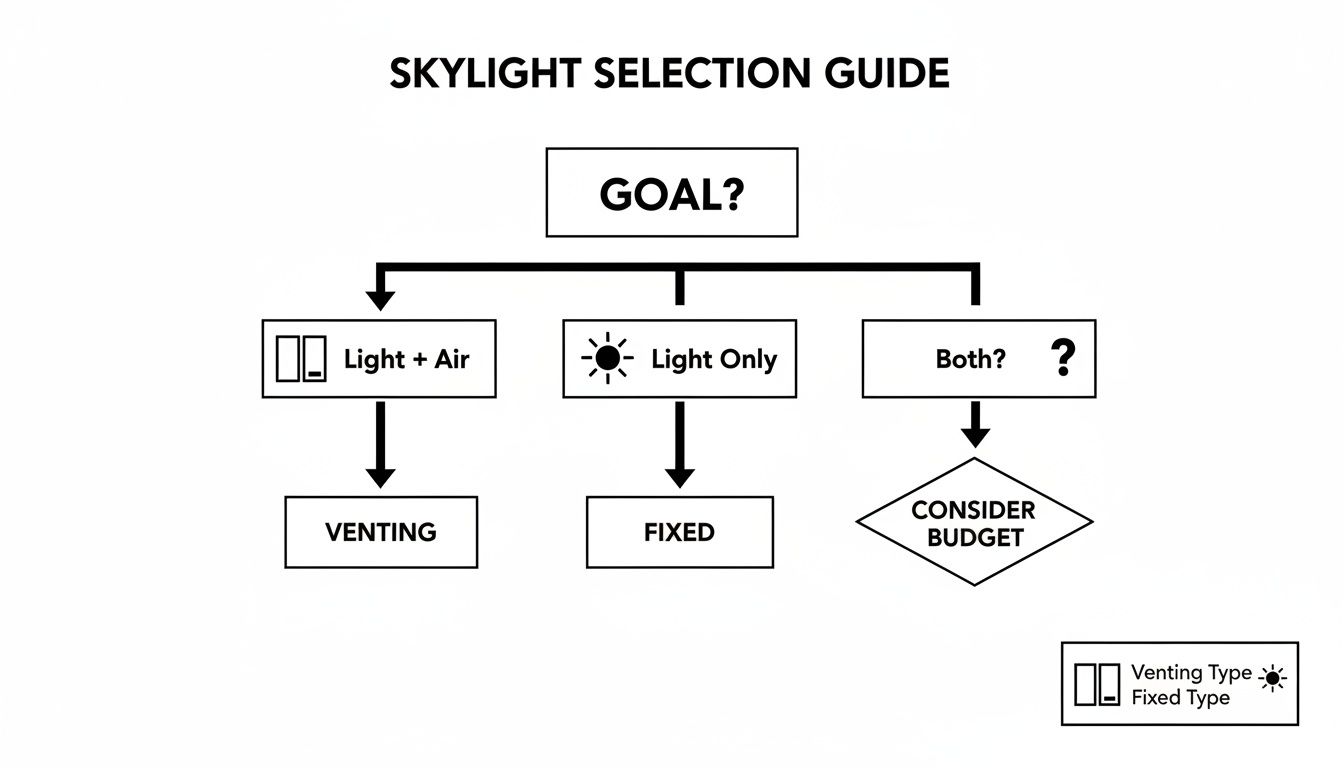
As you can see, what you want your skylight to do is what points you towards either a fixed or an operable model.
To make the decision even clearer, here’s a quick comparison of the three main types you’ll come across.
Comparing Kitchen Skylight Types Fixed vs Venting vs Tubular
This table breaks down the key features and best-case scenarios for each skylight type, helping you pinpoint the right fit for your kitchen project.
| Feature | Fixed Skylight | Venting (Operable) Skylight | Tubular Skylight |
|---|---|---|---|
| Primary Function | Maximum natural light | Natural light & ventilation | Light for confined spaces |
| Ventilation | No | Yes (manual or electric) | No |
| Best For | Brightening dark rooms, architectural features | Kitchens, bathrooms, areas needing airflow | Hallways, pantries, small spaces with obstructions |
| Cost | Most affordable | Higher cost due to mechanisms | Varies, but often cost-effective for tricky installs |
| Maintenance | Minimal | Requires occasional checks on moving parts | Low |
| View of the Sky | Unobstructed, clear view | Clear view, can be opened | No direct view, uses a diffuser |
Ultimately, whether you’re drawn to the simplicity of a fixed skylight, the functionality of a venting one, or the problem-solving nature of a tubular design, you’re choosing a feature that will fundamentally improve your home.
Fixed Skylights: The Uninterrupted View
Fixed skylights are the champions of pure, simple light. Because there’s no opening mechanism, they often have a more streamlined, minimalist look that melts right into your ceiling. Their sealed design makes them a super reliable and low-maintenance way to bring the outdoors in.
They are the perfect fit for:
- Maximising Light: A go-to for darker kitchens or spaces where adding a wall window just isn’t an option.
- Architectural Statements: A big fixed skylight over a kitchen island or dining table creates a jaw-dropping focal point.
- Budget-Conscious Projects: With fewer moving parts, fixed models are generally kinder on the wallet than their venting cousins.
A fixed kitchen skylight is really a ‘set and forget’ solution for a brighter, more welcoming kitchen.
Venting Skylights: For Light and Airflow
A venting or operable kitchen skylight is the ultimate multitasker. It gives you all the glorious daylight of a fixed model but adds the game-changing benefit of ventilation. This is a huge plus in a kitchen, which is pretty much the home’s headquarters for heat, humidity, and cooking odours.
Being able to crack open the skylight lets warm air, steam, and smells rise and escape naturally. This is known as the “stack effect,” and it’s incredibly good at improving your indoor air quality without firing up a noisy extractor fan.
Venting skylights are a seriously popular choice, with manual models holding a hefty 32.5% share of Australia’s residential market. Homeowners love them for their power to clear steamy cooking environments—they can vent up to 150 cubic metres of air per hour. In humid spots like Brisbane, that efficiency can slash condensation by 45%.
Venting skylights aren’t just passive windows to the sky; they are active players in your home’s ventilation system, helping to create a healthier, more comfortable place to live.
If you’re thinking about an upgrade, you can check out the different kinds of operable skylights available to suit your needs. They’re a fantastic way to manage your kitchen’s climate naturally.
Tubular Skylights: A Solution for Tricky Spaces
But what if your kitchen layout just won’t accommodate a traditional skylight? Maybe there’s an attic or another room sitting directly above it. This is where tubular skylights shine, offering a clever workaround to funnel daylight into spots that are otherwise impossible to reach.
A tubular skylight uses a small dome on the roof to catch sunlight, which then bounces down a highly reflective tube to a diffuser that sits flush with your ceiling. While you don’t get that expansive view of the sky, they are incredibly efficient at piping bright, natural light into smaller or boxed-in areas.
Consider a tubular skylight if you have:
- A small kitchen or a galley-style layout.
- Obstructions in the roof space, like ductwork or wiring.
- A need for a concentrated beam of light in a specific spot, like a pantry or over the sink.
In the end, the best kitchen skylight is the one that fits your priorities. Whether you go for the uninterrupted light of a fixed model, the practical airflow of a venting unit, or the problem-solving design of a tubular skylight, you’re making an investment that will brighten up your home for years to come.
Decoding Glazing and Materials for Peak Performance
Once you’ve settled on the type of skylight that’s right for your kitchen, it’s time to get into the details that separate a standard skylight from a high-performance one. The materials, particularly the glazing, are what really define its quality and efficiency. These technical specs are the key to managing your kitchen’s climate, ensuring safety, and making sure your investment lasts for years to come.
Think of skylight glazing as the lens through which your home interacts with the sun. It’s not just about letting in light; it’s about controlling heat, blocking harsh UV rays, and providing solid insulation. Understanding a couple of key terms will give you the power to choose a product that performs brilliantly in the Australian climate, keeping you comfortable all year round.
This is where you’ll hear terms like U-value and Solar Heat Gain Coefficient (SHGC). They might sound a bit technical, but their job is simple: to measure how well a skylight stops heat from passing through it.
Mastering Heat Control with U-Value and SHGC
Imagine you’re trying to keep a drink cold on a scorching summer day. A well-insulated thermos is going to do a much better job than a thin glass, right? The same logic applies to your skylight.
The U-value measures how well the skylight stops heat from escaping your home. A lower U-value means better insulation, which is a huge plus for keeping your kitchen warm and cosy in winter.
On the flip side, the Solar Heat Gain Coefficient (SHGC) measures how much solar radiation a skylight blocks from getting into your home. A lower SHGC is your best friend during Australian summers, as it helps stop your kitchen from turning into an oven under that intense sun.
Finding the sweet spot between a low U-value and a low SHGC is the secret to a comfortable, energy-smart kitchen. It means you get the sun’s warmth when you want it and block it out when you don’t.
Modern skylights nail this balance with advanced glazing technologies, and double glazing has become the industry benchmark for getting it right.
The Power of Advanced Glazing Options
Gone are the days of single, flimsy panes of glass. Today’s skylights use sophisticated glazing systems built for safety, efficiency, and easy maintenance. When you’re choosing a kitchen skylight, these are the features you should be looking for.
- Double Glazing: This is the big one. It’s made up of two panes of glass with a sealed gap between them, usually filled with air or an inert gas. This gap is a powerful insulating barrier that dramatically cuts down on heat transfer. To really get a feel for it, exploring the benefits of double glazed skylights will give you a deeper understanding of their energy-saving punch.
- Low-E Coatings: A low-emissivity (Low-E) coating is a microscopically thin, transparent layer of metal oxide applied to the glass. It’s clever stuff—in winter, it reflects heat back into the room, and in summer, it reflects solar heat away from the house.
- Laminated Glass: When it comes to safety, laminated glass is the undisputed champion. It’s made of two layers of glass fused together with a tough plastic interlayer. If the glass ever breaks, the fragments stick to the interlayer instead of shattering and falling. For any overhead installation, this is an absolutely critical safety feature.
These technologies all work together to create a skylight that isn’t just a window to the sky, but a high-performing part of your home’s thermal shield.
Choosing the Right Frame and Flashing
While the glass does most of the heavy lifting, the frame and flashing are the unsung heroes holding everything together and guaranteeing a leak-proof seal. The frame supports the glazing, while the flashing is a custom-fitted metal apron that masterfully directs water away from the skylight and down your roof.
Different frame materials bring different strengths to the table:
| Material | Pros | Cons |
|---|---|---|
| Aluminium | Strong, durable, low maintenance, and weather-resistant. Powder-coated finishes last for decades. | Can be less insulating than other materials if it doesn’t have a thermal break. |
| Timber | Offers a classic, warm look and provides good natural insulation. | Needs regular maintenance (painting or sealing) to stop rot and weather damage. |
| uPVC | Excellent thermal performance and very low maintenance. | Can look a bit bulkier and may discolour or become brittle over time with sun exposure. |
For most Australian homes, powder-coated aluminium strikes the perfect balance of durability, modern style, and minimal fuss. When you pair that with a high-quality flashing kit designed specifically for your roof type (whether it’s tiles or metal), you get a robust, completely weatherproof system. This combination is your ticket to a kitchen skylight that will look and perform beautifully for decades.
Exploring Smart Skylights and Modern Upgrades
A modern kitchen skylight is so much more than a simple window in your roof. These days, they can be a fully integrated part of your smart home, giving you a level of convenience that genuinely changes how you use your kitchen. Picture this: you’re searing a steak, and smoke starts to build up. Instead of hunting for a pole winder, you simply tap a button on a remote to open the skylight and clear the air.
That’s the beauty of motorised skylights. They swap out old-school manual cranks for whisper-quiet motors, making it dead simple to manage ventilation. But the real game-changer is when you add smart sensors into the mix.
For anyone living in Australia, a rain sensor is an absolute must. We all know how quickly the weather can turn. A rain sensor detects the very first drops and automatically closes your venting skylight. It’s total peace of mind, whether you’ve just popped out to the shops or you’re away for the weekend.
Essential Accessories for Full Functionality
Beyond the smart tech, a few key accessories will take your kitchen skylight from great to indispensable. These additions give you complete control over light, airflow, and unwelcome pests, making sure your skylight works for you.
- Integrated Blinds: A blockout blind is non-negotiable for taming the harsh Aussie sun. It lets you instantly dial down the light, block out heat during a summer scorcher, and even adds a bit of extra insulation on cold winter nights.
- Fly Screens: An open skylight is perfect for letting a breeze through, but not so much for letting in flies and mozzies. A custom-fitted fly screen keeps the fresh air flowing while telling insects they’re not on the guest list.
A truly great kitchen skylight is one that adapts to your needs throughout the day. Combining a motorised opener with a blockout blind gives you ultimate control over your kitchen’s light and climate at the touch of a button.
As you think about these upgrades, it’s also worth looking into how energy-efficient smart home window coverings can bring similar benefits to the rest of your house.
Virtual Skylights for Challenging Spaces
So, what happens when a traditional skylight just isn’t an option? If you’re in an apartment, a ground-floor unit, or have another storey directly above your kitchen, you’re not out of luck. There’s a clever technological solution.
Enter the virtual skylight. It’s a sophisticated LED lighting system that perfectly mimics the look and feel of natural daylight. By replicating the sun’s colour temperature and brightness throughout the day, it creates a surprisingly realistic and uplifting vibe in rooms where a real window to the sky is impossible.
This technology is taking off in urban Australian settings where high-density living presents unique challenges. In fact, sales for these units in kitchens saw a 22% compound annual growth rate from 2021 to 2024. In 2023 alone, around 8,500 units were sold nationwide, capturing 18% of the premium kitchen lighting market. They do an incredible job, simulating natural daylight with 95% accuracy while cutting energy use by 60% compared to standard lights.
By embracing these modern upgrades—from smart automation to innovative lighting—you can make sure your kitchen skylight is a source of convenience, comfort, and enjoyment every single day.
Your Kitchen Skylight Installation Roadmap
Bringing a skylight into your kitchen is an exciting project, but a great result really hinges on smart planning. Before anyone thinks about cutting a hole in your roof, it’s crucial to map out the journey from start to finish. This roadmap will walk you through the key decisions you’ll need to make, from picking the perfect spot to figuring out who should do the work.
Getting the size and placement right is the very first—and most important—step. It all comes back to your goal. Are you after bright, focused task lighting directly over your kitchen island for chopping veggies? Or is the aim to fill the entire room with soft, ambient light? Each of these goals requires a totally different strategy.
A good rule of thumb is that the skylight’s size should be no more than 5% of the room’s total floor area if you already have plenty of windows. For rooms that are a bit darker, you can go up to 15%. For example, a skylight positioned right over an island creates a stunning focal point, whereas one in the centre of the ceiling will give you balanced, beautiful light all day long.
DIY vs Professional Installation
The next big decision is whether to roll up your sleeves and install it yourself or bring in a professional. While the DIY route might seem like a good way to save a bit of cash, it comes with some serious risks if you’re not a seasoned roofer. One small mistake can quickly snowball into big problems like leaks, structural damage, or poor insulation that costs you more in the long run.
Hiring a professional installer offers complete peace of mind. They live and breathe this stuff—they understand roofing structures, proper waterproofing techniques, and exactly how to ensure your skylight performs at its best for years. They’re also equipped to handle any surprises that pop up and will usually offer a warranty on their work, protecting your investment.
“A professional installation isn’t just about convenience; it’s about guaranteeing a leak-free, secure fit that integrates seamlessly with your roof structure. It’s the safest bet for protecting your home and your warranty.”
If you’re weighing up your options, getting a clear picture of what the job involves can really help. You can learn more about what’s involved with a professional skylight installation to see if it’s the right fit for your project.
Navigating Permits and Building Codes
Finally, don’t get caught out by the paperwork. Before any work kicks off, checking in with your local council about permits is an absolute must. Many structural changes, including installing a kitchen skylight, need official approval to make sure they comply with Australian building codes and safety standards.
Forgetting to get the right permits can lead to fines, being ordered to remove the skylight, or headaches down the track when you decide to sell your home. It’s a simple check that protects your project both legally and structurally. Following every step of your installation roadmap carefully is the key to a bright, beautiful kitchen you can enjoy without a single worry.
Common Kitchen Skylight Questions Answered
As you get closer to a decision, it’s completely normal for a few last-minute questions to pop up. A kitchen skylight is a big step up for your home, so you want to feel absolutely confident before you commit. Let’s walk through some of the most common queries we get from Aussie homeowners, so you can clear up any lingering doubts.
One of the biggest worries is always about the heat. “Will a skylight turn my kitchen into a greenhouse in summer?” It’s a fair question, especially with the fierce Australian sun. The short answer is no, not with today’s technology. Modern skylights are engineered specifically to tackle this.
High-performance units feature double glazing and special Low-E coatings, which are designed to block a huge chunk of solar heat. When you pair this advanced glass with a good blockout blind, you have total control over both light and temperature, keeping your kitchen comfortable no matter the season.
Realistic Costs and Maintenance
Another question that comes up a lot is, “What’s the real cost to get a kitchen skylight installed?” The final price tag can vary, but it helps to think in terms of a range. A smaller, basic fixed skylight might land somewhere between $1,500 – $2,500, fully installed.
If you’re looking at a larger, opening model with all the bells and whistles like motorised controls and a rain sensor, you could be looking at $3,500 – $5,500 or even more. The final cost really comes down to a few things:
- How complex your roof structure is.
- The size and type of skylight you choose.
- Any extras you add, like blinds or smart controls.
The initial investment in a quality skylight pays itself back over time through lower energy bills and a solid boost to your home’s resale value. It’s less of an expense and more of a long-term upgrade to your property and your lifestyle.
Finally, homeowners always want to know, “Are skylights a pain to clean and maintain?” The great news is, they’re surprisingly low-maintenance. Many top-tier skylights, including ours at Vivid Skylights, come with self-cleaning glass. This clever coating uses UV rays from the sun to break down grime, and the rain simply washes it away.
For the inside pane, a quick wipe with a standard window cleaner on an extension pole a couple of times a year is usually all it needs. The only other thing to remember is to check that the flashing on the roof is clear of leaves or debris every now and then to ensure water can drain properly. That’s it—your skylight will stay crystal clear for years with minimal effort.
Ready to bring beautiful, natural light into the heart of your home? Explore the full range of high-performance, double-glazed kitchen skylights at Vivid Skylights and find the perfect fit for your space. Visit us online to get started.